
Henodus
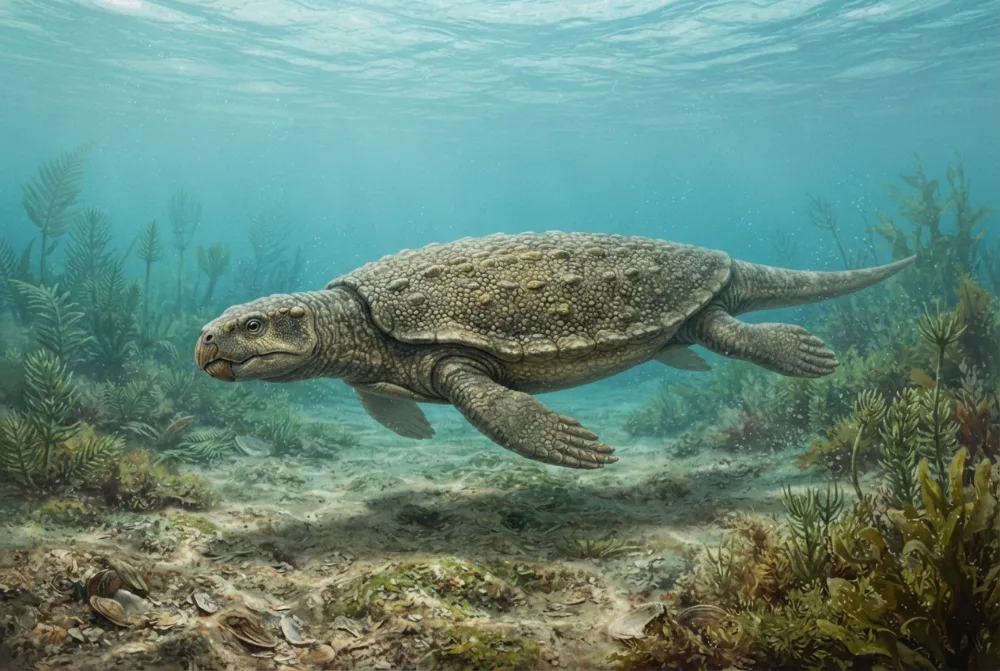
Henodus was a strange reptile that looked a bit like a turtle, but it wasn't one. It lived in shallow, salty lagoons during the Late Triassic, about 237 to 227 million years ago. It had a flat shell and a beak, and it probably used its special jaws to filter food from the water.13
When did it live?
How big was it?
How long was it?
How big was Henodus compared to YOU?
Just maths in your browser. Nothing is saved or sent anywhere.
Fun facts
Henodus is the only placodont found in rocks that were not from the open sea, so it probably lived in brackish or freshwater lagoons.1
Its shell was made of many small bony plates that formed a mosaic pattern, unlike a turtle's shell.1
Henodus had only one tooth on each side of its mouth, and the rest of its jaws were a beak.1
It had baleen-like denticles along its jaws, similar to some whales, which helped it filter small food from the water.1
Its weak limbs suggest it spent little or no time on land.1
Scientists think Henodus could close its jaws very quickly, which helped it catch small prey.1
Small snail shells were found near the skulls of Henodus, so it might have eaten those tiny snails.2
Most asked questions about Henodus
?How big was Henodus?
About 1 metre (3.3 feet) long.1
?What did Henodus eat?
It probably ate tiny snails, small crustaceans, and maybe plants. It had a beak and baleen-like denticles to filter food from the water.12
?Was Henodus a dinosaur?
No, it was a marine reptile called a placodont, not a dinosaur.1
?Could Henodus walk on land?
Probably not much. Its weak limbs suggest it spent little or no time on land.1
?When did Henodus live?
It lived during the Late Triassic period, about 237 to 227 million years ago.1
?Why did Henodus have a shell?
Its shell was made of many small bony plates that formed a mosaic pattern, and it probably protected Henodus from predators.1

Ask Rex about Henodus
Rex only answers questions about this page. 3 questions a day.
Rex is an AI and can make mistakes. He runs on servers in the EU and questions are never saved. Never type your name or other personal things.
Myth buster
Myth: Henodus was a turtle.
Truth: Henodus looked like a turtle, but it was a different kind of reptile called a placodont. Its shell was made of many more bones, and its limbs were not inside its ribcage like a turtle's.1
For dino experts
- Scientific name
- Henodus
- Named by
- Huene 19363
- Group
- Sea reptiles
- Family / clade
- Henodontidae3
- Classification
- Placodontia > Sauropterygia3
- Age of the rocks
- 237 to 227 million years (Carnian)3
- Rock formations
- Grabfeld3
- Countries
- Germany3
- Fossil records
- 1 in the Paleobiology Database3
- Discovery
- Henodus was named by Friedrich von Huene in 1936. The first fossils were found in the Grabfeld Formation near Tübingen, Germany.31
- Still debated
- Scientists are not sure exactly what Henodus ate. Some think it was a filter feeder, others think it ate plants, and some think it ate small animals. It might have done all of these.2
Where the facts come from
- Henodus (en.wikipedia.org)
- Dentition and feeding in Placodontia: tooth replacement in Henodus chelyops | BMC Ecology and Evolution | Springer Nature Link (link.springer.com)
- Henodus in The Paleobiology Database (CC BY 4.0): age, places, rock formations, classification.
Every fact on this page has a number that points to its source. If we got something wrong, sorry, we are dino fans, not a science journal. Tell us at [email protected] and we will fix it.
 Rex is hungry! Dino Wiki is a dad's project for his dino-loving son, free with no ads. Grown-ups can feed Rex a snack to help keep it online.Feed Rex
 Nothosaurus
 Placodus
 Lariosaurus
 Cyamodus
 Cymatosaurus
 Proneusticosaurus
 Massospondylus
 Plateosaurus
 Coelophysis
 Podokesaurus
 Thecodontosaurus
 Eudimorphodon