 Home
 All dinos
 Dino groups
 Explore
 Dinos by country
 Dino vs dino
 How big were they?
 Dinos A to Z
 Who ate what?
 What dino are you? Quiz
 Dino games
 Dino battle
 Dino race
 Dino mini-games
 Sticker album
 Dino TOP lists
 Timeline
 Surprise me!
 Language: English

Jormungandr
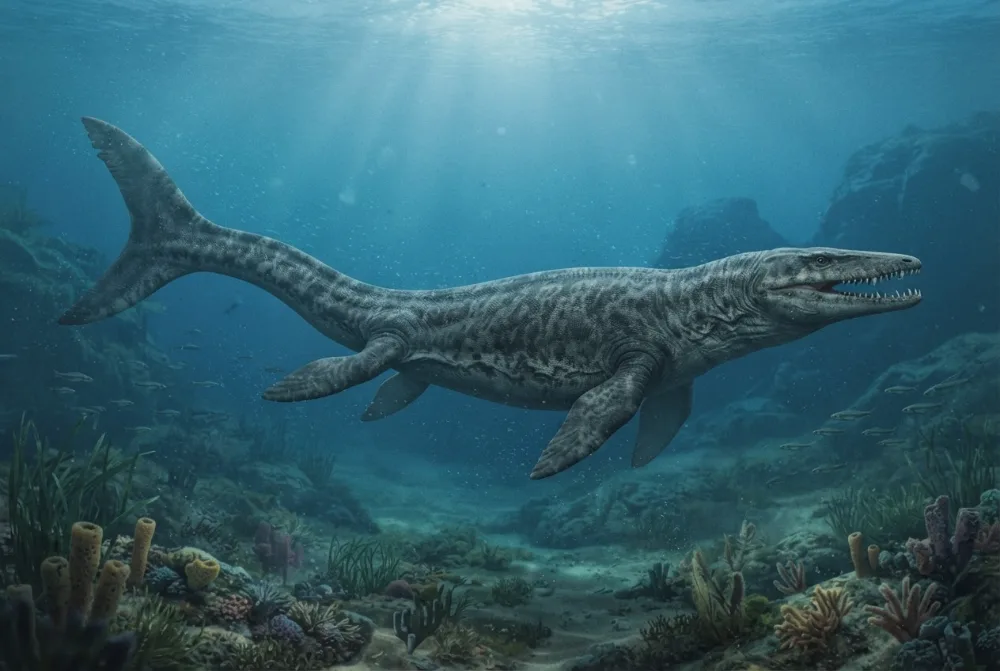
Jormungandr was a huge, swimming lizard that lived in the sea during the time of dinosaurs. It had a long body, strong jaws, and sharp teeth for catching fish and other sea creatures. This marine reptile was not a dinosaur, but a fierce predator of the ancient oceans.1
 USA
When did it live?
Jormungandr: 84 to 72 million years ago
How big was it?
How long was it?
 as long as 7 dogs nose to tail🍌as long as 41 bananas end to end🏊could swim the length of a big swimming pool (50 m) in 4.9 seconds
How big was Jormungandr compared to YOU?
Just maths in your browser. Nothing is saved or sent anywhere.
How fast was it?


Fun facts
Jormungandr's skull was about 72 centimeters (28 inches) long, and its lower jaw measured 80.8 centimeters (31.8 inches).1
The fossil was discovered in 2015 by a fossil collector named Deborah Shepherd near Walhalla, North Dakota.1
Jormungandr lived about 80 million years ago, during the Late Cretaceous period.1
The fourth dorsal vertebra of Jormungandr has marks that scientists think are bite marks from another mosasaur, possibly from a fight or scavenging.1
Jormungandr shares features with both primitive mosasaurs like Clidastes and more advanced ones like Mosasaurus, making it a 'missing link' in mosasaur evolution.1
The species name walhallaensis comes from the town of Walhalla, which is named after Valhalla, the hall of slain warriors in Norse mythology.1
Most asked questions about Jormungandr
Myth buster
Myth: Some people think Jormungandr was a dinosaur.
Truth: Jormungandr was a mosasaur, a type of marine lizard, not a dinosaur. Mosasaurs are reptiles but belong to a different group than dinosaurs.1
For dino experts
- Scientific name
- Jormungandr
- Named by
- Zietlow et al. 20232
- Group
- Mosasaurs
- Family / clade
- Mosasauridae2
- Classification
- Mosasauroidea2
- Age of the rocks
- 84 to 72 million years (Campanian)2
- Rock formations
- Pierre Shale2
- Countries
- USA2
- Fossil records
- 1 in the Paleobiology Database2
- Discovery
- The only known fossil of Jormungandr was found in 2015 by fossil collector Deborah Shepherd near Walhalla, North Dakota. It was later described and named by paleontologists Amelia Zietlow, Clint Boyd, and Nathan Van Vranken in 2023.1
- Still debated
- Scientists are not sure if Jormungandr is a distinct genus or just a new species of Clidastes. Some researchers think it might be renamed Clidastes walhallaensis in the future.1
Where the facts come from
- Jormungandr walhallaensis (en.wikipedia.org)
- Jormungandr in The Paleobiology Database (CC BY 4.0): age, places, rock formations, classification.
Every fact on this page has a number that points to its source. If we got something wrong, sorry, we are dino fans, not a science journal. Tell us at hello@dinowiki.app and we will fix it.
 Rex is hungry! Dino Wiki is a dad's project for his dino-loving son, free with no ads and no cookies. Grown-ups can feed Rex a snack to help keep it online.Feed Rex
 Mosasaurus
 Prognathodon
 Tylosaurus
 Platecarpus
 Clidastes
 Globidens
 Tyrannosaurus
 Triceratops
 Velociraptor
 Spinosaurus
 Ankylosaurus
 Parasaurolophus