
Kimmerosaurus
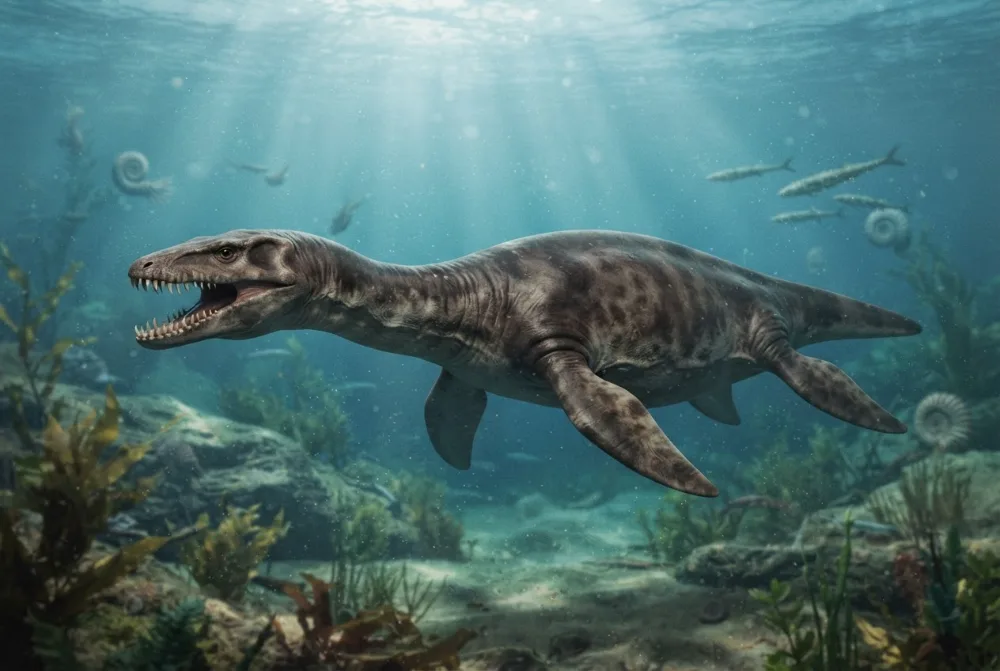
Kimmerosaurus was a plesiosaur, a long-necked marine reptile that swam in the Jurassic seas. It had a broad skull and sharp, curved teeth for catching fish. Only its skull and a few neck bones have been found, so scientists are still guessing what the rest of its body looked like.12
When did it live?
Fun facts
Kimmerosaurus is known from only a few skulls and neck bones. No one has found its flippers, tail, or body.1
Some scientists think Kimmerosaurus might actually be the missing head of another plesiosaur called Colymbosaurus, because their neck bones look alike.1
The first Kimmerosaurus fossil was a partial skull found in 1976 by Peter Langham on the Jurassic Coast of England.1
Kimmerosaurus had 8 teeth in its upper jaw and 36 teeth on each side of its lower jaw, all sharply pointed.1
The most complete specimen was discovered on March 7, 2015, and includes the skull roof, brain case, teeth, and vertebrae.1
Most asked questions about Kimmerosaurus
?Was Kimmerosaurus a dinosaur?
No, Kimmerosaurus was a plesiosaur, a marine reptile, not a dinosaur.1
?How big was Kimmerosaurus?
Nobody knows for sure. Only its skull and a few neck bones have been found, so its full size is unknown.1
?What did Kimmerosaurus eat?
It likely ate fish, using its sharp, curved teeth to catch them.1
?Where did Kimmerosaurus live?
It lived in the seas near what is now England and Norway, about 152 to 147 million years ago.1

Ask Rex about Kimmerosaurus
Rex only answers questions about this page. 3 questions a day.
Rex is an AI and can make mistakes. He runs on servers in the EU and questions are never saved. Never type your name or other personal things.
Myth buster
Myth: Kimmerosaurus is often thought to be a dinosaur because it lived in the Jurassic.
Truth: Kimmerosaurus was a plesiosaur, a marine reptile that swam in the ocean. It was not a dinosaur.1
For dino experts
- Scientific name
- Kimmerosaurus
- Named by
- Brown 19812
- Group
- Plesiosaurs
- Family / clade
- Cryptoclididae2
- Classification
- Plesiosauria > Sauropterygia2
- Age of the rocks
- 155 to 145 million years (Kimmeridgian / Tithonian)2
- Rock formations
- Kimmeridge Clay2
- Countries
- United Kingdom2
- Fossil records
- 2 in the Paleobiology Database2
- Discovery
- Kimmerosaurus was named by D. S. Brown in 1981 based on a partial skull found in Dorset, England, in 1976 by Peter Langham. The name comes from the Kimmeridge Clay where it was found.12
- Still debated
- Scientists are not sure what the rest of Kimmerosaurus's body looked like. Some think it might be the same animal as Colymbosaurus, but no one knows for certain.1
Where the facts come from
- Kimmerosaurus (en.wikipedia.org)
- Kimmerosaurus in The Paleobiology Database (CC BY 4.0): age, places, rock formations, classification.
Every fact on this page has a number that points to its source. If we got something wrong, sorry, we are dino fans, not a science journal. Tell us at [email protected] and we will fix it.
 Rex is hungry! Dino Wiki is a dad's project for his dino-loving son, free with no ads. Grown-ups can feed Rex a snack to help keep it online.Feed Rex
 Elasmosaurus
 Pliosaurus
 Plesiosaurus
 Cimoliasaurus
 Colymbosaurus
 Trinacromerum
 Brachiosaurus
 Diplodocus
 Allosaurus
 Brontosaurus
 Compsognathus
 Camarasaurus