
Plesiosaurus
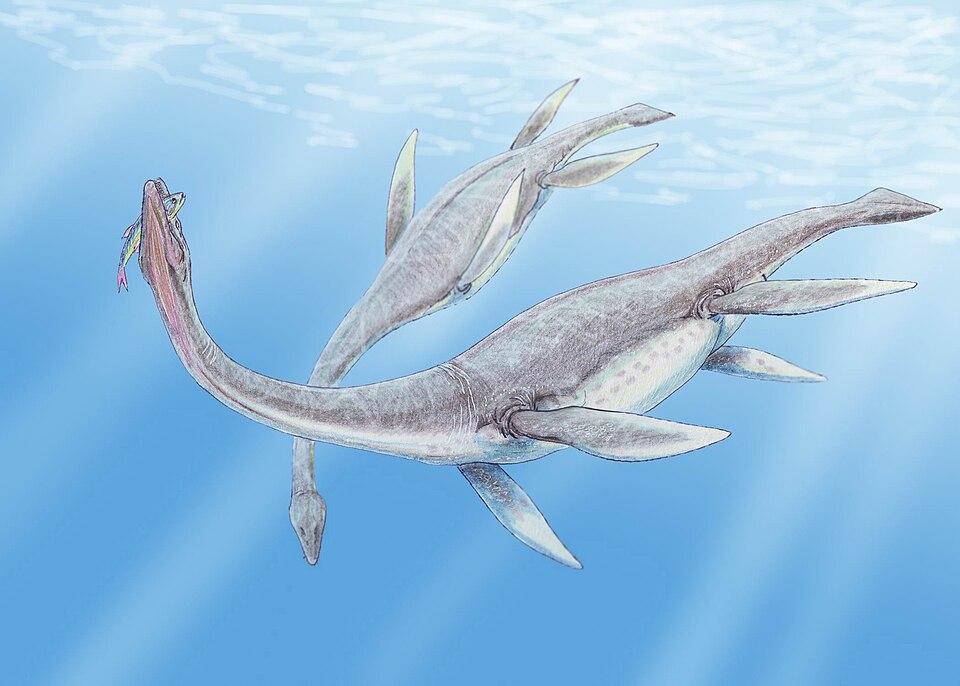
Plesiosaurus was a marine reptile that swam in the oceans while dinosaurs lived on land. It had a long neck, a small head, and four flipper-like limbs to push through the water. It was about 3.5 metres long and ate small prey like fish and crustaceans.1
When did it live?
How big was it?
Fun facts
Plesiosaurus was named in 1821 by William Conybeare and Henry Thomas De la Beche, and the name means 'near reptile'.1
Mary Anning discovered an almost complete Plesiosaurus skeleton in 1823, which helped scientists understand what these animals looked like.1
Plesiosaurs swam with four flipper-like limbs, and experiments with robot flippers showed they could generate 60% more thrust from their back flipper by timing both limbs carefully.1
Plesiosaurs were unable to return to land, so they likely gave birth to live young in the open water, as supported by a preserved foetus in a related species.1
Plesiosaurs survived for more than 140 million years, making it through multiple extinctions that wiped out other groups.1
Some plesiosaurs swallowed stones that stayed in their stomachs, possibly to help break up food or to help with buoyancy.1
Myth buster
Myth: Plesiosaurs are often thought to be dinosaurs, especially because they lived at the same time.
Truth: Plesiosaurs are marine reptiles and are only distantly related to dinosaurs, which lived on land.1
For dino experts
- Scientific name
- Plesiosaurus
- Named by
- de la Beche and Conybeare 18213
- Group
- Plesiosaurs
- Family / clade
- Plesiosauroidea3
- Classification
- Plesiosauria > Sauropterygia3
- Age of the rocks
- 206 to 66 million years (Rhaetian to Maastrichtian)3
- Rock formations
- Kimmeridge Clay, Charmouth Mudstone, Westbury3
- Countries
- United Kingdom, France, USA, Belgium, New Zealand, South Africa3
- Fossil records
- 55 in the Paleobiology Database3
- Discovery
- Plesiosaurus was named in 1821 by William Conybeare and Henry Thomas De la Beche, and Mary Anning discovered an almost complete skeleton in 1823.1
- Still debated
- Scientists still debate how plesiosaurs used their four flippers to swim, and whether the stones they swallowed helped with digestion or buoyancy.1
Where the facts come from
- What is a plesiosaur? The prehistoric sea creatures that inspired the Loch Ness Monster | Natural History Museum (nhm.ac.uk)
- PBDB Taxon (paleobiodb.org)
- Plesiosaurus in The Paleobiology Database (CC BY 4.0): age, places, rock formations, classification.
Every fact on this page has a number that points to its source. If we got something wrong, sorry, we are dino fans, not a science journal. Tell us at [email protected] and we will fix it.
 Rex is hungry! Dino Wiki is free with no ads. Grown-ups can feed Rex a snack to keep it that way.Feed Rex
 Elasmosaurus
 Pliosaurus
 Cimoliasaurus
 Colymbosaurus
 Trinacromerum
 Cryptoclidus
 Stegosaurus
 Iguanodon
 Archaeopteryx
 Giganotosaurus
 Microraptor
 Deinonychus