
Elasmosaurus
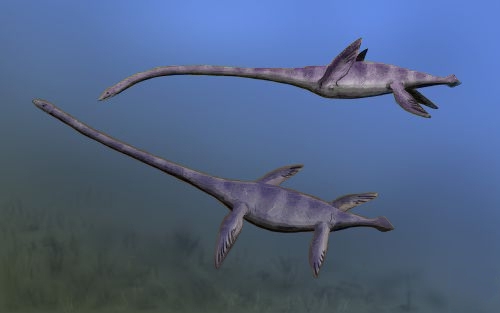
Elasmosaurus was a giant marine reptile with an incredibly long neck, longer than a school bus! It swam in the ancient sea that once covered the middle of North America, using its four flippers to paddle through the water.1
When did it live?
How big was it?
Fun facts
Elasmosaurus had 72 bones in its neck, which was about 7.1 meters (23 feet) long, making it one of the longest-necked animals ever.1
The first Elasmosaurus fossil was found in 1867 near Fort Wallace, Kansas, by a military doctor named Theophilus Turner.1
The scientist who named Elasmosaurus, Edward Drinker Cope, made a famous mistake: he put the skull on the tail end of the skeleton!1
Elasmosaurus lived about 80.6 to 77 million years ago, during the Late Cretaceous Period, in a shallow sea called the Western Interior Seaway.1
Despite its long neck, Elasmosaurus could not lift its head high above the water like a swan; its neck was not very flexible.1
Elasmosaurus may have used stomach stones, called gastroliths, to help grind up food in its belly.1
The name Elasmosaurus means 'thin-plate reptile', referring to the flat bones in its chest and hips.1
Myth buster
Myth: Many people think Elasmosaurus could hold its neck high out of the water like a giraffe.
Truth: Scientists now know its neck was not flexible enough to lift high; it probably kept its neck low in the water while swimming.1
For dino experts
- Scientific name
- Elasmosaurus
- Named by
- Cope 18682
- Group
- Plesiosaurs
- Family / clade
- Elasmosauridae2
- Classification
- Plesiosauria > Elasmosauridae > Sauropterygia2
- Age of the rocks
- 94 to 72 million years (Turonian to Campanian)2
- Rock formations
- Pierre Shale2
- Countries
- Japan, USA2
- Fossil records
- 9 in the Paleobiology Database2
- Discovery
- Elasmosaurus was named in 1868 by American paleontologist Edward Drinker Cope, based on a partial skeleton found in Kansas. The fossil was dug out of shale and shipped to Philadelphia in crates.1
- Still debated
- Scientists are still not sure exactly what Elasmosaurus used its extremely long neck for, though it may have helped it catch prey on the seafloor or surprise fish.1
Where the facts come from
- Elasmosaurus (en.wikipedia.org)
- Elasmosaurus in The Paleobiology Database (CC BY 4.0): age, places, rock formations, classification.
Every fact on this page has a number that points to its source. If we got something wrong, sorry, we are dino fans, not a science journal. Tell us at [email protected] and we will fix it.
 Rex is hungry! Dino Wiki is free with no ads. Grown-ups can feed Rex a snack to keep it that way.Feed Rex
 Pliosaurus
 Plesiosaurus
 Cimoliasaurus
 Colymbosaurus
 Trinacromerum
 Cryptoclidus
 Triceratops
 Velociraptor
 Spinosaurus
 Ankylosaurus
 Parasaurolophus