
Kourisodon
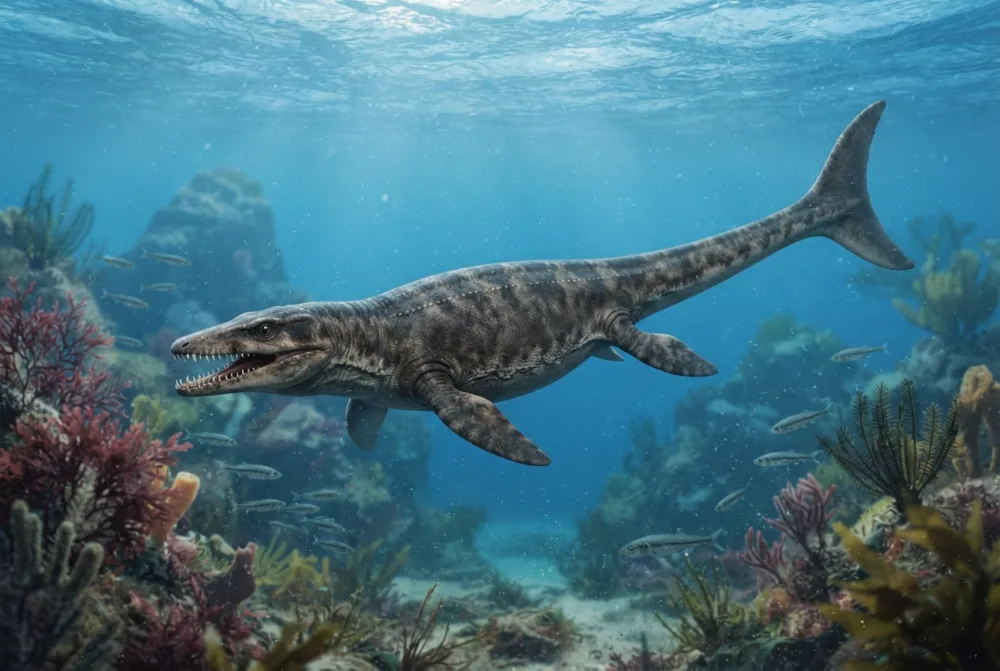
Kourisodon was a small, fast-swimming marine lizard that lived in the late Cretaceous seas. It had sharp, blade-like teeth for slicing through fish and other prey. Even though it was a mosasaur, not a dinosaur, it was a fierce predator in its ocean home.1
When did it live?
How big was it?
How big was Kourisodon compared to YOU?
Just maths in your browser. Nothing is saved or sent anywhere.
Fun facts
Kourisodon was a small mosasaur, only about 3.75 metres (12.3 feet) long, much smaller than giants like Mosasaurus.1
Its name means 'razor tooth' in Greek, because its teeth were shaped like blades.1
Fossils of Kourisodon have been found in both Canada and Japan, showing it lived in the Pacific Ocean.12
The first Kourisodon fossil was discovered along the Puntledge River on Vancouver Island, and the species was named K. puntledgensis after that river.1
A life-sized replica of the Puntledge River specimen is on display at the Canadian Fossil Discovery Centre in Morden, Manitoba.1
Kourisodon lived alongside long-necked plesiosaurs (elasmosaurids), turtles, and other mosasaurs, but no short-necked plesiosaurs (polycotylids) were found in its Canadian home.1

Ask Rex about Kourisodon
Rex only answers questions about this page. 3 questions a day.
Rex is an AI and can make mistakes. He runs on servers in the EU and questions are never saved. Never type your name or other personal things.
For dino experts
- Scientific name
- Kourisodon
- Named by
- Nicholls and Meckert 20023
- Group
- Mosasaurs
- Family / clade
- Mosasauridae3
- Classification
- Mosasauroidea3
- Age of the rocks
- 86 to 66 million years (Santonian / Maastrichtian)3
- Rock formations
- Pender, Hiketa, Mutsuo3
- Countries
- Japan, Canada3
- Fossil records
- 3 in the Paleobiology Database3
- Discovery
- Kourisodon was named in 2002 by paleontologists Elizabeth Nicholls and Dirk Meckert, based on a fossil found on Vancouver Island, Canada. The type species is K. puntledgensis.13
- Still debated
- Scientists are not sure if the Japanese fossils belong to a second, unnamed species of Kourisodon, because they have slightly different teeth.1
Where the facts come from
- Kourisodon (en.wikipedia.org)
- Kourisodon sp. (Mosasauridae) from the Upper Cretaceous Izumi Group (Upper Campanian) of Kanewari, Tawa, Sanuki City, Kagawa Prefecture, Southwest Japan (gbank.gsj.jp)
- Kourisodon in The Paleobiology Database (CC BY 4.0): age, places, rock formations, classification.
Every fact on this page has a number that points to its source. If we got something wrong, sorry, we are dino fans, not a science journal. Tell us at [email protected] and we will fix it.
Rex is hungry! Dino Wiki is a dad's project for his dino-loving son, free with no ads. Grown-ups can feed Rex a snack to help keep it online.Feed Rex Mosasaurus
 Prognathodon
 Tylosaurus
 Platecarpus
 Clidastes
 Globidens
 Triceratops
 Velociraptor
 Spinosaurus
 Ankylosaurus
 Parasaurolophus