 Get the Dino Wiki app
 Home
 All dinos
 Dino groups
 Explore
 Dinos by country
 Dino vs dino
 How big were they?
 Dinos A to Z
 Who ate what?
 What dino are you? Quiz
 Dino games
 Dino battle
 Dino race
 Dino mini-games
 Sticker album
 Dino TOP lists
 Timeline
 Surprise me!
 Language: English

Kritosaurus
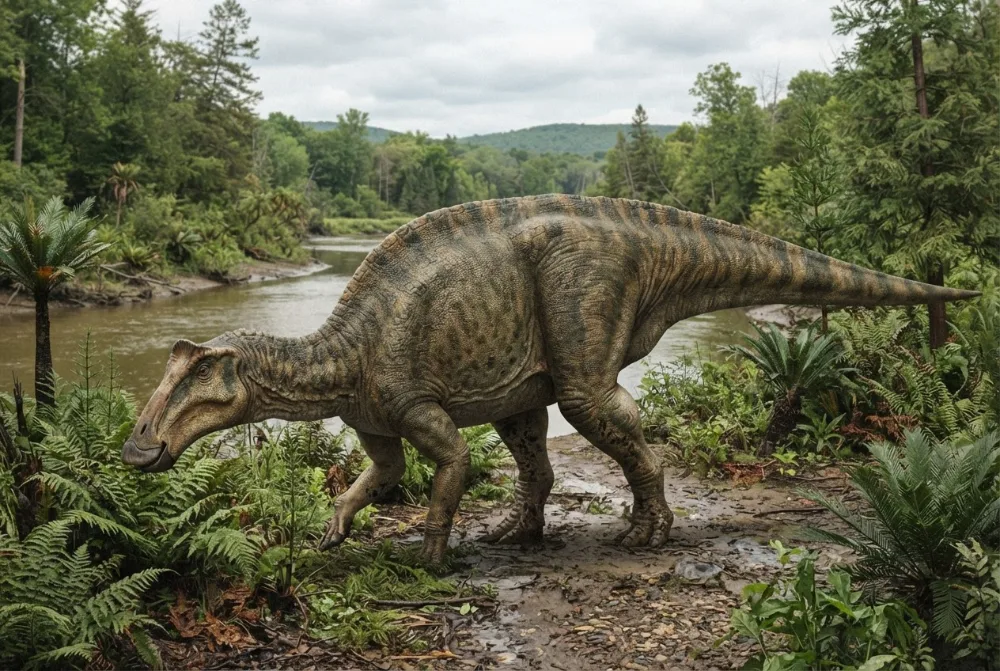
Kritosaurus was a duck-billed dinosaur that lived in North America near the end of the Age of Dinosaurs. It had a big, flat beak like a duck and could walk on two legs or all fours. This plant-eater munched on tough plants with hundreds of teeth in its cheeks.1
 USA
When did it live?
Kritosaurus: 86 to 66 million years ago
How big was it?
How long was it?
How tall was it?
estimate
How heavy was it?
 as long as 2 cars parked in a row🍌as long as 50 bananas end to end
 as heavy as 200 dogs🍉as heavy as 800 watermelons🎒as heavy as 5 whole school classes of kids🐻❄️as heavy as 9 polar bears🏃could run 100 metres in 16 seconds (the fastest human needs 9.6)
How big was Kritosaurus compared to YOU?
Just maths in your browser. Nothing is saved or sent anywhere.
How fast was it?


Fun facts
Kritosaurus means 'separated lizard' because the bones in its cheek were arranged in a special way.1
The first Kritosaurus fossil was found in 1904 by Barnum Brown in New Mexico, but the front of the skull was missing.1
The nose of the first skull was broken into pieces, so scientists first rebuilt it flat and later with an arched 'Roman nose'. Its true shape is still not certain.1
Kritosaurus lived alongside other dinosaurs like Alamosaurus, Parasaurolophus, Pentaceratops, and Bistahieversor.1
Some scientists think Kritosaurus and Anasazisaurus might be the same dinosaur, but others disagree.1
Kritosaurus could reach about 9 metres (30 feet) long and weigh about 4 metric tons (4.4 short tons).1
Get the Dino Wiki app
Every dino, the quiz and the games on your phone or tablet. The full version also works offline in your language.

Most asked questions about Kritosaurus
?How big was Kritosaurus?
Kritosaurus reached about 9 metres (30 feet) long and weighed about 4 metric tons (4.4 short tons). Some partial remains from Mexico may have been around 11 metres (36 feet) long, but those are now considered a different dinosaur.12
?What did Kritosaurus eat?
Kritosaurus was a herbivore, eating plants with a broad beak and hundreds of teeth in its cheeks. It could feed from the ground up to about 4 metres (13 feet) high.1
?When did Kritosaurus live?
Kritosaurus lived during the Late Cretaceous, approximately 74.5 to 66 million years ago.12
?Where was Kritosaurus found?
Kritosaurus fossils were found in New Mexico, USA, in the De-na-zin Member of the Kirtland Formation. Some bones from Texas and Mexico were also referred to it, but those are now considered different genera.1
?Why is it called Kritosaurus?
Kritosaurus means 'separated lizard' because of the arrangement of its cheek bones. It's sometimes mistranslated as 'noble lizard' due to a mistaken idea about its nose.1
?Did Kritosaurus have a crest?
Yes, based on a skull originally referred to Anasazisaurus, Kritosaurus had a tab-like crest made of nasal bones that rose between and above its eyes and folded back under itself. This crest helped tell it apart from similar duck-billed dinosaurs.1
Myth buster
Myth: Scientists know exactly what the nose of Kritosaurus looked like.
Truth: The nose of the first skull was broken. Barnum Brown first rebuilt it flat, then gave it an arched nose like Gryposaurus, but its true shape is still uncertain.1
For dino experts
- Scientific name
- Kritosaurus
- Named by
- Brown 19103
- Group
- Duck-bills
- Family / clade
- Hadrosauridae3
- Classification
- Ornithischia > Ornithopoda > Iguanodontia > Hadrosauridae3
- Age of the rocks
- 86 to 66 million years (Santonian / Maastrichtian)3
- Rock formations
- Kirtland, Fruitland, Fruitland/Kirtland3
- Countries
- USA, Canada3
- Fossil records
- 25 in the Paleobiology Database3
- Discovery
- Barnum Brown discovered the first Kritosaurus fossil in 1904 in New Mexico. He named it in 1910, but the front of the skull was missing and he had to guess what it looked like.1
- Still debated
- Scientists still debate whether Kritosaurus is the same as Anasazisaurus and exactly how its skull was shaped.1
Where the facts come from
- Kritosaurus (en.wikipedia.org)
- Kritosaurus | Natural History Museum (nhm.ac.uk)
- Kritosaurus in The Paleobiology Database (CC BY 4.0): age, places, rock formations, classification.
Every fact on this page has a number that points to its source. If we got something wrong, sorry, we are dino fans, not a science journal. Tell us at hello@dinowiki.app and we will fix it.
 Parasaurolophus
 Edmontosaurus
 Saurolophus
 Hypacrosaurus
 Corythosaurus
 Gryposaurus
 Tyrannosaurus
 Triceratops
 Velociraptor
 Spinosaurus
 Ankylosaurus
 Pteranodon