
Leiodon
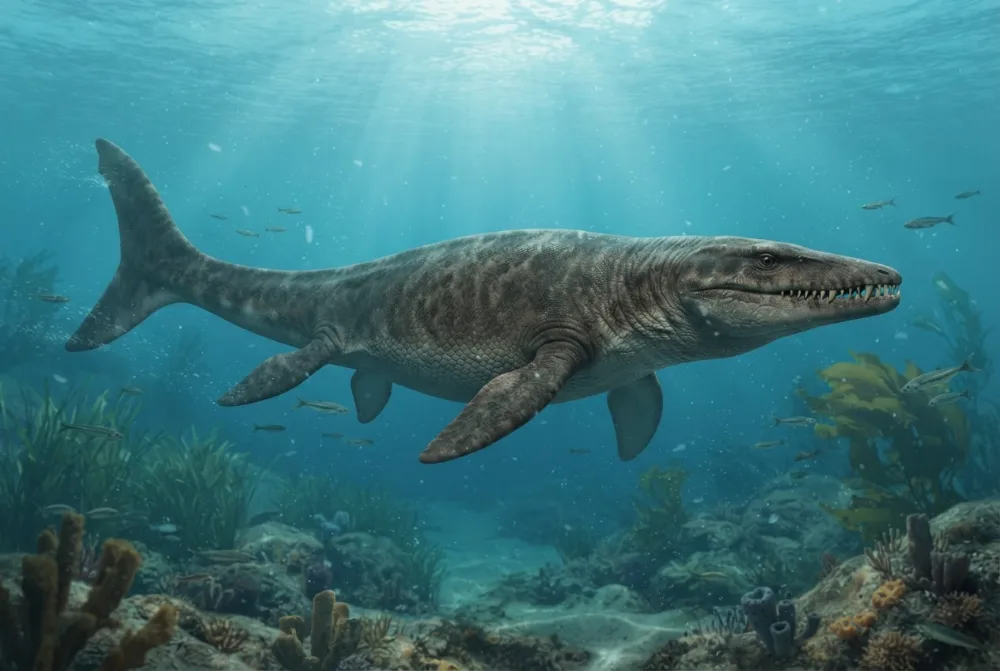
Leiodon was a giant marine lizard that swam in the warm seas of the Late Cretaceous. It had smooth, curved teeth perfect for grabbing slippery fish and other sea creatures.1
When did it live?
Fun facts
Leiodon was first named by the famous scientist Richard Owen in 1841, based on just two tooth fragments and a bit of jawbone.1
The name Leiodon means 'smooth tooth' because the fossil teeth had a smooth and polished surface.1
Leiodon lived between about 100 and 66 million years ago, during the Late Cretaceous period.3
Leiodon fossils have been found all over the world, including in Antarctica, Europe, Africa, and South America.3
Some scientists think Leiodon might not be a valid genus because its main fossil teeth are now lost, making it a 'nomen dubium' or doubtful name.1
Leiodon was one of the original genera used to define the family Mosasauridae in 1853.1

Ask Rex about Leiodon
Rex only answers questions about this page. 3 questions a day.
Rex is an AI and can make mistakes. He runs on servers in the EU and questions are never saved. Never type your name or other personal things.
Myth buster
Myth: Leiodon was a dinosaur.
Truth: Leiodon was not a dinosaur. It was a mosasaur, a type of giant marine lizard that lived in the ocean.1
For dino experts
- Scientific name
- Leiodon
- Named by
- Owen 18423
- Group
- Mosasaurs
- Family / clade
- Mosasauridae3
- Classification
- Mosasauroidea3
- Age of the rocks
- 100 to 66 million years (Cenomanian / Maastrichtian)3
- Rock formations
- López de Bertodano, Gramame, Opoka3
- Countries
- Syria, Antarctica, Brazil, Sweden, Poland, Germany3
- Fossil records
- 18 in the Paleobiology Database3
- Discovery
- Richard Owen named Leiodon in 1841 from two tooth fragments and a small jaw piece found in Essex, England.1
- Still debated
- Scientists are not sure if Leiodon is a valid genus because the original tooth fossils are missing, so it might be a 'nomen dubium' (doubtful name).1
Where the facts come from
- Liodon (en.wikipedia.org)
- PBDB Taxon (paleobiodb.org)
- Leiodon in The Paleobiology Database (CC BY 4.0): age, places, rock formations, classification.
Every fact on this page has a number that points to its source. If we got something wrong, sorry, we are dino fans, not a science journal. Tell us at [email protected] and we will fix it.
 Rex is hungry! Dino Wiki is a dad's project for his dino-loving son, free with no ads. Grown-ups can feed Rex a snack to help keep it online.Feed Rex
 Mosasaurus
 Prognathodon
 Tylosaurus
 Platecarpus
 Clidastes
 Globidens
 Tyrannosaurus
 Triceratops
 Velociraptor
 Spinosaurus
 Ankylosaurus
 Parasaurolophus