
Lindwurmia
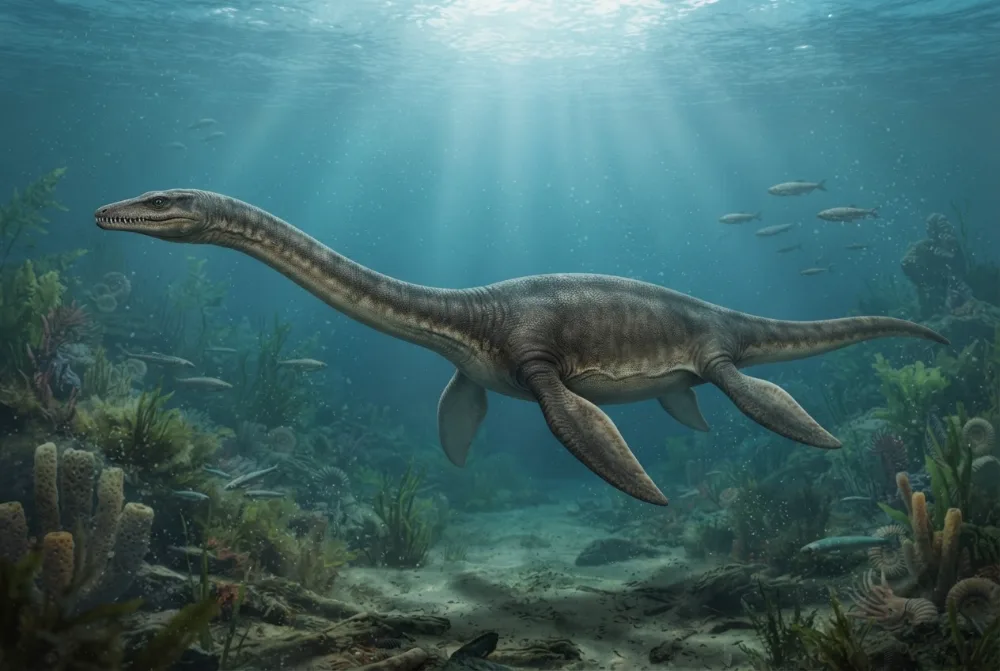
Lindwurmia was a small, long-necked marine reptile that swam in the seas of Early Jurassic Germany. It was a plesiosaur, not a dinosaur, and it used its four flippers to paddle through the water. This ancient hunter ate fish and other sea creatures.12
When did it live?
How big was it?
How long was it?
How big was Lindwurmia compared to YOU?
Just maths in your browser. Nothing is saved or sent anywhere.
Fun facts
Its name comes from the Lindwurm, a dragon in German stories, because the fossil was found in Germany.1
The only known fossil was discovered in 1899 by Johannes Maak, but it was not recognized as a new species until over a century later.1
Lindwurmia had 24 neck vertebrae and five pairs of teeth in its upper jaw.1
The fossil was partly damaged by a dragline excavator when it was first found, but it was restored by 1900.1
Scientists think Lindwurmia was a rhomaleosaurid, a group of plesiosaurs with short necks and large heads.1

Ask Rex about Lindwurmia
Rex only answers questions about this page. 3 questions a day.
Rex is an AI and can make mistakes. He runs on servers in the EU and questions are never saved. Never type your name or other personal things.
For dino experts
- Scientific name
- Lindwurmia
- Named by
- Vincent and Storrs 20192
- Group
- Plesiosaurs
- Family / clade
- Plesiosauria2
- Classification
- Plesiosauria > Sauropterygia2
- Age of the rocks
- 201 to 200 million years (Hettangian)2
- Countries
- Germany2
- Fossil records
- 1 in the Paleobiology Database2
- Discovery
- The only fossil of Lindwurmia was found in 1899 in a clay quarry in Halberstadt, Germany, by Johannes Maak. It was first described by Theodore Brandes in 1912 and 1914, but it was not named Lindwurmia thiuda until 2019 by Peggy Vincent and Glenn Storrs.12
- Still debated
- Scientists are still debating exactly where Lindwurmia fits on the plesiosaur family tree. Some studies place it close to Anningasaura within Rhomaleosauridae.1
Where the facts come from
- Lindwurmia (en.wikipedia.org)
- Lindwurmia in The Paleobiology Database (CC BY 4.0): age, places, rock formations, classification.
Every fact on this page has a number that points to its source. If we got something wrong, sorry, we are dino fans, not a science journal. Tell us at [email protected] and we will fix it.
 Rex is hungry! Dino Wiki is a dad's project for his dino-loving son, free with no ads. Grown-ups can feed Rex a snack to help keep it online.Feed Rex
 Elasmosaurus
 Pliosaurus
 Plesiosaurus
 Cimoliasaurus
 Colymbosaurus
 Trinacromerum
 Dilophosaurus
 Stenopterygius
 Dorygnathus
 Lufengosaurus
 Scutellosaurus
 Yunnanosaurus