 Home
 All dinos
 Dino groups
 Explore
 Dinos by country
 Dino vs dino
 How big were they?
 Dinos A to Z
 Who ate what?
 What dino are you? Quiz
 Dino games
 Dino battle
 Dino race
 Dino mini-games
 Sticker album
 Dino TOP lists
 Timeline
 Surprise me!
 Language: English

Linhenykus
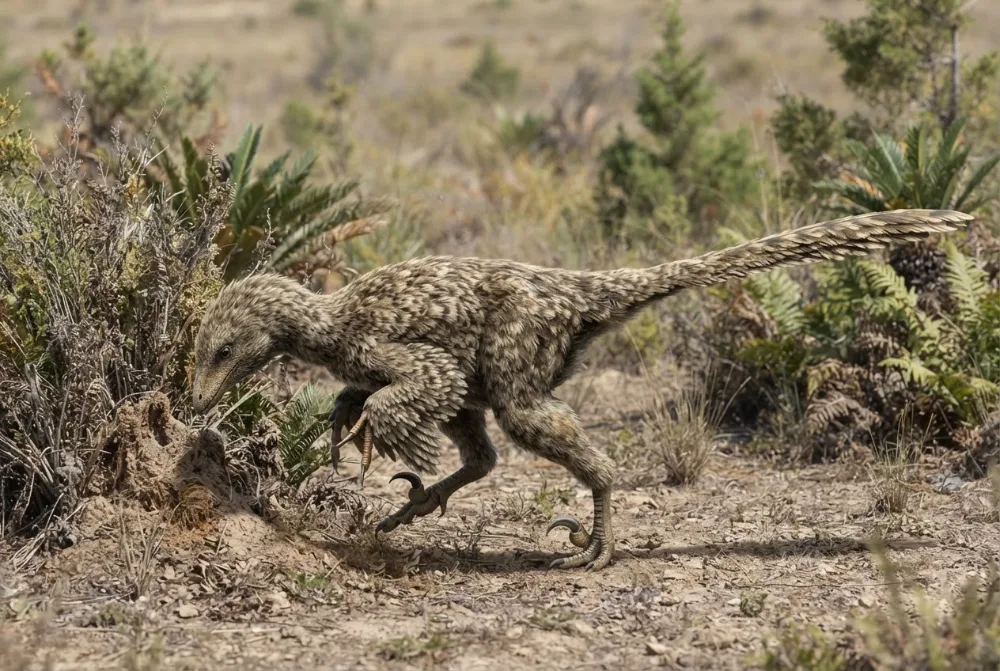
Linhenykus was a tiny dinosaur that lived in the Late Cretaceous period. It is famous for having only one big finger on each hand, making it the only non-avian dinosaur known with just one digit. It probably used its single claw to dig into insect nests for food.21
 China
When did it live?
Linhenykus: 84 to 72 million years ago
How big was it?
How long was it?
How tall was it?
estimate
How heavy was it?
How big was Linhenykus compared to YOU?
Just maths in your browser. Nothing is saved or sent anywhere.
How fast was it?


Fun facts
Linhenykus is the only known non-avian dinosaur that had just one functional finger on each hand.2
It was very small, only about 50 centimetres (1.6 feet) long and weighed around 500 grams (18 ounces).1
The fossil was found in the Wulansuhai Formation, which is about 75 to 71 million years old.1
Linhenykus belonged to a group called alvarezsaurids, which are known for their short, strong arms and big claws.2
Scientists think Linhenykus was a subadult when it died, because its bones were not fully fused together.2
The hand of Linhenykus shows a mix of primitive and advanced features, meaning its evolution was complex.2
Most asked questions about Linhenykus
?How big was Linhenykus?
It was very small, about 50 centimetres (1.6 feet) long and weighed around 500 grams (18 ounces).1
?What did Linhenykus eat?
Scientists think it was insectivorous, using its single claw to dig into ant and termite nests, similar to modern anteaters.1
?Why did Linhenykus have only one finger?
Linhenykus had only one functional finger because the outer digits were reduced and lost their finger bones, making it the only non-avian dinosaur with a single digit.12
?Is Linhenykus a dinosaur?
Yes, Linhenykus is a non-avian dinosaur, specifically an alvarezsaurid theropod.1
For dino experts
- Scientific name
- Linhenykus
- Named by
- Xu et al. 20113
- Group
- Odd feathered dinos
- Family / clade
- Alvarezsauridae3
- Classification
- Theropoda > Alvarezsauridae3
- Age of the rocks
- 84 to 72 million years (Campanian)3
- Rock formations
- Wulansuhai3
- Countries
- China3
- Fossil records
- 2 in the Paleobiology Database3
- Discovery
- Linhenykus was named in 2011 by Xu Xing and his team. The fossil was collected by Jonah N. Choiniere and Michael Pittman in Inner Mongolia, China.1
- Still debated
- Scientists are still debating whether Linhenykus used its single claw mainly for digging or for other purposes.2
Where the facts come from
- Linhenykus (en.wikipedia.org)
- A monodactyl nonavian dinosaur and the complex evolution of the alvarezsauroid hand | PNAS (pnas.org)
- Linhenykus in The Paleobiology Database (CC BY 4.0): age, places, rock formations, classification.
Every fact on this page has a number that points to its source. If we got something wrong, sorry, we are dino fans, not a science journal. Tell us at hello@dinowiki.app and we will fix it.
 Rex is hungry! Dino Wiki is a dad's project for his dino-loving son, free with no ads and no cookies. Grown-ups can feed Rex a snack to help keep it online.Feed Rex
 Therizinosaurus
 Oviraptor
 Chirostenotes
 Citipes
 Leptorhynchos
 Avimimus
 Tyrannosaurus
 Triceratops
 Velociraptor
 Spinosaurus
 Ankylosaurus
 Parasaurolophus