
Linhevenator
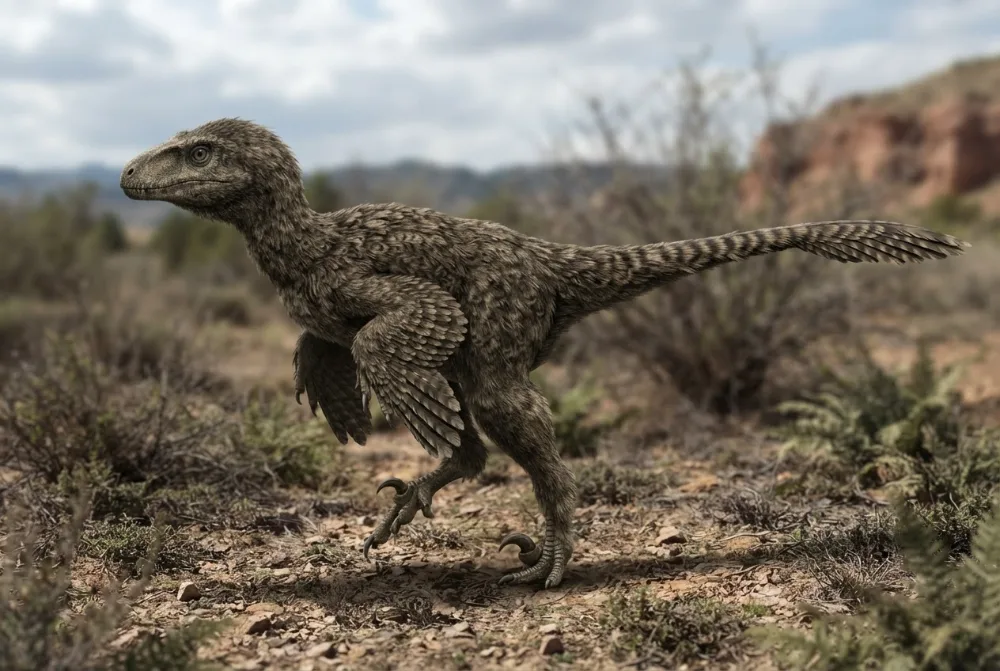
Linhevenator was a small, bird-like dinosaur that lived in what is now China. It had short, strong arms and a big claw on its foot, just like its cousins the raptors. It probably used its arms and claws to catch food.1
When did it live?
Fun facts
Linhevenator had a humerus, the upper arm bone, that was much shorter and sturdier than in most other troodontids.1
Its second toe had a big, curved claw, similar to the killer claw of dromaeosaurids like Velociraptor.1
The deltopectoral crest, a bump on the upper arm bone where muscles attach, was large, suggesting strong arm muscles.1
Linhevenator lived about 83 to 72 million years ago, during the Campanian age of the Late Cretaceous.2
The only known skeleton is partly articulated, meaning some bones were still connected when found.1
Scientists think Linhevenator might have used its strong arms for digging or climbing, not just for catching prey.1
Most asked questions about Linhevenator
?How big was Linhevenator?
Linhevenator was about 1.9 to 2.7 metres long (6.2 to 8.9 feet), with an average of 2.2 metres (7.2 feet). It weighed around 23 kilograms (51 pounds).3
?What did Linhevenator eat?
Scientists are not sure. Some think troodontids like Linhevenator ate plants because of their teeth, while others think they were meat-eaters. The strong arms and big claw suggest it could catch prey.43
?Did Linhevenator have feathers?
The sources do not say for sure, but troodontids were bird-like dinosaurs closely related to birds, so many scientists think they probably had feathers.3
?When did Linhevenator live?
Linhevenator lived about 83 to 72 million years ago, during the Campanian age of the Late Cretaceous.3

Ask Rex about Linhevenator
Rex only answers questions about this page. 3 questions a day.
Rex is an AI and can make mistakes. He runs on servers in the EU and questions are never saved. Never type your name or other personal things.
Myth buster
Myth: Some people think all raptors had long, grasping arms.
Truth: Linhevenator shows that some troodontids had short, strong arms, so not all raptor-like dinosaurs had long arms.1
For dino experts
- Scientific name
- Linhevenator
- Named by
- Xu et al. 20115
- Group
- Raptors
- Family / clade
- Troodontidae5
- Classification
- Theropoda > Troodontidae5
- Age of the rocks
- 84 to 72 million years (Campanian)5
- Rock formations
- Wulansuhai5
- Countries
- China5
- Fossil records
- 1 in the Paleobiology Database5
- Discovery
- Linhevenator was named by Xu and colleagues in 2011 based on a partial skeleton found in the Wulansuhai Formation in Inner Mongolia, China.21
- Still debated
- Scientists are not sure if Linhevenator was mainly a meat-eater or if it also ate plants, because its teeth have large serrations that some researchers link to herbivory.1
Where the facts come from
- A Short-Armed Troodontid Dinosaur from the Upper (ivpp.cas.cn)
- PBDB Taxon (paleobiodb.org)
- Linhevenator (en.wikipedia.org)
- A Short-Armed Troodontid Dinosaur from the Upper Cretaceous of Inner Mongolia and Its Implications for Troodontid Evolution | PLOS One (journals.plos.org)
- Linhevenator in The Paleobiology Database (CC BY 4.0): age, places, rock formations, classification.
Every fact on this page has a number that points to its source. If we got something wrong, sorry, we are dino fans, not a science journal. Tell us at [email protected] and we will fix it.
Rex is hungry! Dino Wiki is a dad's project for his dino-loving son, free with no ads. Grown-ups can feed Rex a snack to help keep it online.Feed Rex Velociraptor
 Microraptor
 Deinonychus
 Asiamericana
 Richardoestesia
 Saurornitholestes
 Triceratops
 Spinosaurus
 Ankylosaurus
 Parasaurolophus
 Pteranodon