
Liopleurodon
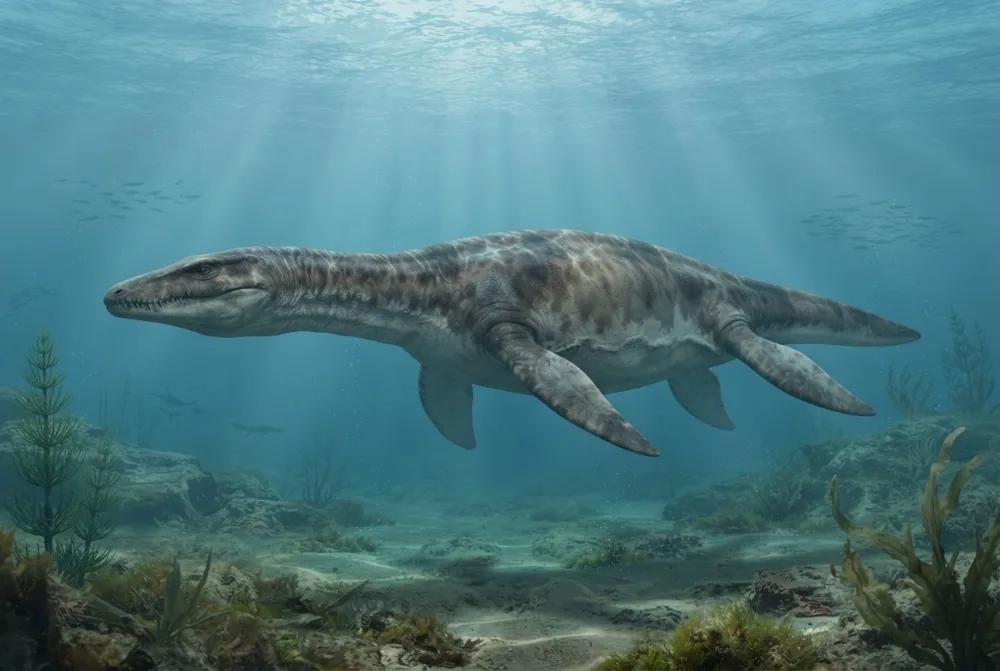
Liopleurodon was a huge marine reptile that swam in the Jurassic seas. It had four flippers like paddles and a long head with a short neck. It was an ambush predator that ate fish, squid, and other reptiles.1
When did it live?
How big was it?
How long was it?
How big was Liopleurodon compared to YOU?
Just maths in your browser. Nothing is saved or sent anywhere.
Fun facts
Liopleurodon had four strong flippers that helped it accelerate quickly to catch prey.1
A study using a swimming robot showed that its four-flipper swimming style gave it great acceleration, perfect for ambushing prey.1
Fossils of Liopleurodon have been found with stomach contents including fish bones, squid hooklets, and even a reptile tooth.1
The BBC show Walking with Dinosaurs made Liopleurodon look 25 metres long, but real fossils show it was much smaller, up to about 8 metres.1
Liopleurodon could probably smell underwater by sniffing through its nostrils to find food.1
The first Liopleurodon fossil was just a single tooth, which makes it hard for scientists to tell different species apart.1
Most asked questions about Liopleurodon
?How big was Liopleurodon?
Liopleurodon reached a maximum length of just over 8 metres (about 26 feet), based on the most complete fossils. Earlier claims of 25 metres were exaggerated.12
?Was Liopleurodon a dinosaur?
No, Liopleurodon was a marine reptile called a pliosaur, not a dinosaur. Dinosaurs lived on land.1
?What did Liopleurodon eat?
Liopleurodon ate fish, squid, and other marine reptiles. It was an ambush predator that used its four flippers to accelerate quickly and catch prey.1
?When did Liopleurodon live?
Liopleurodon lived during the Middle and Late Jurassic Period, about 166 to 155 million years ago.1
?Could Liopleurodon swim fast?
Liopleurodon was a powerful swimmer with four paddle-like flippers. A swimming robot study showed its four-flipper style gave it great acceleration, perfect for ambushing prey.1
?How did Liopleurodon get its name?
Liopleurodon means 'smooth-sided tooth' in Greek, because its teeth were smooth on the sides. The species name ferox means 'fierce' in Latin.1
?Where were Liopleurodon fossils found?
Most Liopleurodon fossils come from Europe, especially England and France. One possible fossil was also found in Mexico.1
?Why did Liopleurodon have a big head?
Liopleurodon had an unusually large skull, making up about a quarter of its total body length. This helped it tackle large prey.2

Ask Rex about Liopleurodon
Rex only answers questions about this page. 3 questions a day.
Rex is an AI and can make mistakes. He runs on servers in the EU and questions are never saved. Never type your name or other personal things.
Myth buster
Myth: Liopleurodon was a dinosaur.
Truth: Liopleurodon was a plesiosaur, a marine reptile that lived in the sea, not a dinosaur.1
For dino experts
- Scientific name
- Liopleurodon
- Named by
- Sauvage 18733
- Group
- Plesiosaurs
- Family / clade
- Pliosauridae3
- Classification
- Plesiosauria > Pliosauridae > Sauropterygia3
- Age of the rocks
- 165 to 137 million years (Callovian / Berriasian)3
- Rock formations
- Oxford Clay, Ornatenton, Ampthill Clay3
- Countries
- United Kingdom, Germany, France, Argentina3
- Fossil records
- 13 in the Paleobiology Database3
- Discovery
- Liopleurodon was named by Sauvage in 1873 based on a tooth from France. Later, more complete skeletons were found in England and Germany.31
- Still debated
- Scientists are not sure if Liopleurodon pachydeirus is a separate species or just the same as Liopleurodon ferox.1
Where the facts come from
- Liopleurodon (en.wikipedia.org)
- Jurassic sea monster was smaller than once thought, but no less formidable | University of Portsmouth (port.ac.uk)
- Liopleurodon in The Paleobiology Database (CC BY 4.0): age, places, rock formations, classification.
Every fact on this page has a number that points to its source. If we got something wrong, sorry, we are dino fans, not a science journal. Tell us at [email protected] and we will fix it.
 Rex is hungry! Dino Wiki is a dad's project for his dino-loving son, free with no ads. Grown-ups can feed Rex a snack to help keep it online.Feed Rex
 Elasmosaurus
 Pliosaurus
 Plesiosaurus
 Cimoliasaurus
 Colymbosaurus
 Trinacromerum
 Brachiosaurus
 Diplodocus
 Allosaurus
 Brontosaurus
 Compsognathus
 Camarasaurus