
Lusonectes
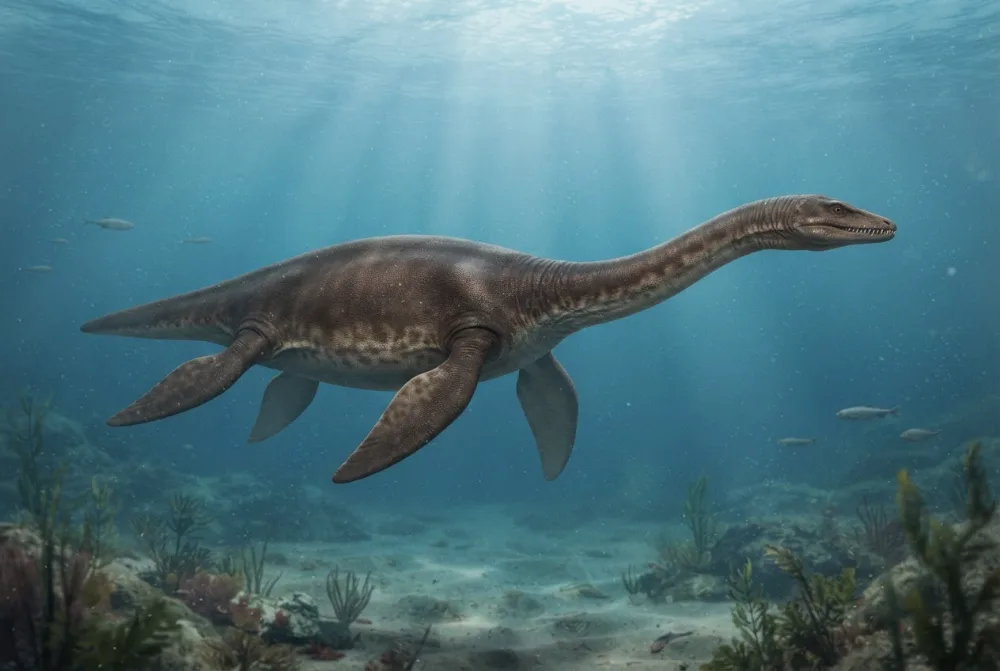
Lusonectes was a marine reptile that swam in the warm Jurassic seas near what is now Portugal. It had a long snout and sharp teeth to catch fish and other slippery prey.2
When did it live?
Fun facts
Lusonectes is the only plesiosaur from Portugal that scientists can identify as a distinct species.1
Its name comes from Latin and Greek words meaning 'Portuguese swimmer'.1
The only fossil found is a partial skull, which is about 127 millimeters (5 inches) long.1
Lusonectes lived about 184 to 175 million years ago, during the Early Jurassic period.3
It was first described in 1897 by French paleontologist Henri Émile Sauvage, who thought it was a Plesiosaurus.2
Lusonectes is one of the few plesiosaurs from the Early Jurassic found outside the United Kingdom and Germany.2

Ask Rex about Lusonectes
Rex only answers questions about this page. 3 questions a day.
Rex is an AI and can make mistakes. He runs on servers in the EU and questions are never saved. Never type your name or other personal things.
For dino experts
- Scientific name
- Lusonectes
- Named by
- Smith et al. 20123
- Group
- Plesiosaurs
- Family / clade
- Plesiosauridae3
- Classification
- Plesiosauria > Sauropterygia3
- Age of the rocks
- 184 to 175 million years (Toarcian)3
- Rock formations
- São Gião3
- Countries
- Portugal3
- Fossil records
- 1 in the Paleobiology Database3
- Discovery
- The fossil was first described in 1897 by French paleontologist Henri Émile Sauvage, who called it Plesiosaurus sp. In 2012, scientists Smith, Araújo, and Mateus gave it the new name Lusonectes sauvagei.2
- Still debated
- Scientists are not sure whether Lusonectes was an early pliosaurid or a plesiosauroid, because the only fossil is a poorly preserved partial skull.2
Where the facts come from
- A new plesiosauroid from the Toarcian (Lower Jurassic) (app.pan.pl)
- The osteology, taxonomy, and phylogenetic affinities of the Early Jurassic plesiosaur Lusonectes sauvagei - PMC (pmc.ncbi.nlm.nih.gov)
- Lusonectes in The Paleobiology Database (CC BY 4.0): age, places, rock formations, classification.
Every fact on this page has a number that points to its source. If we got something wrong, sorry, we are dino fans, not a science journal. Tell us at [email protected] and we will fix it.
 Rex is hungry! Dino Wiki is a dad's project for his dino-loving son, free with no ads. Grown-ups can feed Rex a snack to help keep it online.Feed Rex
 Elasmosaurus
 Pliosaurus
 Plesiosaurus
 Cimoliasaurus
 Colymbosaurus
 Trinacromerum
 Dilophosaurus
 Stenopterygius
 Dorygnathus
 Lufengosaurus
 Scutellosaurus
 Yunnanosaurus