
Mahakala
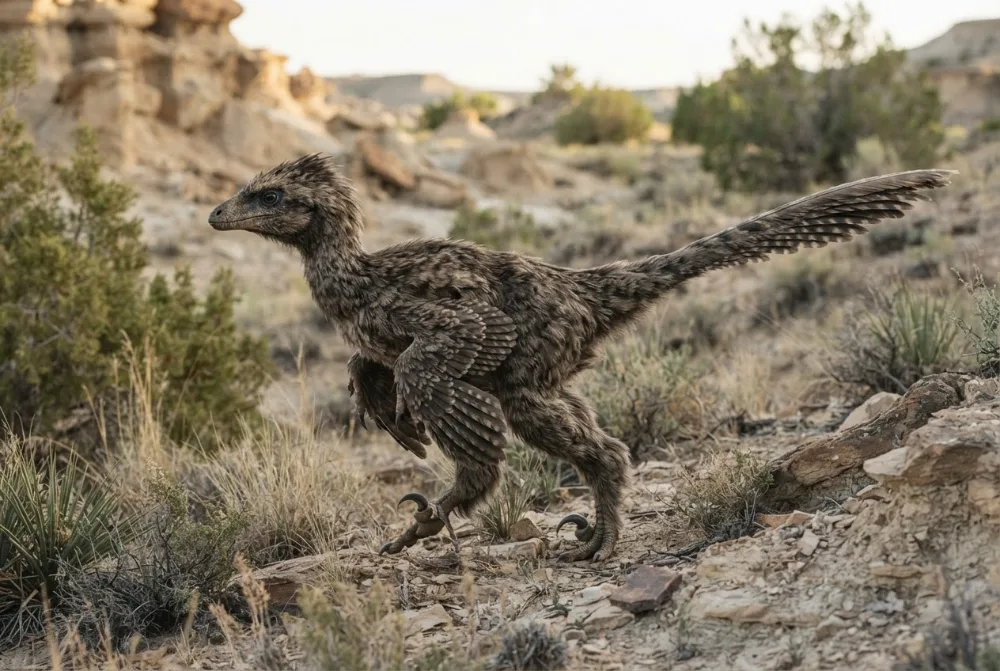
Mahakala was a tiny, feathered raptor that lived in the Gobi Desert about 80 million years ago. It was one of the smallest dromaeosaurids ever found, about the size of a crow. Its small size and bird-like features help scientists understand how flight may have evolved in dinosaurs.1
When did it live?
How big was it?
How long was it?
How heavy was it?
How big was Mahakala compared to YOU?
Just maths in your browser. Nothing is saved or sent anywhere.
Fun facts
Mahakala is one of the most primitive (basal) dromaeosaurids known, even though it lived late in the Cretaceous Period.1
Its skeleton shows a mix of features found in early troodontids and early birds, making it a key fossil for studying bird origins.1
Mahakala belonged to a group called Halszkaraptorinae, whose members were probably strong swimmers.1
The holotype specimen was nearly an adult, but it was still only as big as Archaeopteryx, a famous early bird.1
It lived alongside Velociraptor, Protoceratops, and many other dinosaurs in a dry, sandy environment with seasonal streams.1
Like other dromaeosaurids, Mahakala had a large, curved claw on its second toe that it may have used to catch prey.1

Ask Rex about Mahakala
Rex only answers questions about this page. 3 questions a day.
Rex is an AI and can make mistakes. He runs on servers in the EU and questions are never saved. Never type your name or other personal things.
For dino experts
- Scientific name
- Mahakala
- Named by
- Turner et al. 20073
- Group
- Raptors
- Family / clade
- Dromaeosauridae3
- Classification
- Theropoda > Dromaeosauridae3
- Age of the rocks
- 84 to 72 million years (Campanian)3
- Rock formations
- Djadokhta3
- Countries
- Mongolia3
- Fossil records
- 1 in the Paleobiology Database3
- Discovery
- Mahakala was named in 2007 by Alan H. Turner and colleagues based on a partial skeleton found in the Gobi Desert of Mongolia.13
- Still debated
- Scientists are still debating whether Mahakala was a member of the Halszkaraptorinae subfamily or a more primitive dromaeosaurid outside that group.1
Where the facts come from
- Mahakala omnogovae (en.wikipedia.org)
- Mahakala omnogovae Turner et al. 2007 - Encyclopedia of Life (eol.org)
- Mahakala in The Paleobiology Database (CC BY 4.0): age, places, rock formations, classification.
Every fact on this page has a number that points to its source. If we got something wrong, sorry, we are dino fans, not a science journal. Tell us at [email protected] and we will fix it.
 Rex is hungry! Dino Wiki is a dad's project for his dino-loving son, free with no ads. Grown-ups can feed Rex a snack to help keep it online.Feed Rex
 Velociraptor
 Microraptor
 Deinonychus
 Asiamericana
 Richardoestesia
 Saurornitholestes
 Tyrannosaurus
 Triceratops
 Spinosaurus
 Ankylosaurus
 Parasaurolophus
 Pteranodon