
Microcleidus
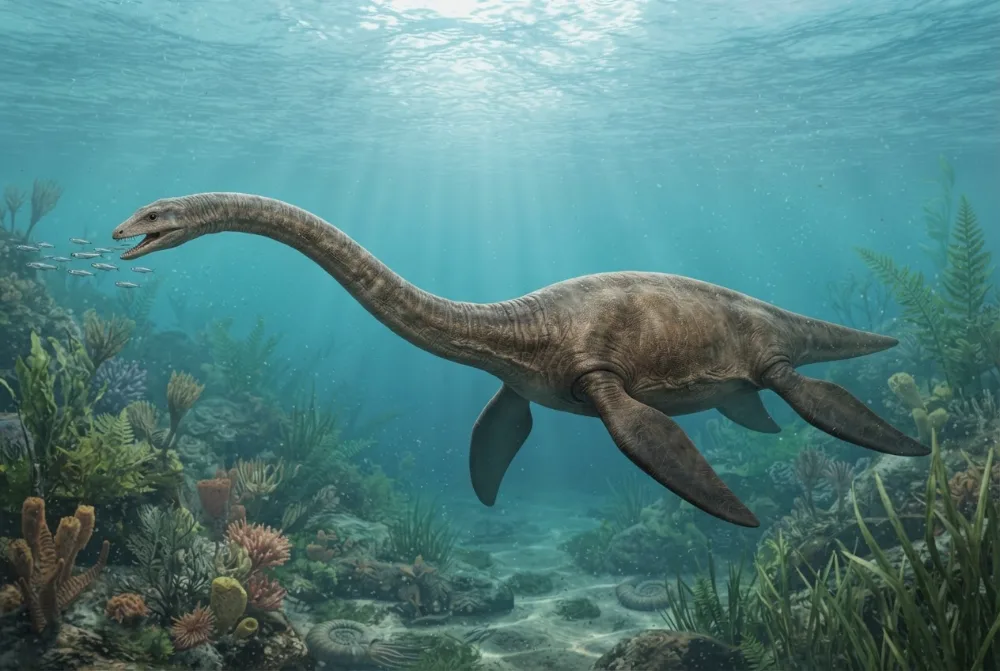
Microcleidus was a long-necked marine reptile that swam in the warm Jurassic seas. It had a small head and a very long neck with 38 to 39 bones. It used its flippers to paddle through the water and catch fish.1
When did it live?
How big was it?
How long was it?
How heavy was it?
How big was Microcleidus compared to YOU?
Just maths in your browser. Nothing is saved or sent anywhere.
Fun facts
Microcleidus had a small head only about 23 centimetres (9 inches) long, even though its body could reach over 5 metres.1
Its neck contained 38 to 39 vertebrae, making it a very long-necked plesiosaur.1
Scientists have named at least five species of Microcleidus, including M. homalospondylus and M. macropterus.1
One species, Microcleidus tournemirensis, was once thought to belong to a different genus called Occitanosaurus.5
Microcleidus lived during the Toarcian age of the Jurassic Period, about 184 to 175 million years ago.2
Its fossils have been found in the Alum Shale of England and the Posidonia Shale of Germany.5
The first Microcleidus fossils were originally described as Plesiosaurus homalospondylus by Richard Owen in 1865.1
Most asked questions about Microcleidus
?How big was Microcleidus?
The largest species, Microcleidus homalospondylus, measured about 5.1 metres (17 feet) long and weighed around 650 kilograms (1,430 pounds). Other species were smaller, like M. tournemirensis at about 4 metres (13 feet) and 300 kilograms (660 pounds).3
?What did Microcleidus eat?
Microcleidus was a carnivore that likely ate fish and other small sea creatures. It used its long neck and small head to snap up prey while swimming.5

Ask Rex about Microcleidus
Rex only answers questions about this page. 3 questions a day.
Rex is an AI and can make mistakes. He runs on servers in the EU and questions are never saved. Never type your name or other personal things.
For dino experts
- Scientific name
- Microcleidus
- Named by
- Watson 19095
- Group
- Plesiosaurs
- Family / clade
- Microcleididae5
- Classification
- Plesiosauria > Sauropterygia5
- Age of the rocks
- 184 to 175 million years (Toarcian)5
- Rock formations
- Alum Shale, Posidonia Shale5
- Countries
- United Kingdom, Germany, France, Luxembourg5
- Fossil records
- 9 in the Paleobiology Database5
- Also known as
- Occitanosaurus (older names now counted as the same animal)5
- Discovery
- The name Microcleidus was given by D. M. S. Watson in 1909 for fossils that had earlier been called Plesiosaurus. The first species, M. homalospondylus, was originally described by Richard Owen in 1865.51
- Still debated
- Scientists are not sure whether some species, like Hydrorion brachypterygius, should really be placed in Microcleidus.1
Where the facts come from
- Microcleidus, Plesiosaur Directory (plesiosauria.com)
- PBDB Taxon (paleobiodb.org)
- Microcleidus (en.wikipedia.org)
- Microcleidus (en.wikipedia.org)
- Microcleidus in The Paleobiology Database (CC BY 4.0): age, places, rock formations, classification.
Every fact on this page has a number that points to its source. If we got something wrong, sorry, we are dino fans, not a science journal. Tell us at [email protected] and we will fix it.
 Rex is hungry! Dino Wiki is a dad's project for his dino-loving son, free with no ads. Grown-ups can feed Rex a snack to help keep it online.Feed Rex
 Elasmosaurus
 Pliosaurus
 Plesiosaurus
 Cimoliasaurus
 Colymbosaurus
 Trinacromerum
 Dilophosaurus
 Stenopterygius
 Dorygnathus
 Lufengosaurus
 Scutellosaurus
 Yunnanosaurus