
Monoclonius
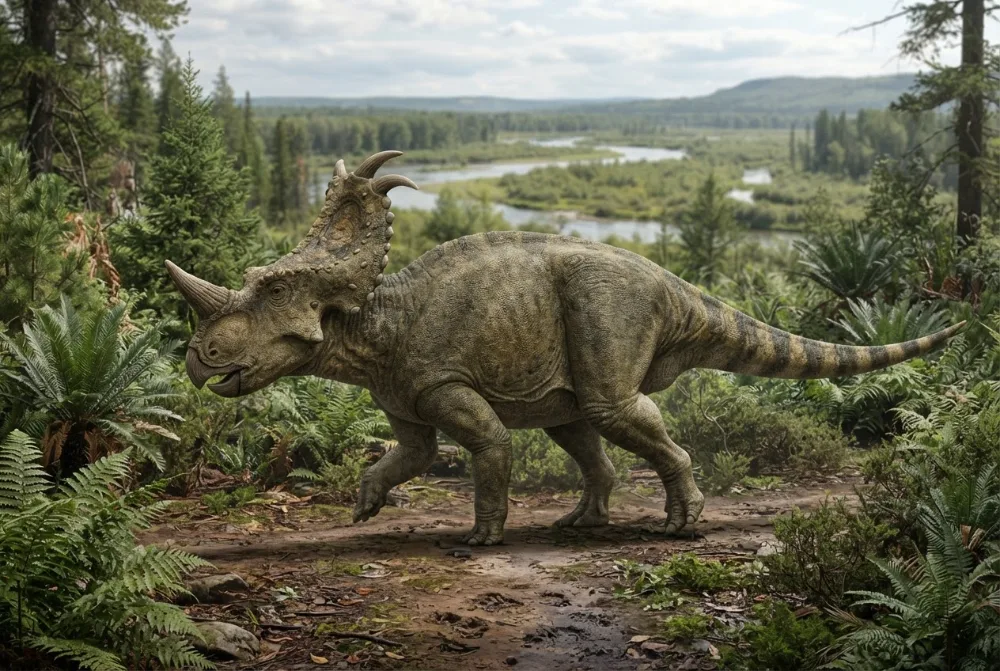
Monoclonius was a plant-eating dinosaur with a big frill on its head and a horn on its nose. It lived about 75 million years ago in what is now Montana and Alberta. Scientists are not sure if Monoclonius is really its own dinosaur or just a young version of another dinosaur called Centrosaurus.12
When did it live?
How big was it?
How long was it?
How heavy was it?
How big was Monoclonius compared to YOU?
Just maths in your browser. Nothing is saved or sent anywhere.
Fun facts
Monoclonius was named in 1876 by the famous fossil hunter Edward Drinker Cope, just months after the Battle of the Little Bighorn.1
The name Monoclonius means 'single sprout' and refers to how its teeth grew, not to a horn. Cope thought only one set of teeth was used at a time.1
Many fossils once called Monoclonius are now thought to belong to other dinosaurs, like Centrosaurus or Styracosaurus.1
The type species is Monoclonius crassus, which means 'the fat one' in Latin.1
Monoclonius fossils have been found in the Judith River Formation in Montana and the Dinosaur Park Formation in Alberta.12
When Cope first described Monoclonius, he did not realize it was a horned dinosaur. He thought the skull frill was part of the breastbone.1
Most asked questions about Monoclonius
?How big was Monoclonius?
Monoclonius was up to 5 metres (16.5 feet) long and may have weighed about 2,170 kilograms (4,780 pounds).4
?What did Monoclonius eat?
Monoclonius was an herbivore, a plant eater. It probably ate cycads, palms, and other prehistoric plants with its tough, hook-like beak.4
?When did Monoclonius live?
Monoclonius lived in the Late Cretaceous period, about 76 to 73 million years ago, toward the end of the age of dinosaurs.4
?Why is Monoclonius called a nomen dubium?
Monoclonius is often considered a nomen dubium, or doubtful name, because the fossils are too incomplete or immature to be confidently matched with adult specimens. Many are thought to be young Centrosaurus.1
?Did Monoclonius have a horn on its nose?
Yes, Monoclonius had a single nose horn that pointed upwards and two smaller horns over its eyes, plus a small frill on its head.4
?Where were Monoclonius fossils found?
Monoclonius fossils have been found in Montana, USA, and Alberta, Canada.4
Ask Rex about Monoclonius
Rex only answers questions about this page. 3 questions a day.
Rex is an AI and can make mistakes. He runs on servers in the EU and questions are never saved. Never type your name or other personal things.
Myth buster
Myth: Monoclonius means 'single horn'.
Truth: Monoclonius actually means 'single sprout', referring to its teeth, not a horn. Cope named it before he knew it was a horned dinosaur.1
For dino experts
- Scientific name
- Monoclonius
- Named by
- Cope 18765
- Group
- Horned dinos
- Family / clade
- Ceratopsidae5
- Classification
- Ornithischia > Ceratopsia > Ceratopsidae5
- Age of the rocks
- 84 to 72 million years (Campanian)5
- Rock formations
- Oldman, Judith River, Kirtland5
- Countries
- USA, Canada5
- Fossil records
- 13 in the Paleobiology Database5
- Discovery
- Edward Drinker Cope named Monoclonius in 1876 based on fossils found near the Judith River in Montana by himself and a young Charles Sternberg.1
- Still debated
- Scientists debate whether Monoclonius is a valid genus or just a mix of juvenile Centrosaurus and other ceratopsids. Many consider it a nomen dubium (doubtful name).12
Where the facts come from
- Monoclonius (en.wikipedia.org)
- PBDB Taxon (paleobiodb.org)
- Monoclonius Cope 1876 - Encyclopedia of Life (eol.org)
- enchantedlearning.com (enchantedlearning.com)
- Monoclonius in The Paleobiology Database (CC BY 4.0): age, places, rock formations, classification.
Every fact on this page has a number that points to its source. If we got something wrong, sorry, we are dino fans, not a science journal. Tell us at [email protected] and we will fix it.
 Rex is hungry! Dino Wiki is a dad's project for his dino-loving son, free with no ads. Grown-ups can feed Rex a snack to help keep it online.Feed Rex
 Triceratops
 Protoceratops
 Ojoceratops
 Tatankaceratops
 Psittacosaurus
 Centrosaurus
 Tyrannosaurus
 Velociraptor
 Spinosaurus
 Ankylosaurus
 Parasaurolophus
 Pteranodon