
Mosaiceratops
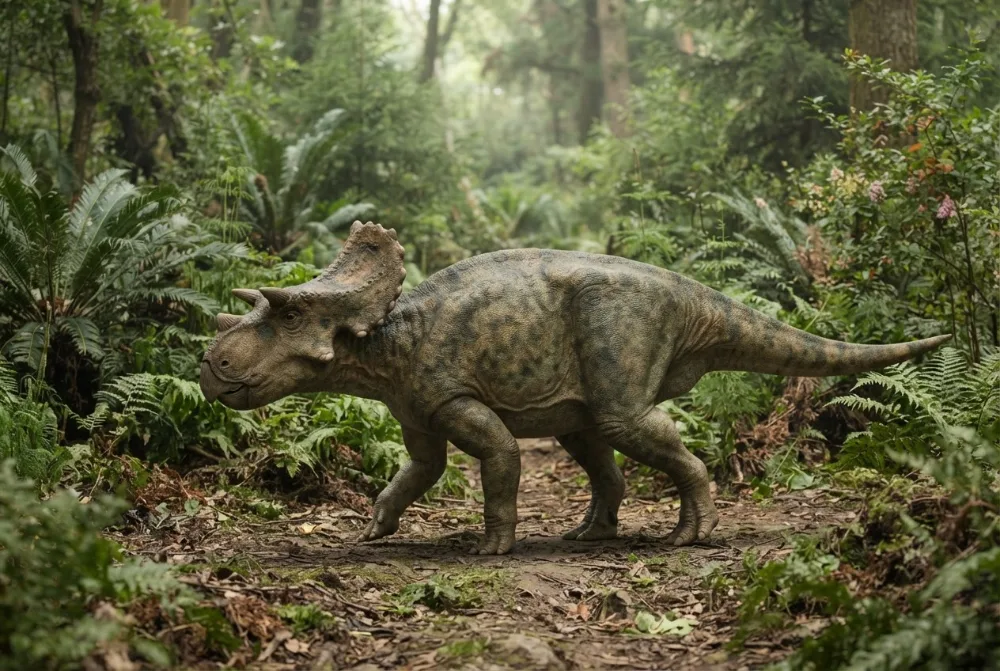
Mosaiceratops was a small, plant-eating dinosaur with a beak and a frill on its head. It lived in what is now China during the Late Cretaceous, about 93 to 72 million years ago. This little dinosaur is special because it had a mix of features from different horned dinosaurs, like a mosaic.12
When did it live?
How big was it?
How big was Mosaiceratops compared to YOU?
Just maths in your browser. Nothing is saved or sent anywhere.
Fun facts
Mosaiceratops had a mix of features from different horned dinosaur groups, which is why it's named after a mosaic.1
It was one of the smallest horned dinosaurs, only about 1 meter (3.3 feet) long and weighing around 10 kilograms (22 pounds).1
Unlike many other horned dinosaurs, Mosaiceratops had no teeth in its premaxilla (the front part of its upper jaw).1
Its skeleton shows that it was a ground-dwelling, active animal that walked on four legs.2
Mosaiceratops lived in a time when the Earth was warmer and had different plants than today.2

Ask Rex about Mosaiceratops
Rex only answers questions about this page. 3 questions a day.
Rex is an AI and can make mistakes. He runs on servers in the EU and questions are never saved. Never type your name or other personal things.
Myth buster
Myth: Some people think Mosaiceratops is a type of Psittacosaurus because it has similar features.
Truth: Scientists now think Mosaiceratops is a more primitive relative, and the similarities are due to convergent evolution, not direct ancestry.1
For dino experts
- Scientific name
- Mosaiceratops
- Named by
- Zheng et al. 20153
- Group
- Horned dinos
- Family / clade
- Neoceratopsia3
- Classification
- Ornithischia > Ceratopsia3
- Age of the rocks
- 94 to 72 million years (Turonian / Campanian)3
- Rock formations
- Xiaguan3
- Countries
- China3
- Fossil records
- 1 in the Paleobiology Database3
- Discovery
- Mosaiceratops was named and described in 2015 by Zheng Wenjie, Jin Xingsheng, and Xu Xing. The fossil was found in the Xiaguan Formation in Henan Province, China.12
- Still debated
- Scientists are still debating whether Mosaiceratops is the most primitive neoceratopsian or if it's more closely related to Psittacosaurus.1
Where the facts come from
- Mosaiceratops (en.wikipedia.org)
- PBDB Taxon (paleobiodb.org)
- Mosaiceratops in The Paleobiology Database (CC BY 4.0): age, places, rock formations, classification.
Every fact on this page has a number that points to its source. If we got something wrong, sorry, we are dino fans, not a science journal. Tell us at [email protected] and we will fix it.
Rex is hungry! Dino Wiki is a dad's project for his dino-loving son, free with no ads. Grown-ups can feed Rex a snack to help keep it online.Feed Rex Triceratops
 Protoceratops
 Ojoceratops
 Tatankaceratops
 Psittacosaurus
 Centrosaurus
 Velociraptor
 Spinosaurus
 Ankylosaurus
 Parasaurolophus
 Pteranodon