
Oksoko
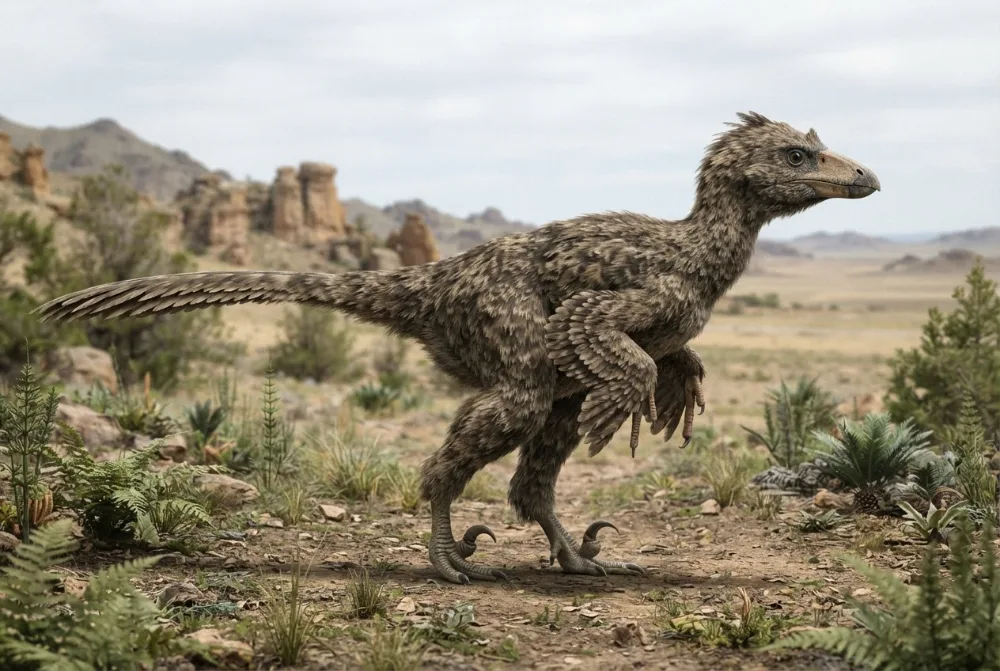
Oksoko was a small, feathered dinosaur that lived in what is now Mongolia. It had only two fingers on each hand, which is very unusual for a meat-eating dinosaur. Oksoko probably used its beak to eat plants and small animals.23
When did it live?
Fun facts
Oksoko had only two functional fingers on each hand, a rare feature among theropod dinosaurs.2
Fossils of at least six Oksoko individuals have been found, some preserved together in a resting pose with their heads tucked under their arms.2
Oksoko lived about 72 to 66 million years ago, during the Late Cretaceous period.3
The name Oksoko comes from a three-headed eagle in Altaic mythology, because the main fossil block contains three skulls.12
Oksoko was a type of oviraptorid, a group of feathered dinosaurs that were close relatives of birds.2

Ask Rex about Oksoko
Rex only answers questions about this page. 3 questions a day.
Rex is an AI and can make mistakes. He runs on servers in the EU and questions are never saved. Never type your name or other personal things.
For dino experts
- Scientific name
- Oksoko
- Named by
- Funston et al. 20203
- Group
- Odd feathered dinos
- Family / clade
- Oviraptoridae3
- Classification
- Theropoda > Oviraptorosauria3
- Age of the rocks
- 72 to 66 million years (Maastrichtian)3
- Rock formations
- Nemegt3
- Countries
- Mongolia3
- Fossil records
- 3 in the Paleobiology Database3
- Discovery
- Oksoko was named in 2020 by paleontologists Gregory Funston and colleagues. The fossils were confiscated from poachers in Mongolia.12
- Still debated
- Scientists are still debating why Oksoko's arms became so reduced, and whether it used its two-fingered hands for foraging, nesting, or display.2
Where the facts come from
- Oksoko avarsan (en.wikipedia.org)
- A new two-fingered dinosaur sheds light on the radiation of Oviraptorosauria (royalsocietypublishing.org)
- Oksoko in The Paleobiology Database (CC BY 4.0): age, places, rock formations, classification.
Every fact on this page has a number that points to its source. If we got something wrong, sorry, we are dino fans, not a science journal. Tell us at [email protected] and we will fix it.
Rex is hungry! Dino Wiki is a dad's project for his dino-loving son, free with no ads. Grown-ups can feed Rex a snack to help keep it online.Feed Rex Therizinosaurus
 Oviraptor
 Chirostenotes
 Citipes
 Leptorhynchos
 Avimimus
 Triceratops
 Velociraptor
 Spinosaurus
 Ankylosaurus
 Parasaurolophus