
Palatodonta
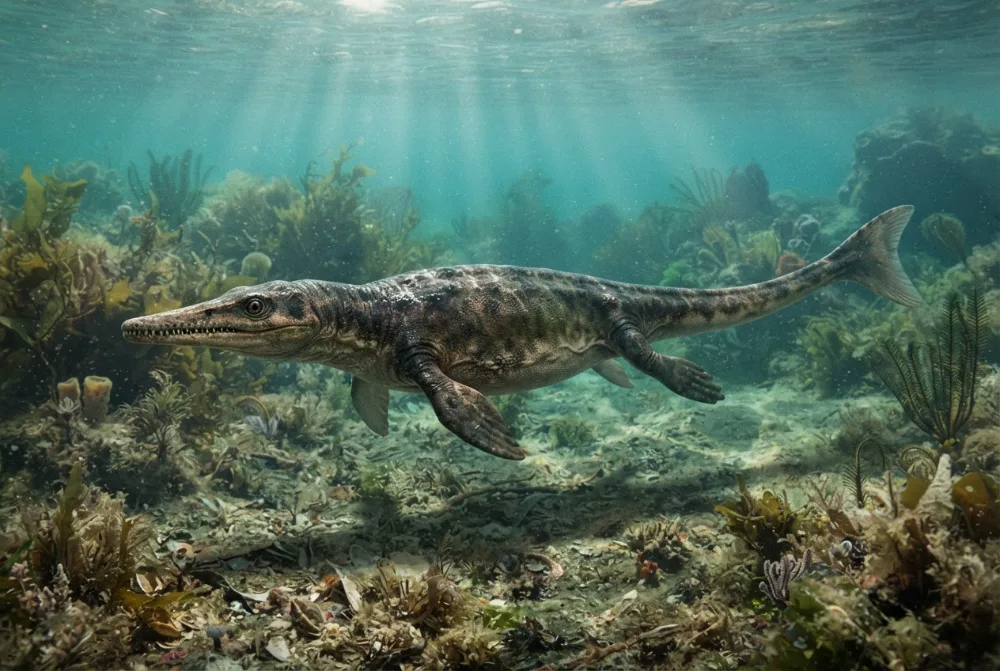
Palatodonta was a small marine reptile that lived in the sea about 245 million years ago. It had a row of pointed teeth on the roof of its mouth, which it probably used to sift through soft mud for tiny prey. It was an early cousin of the placodonts, reptiles with flat crushing teeth for eating shellfish.12
When did it live?
Fun facts
Palatodonta had a single row of at least 10 narrow, pointed teeth on its palate, which is different from the broad, flat crushing teeth of later placodonts.1
Its front teeth were blunt, peg-like, and slightly forward-pointing, similar to those of the placodont Placodus, which used them to pick up hard-shelled prey.1
The only known fossil is a juvenile skull, so scientists think it was a young animal when it died.1
Palatodonta lived in the early Middle Triassic, about 247 to 241 million years ago, in a shallow sea that covered part of Europe.31
Its skull had an L-shaped cheek bone, a feature that links it to early placodonts.1
Palatodonta is the most basal known placodontiform, meaning it branched off before true placodonts evolved their specialized crushing teeth.1
Most asked questions about Palatodonta
?How big was Palatodonta?
The only known fossil is a juvenile skull about 2 centimetres (0.8 inches) long. Adults might have been slightly larger, but no adult fossils have been found.1
?What did Palatodonta eat?
It used its blunt, peg-like front teeth to sift through soft mud on the seafloor for small, soft prey like worms or tiny crustaceans.1

Ask Rex about Palatodonta
Rex only answers questions about this page. 3 questions a day.
Rex is an AI and can make mistakes. He runs on servers in the EU and questions are never saved. Never type your name or other personal things.
For dino experts
- Scientific name
- Palatodonta
- Named by
- Neenan et al. 20134
- Group
- Sea reptiles
- Family / clade
- Placodontiformes4
- Classification
- Sauropterygia4
- Age of the rocks
- 247 to 241 million years ()4
- Rock formations
- Vossenveld4
- Countries
- Netherlands4
- Fossil records
- 1 in the Paleobiology Database4
- Discovery
- Palatodonta was named in 2013 by Neenan and colleagues, based on a fossil skull found by Remco Bleeker in Winterswijk, the Netherlands. The species name bleekeri honors its discoverer.13
- Still debated
- Scientists are still debating exactly how Palatodonta is related to other marine reptiles, and whether it truly represents the European origin of placodonts or if they originated elsewhere.1
Where the facts come from
- European origin of placodont marine reptiles and the evolution of crushing dentition in Placodontia | Nature Communications (nature.com)
- Palatodonta (en.wikipedia.org)
- PBDB Taxon (paleobiodb.org)
- Palatodonta in The Paleobiology Database (CC BY 4.0): age, places, rock formations, classification.
Every fact on this page has a number that points to its source. If we got something wrong, sorry, we are dino fans, not a science journal. Tell us at [email protected] and we will fix it.
 Rex is hungry! Dino Wiki is a dad's project for his dino-loving son, free with no ads. Grown-ups can feed Rex a snack to help keep it online.Feed Rex
 Nothosaurus
 Placodus
 Lariosaurus
 Cyamodus
 Cymatosaurus
 Proneusticosaurus
 Chonespondylus
 Cymbospondylus
 Phalarodon
 Mixosaurus
 Chaohusaurus
 Chensaurus