
Parapengornis
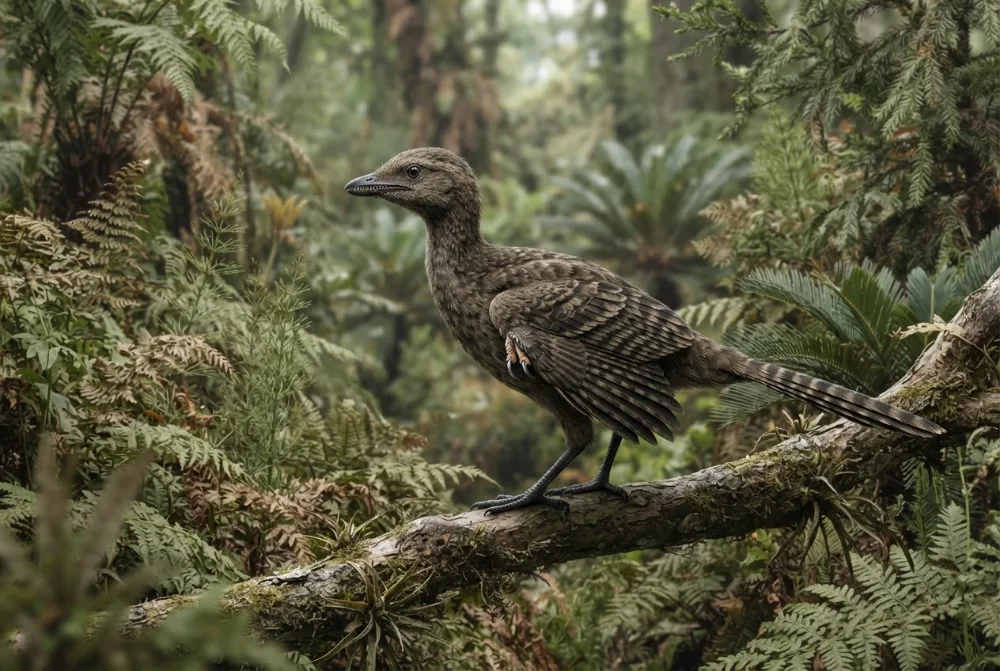
Parapengornis was a bird that lived in the time of dinosaurs, about 120 million years ago. It had a strong tail and special claws that helped it climb trees like a woodpecker. This little bird was a meat-eater and caught insects and other small prey.2
When did it live?
How big was it?
How heavy was it?

How big was Parapengornis compared to YOU?
Just maths in your browser. Nothing is saved or sent anywhere.
How fast was it?


Fun facts
Parapengornis had a very broad and short tail bone (pygostyle) that was wider than it was long, which is unusual for early birds.2
Its tail bone looked like that of modern woodpeckers, so scientists think Parapengornis could climb up tree trunks and cling to bark.2
This bird had long, slender teeth that were constricted at the base and slightly curved backward, perfect for grabbing slippery prey.2
Parapengornis was one of the largest early Cretaceous enantiornithine birds, about the size of a modern crow.2
The fossil of Parapengornis was found with impressions of its wing and tail feathers, showing it had fully developed flight feathers.2
It lived alongside many other early birds and dinosaurs in the Jehol Biota of China, about 120 million years ago.2

Ask Rex about Parapengornis
Rex only answers questions about this page. 10 questions a month.
Rex is an AI and can make mistakes. He runs on servers in the EU and questions are never saved. Never type your name or other personal things.
For dino experts
- Scientific name
- Parapengornis
- Named by
- Hu et al. 20154
- Group
- Early birds
- Family / clade
- Pengornithidae4
- Classification
- Theropoda > Avialae4
- Age of the rocks
- 126 to 113 million years (Barremian / Aptian)4
- Rock formations
- Yixian, Jiufotang4
- Countries
- China4
- Fossil records
- 2 in the Paleobiology Database4
- Discovery
- Parapengornis was named in 2015 by Chinese paleontologists Han Hu, Jingmai O'Connor, and Zhonghe Zhou, based on a nearly complete skeleton found near Lingyuan, Liaoning, China.21
- Still debated
- Scientists are still debating whether the long, stiff tail feathers of Parapengornis were used for display or to help it balance while climbing trees.2
Where the facts come from
- Parapengornis (en.wikipedia.org)
- A New Species of Pengornithidae (Aves: Enantiornithes) from the Lower Cretaceous of China Suggests a Specialized Scansorial Habitat Previously Unknown in Early Birds | PLOS One (journals.plos.org)
- A New Species of Pengornithidae (Aves: Enantiornithes) from the Lower Cretaceous of China Suggests a Specialized Scansorial Habitat Previously Unknown in Early Birds (pmc.ncbi.nlm.nih.gov)
- Parapengornis in The Paleobiology Database (CC BY 4.0): age, places, rock formations, classification.
Every fact on this page has a number that points to its source. If we got something wrong, sorry, we are dino fans, not a science journal. Tell us at [email protected] and we will fix it.
 Rex is hungry! Dino Wiki is a dad's project for his dino-loving son, free with no ads. Grown-ups can feed Rex a snack to help keep it online.Feed Rex
 Archaeopteryx
 Hesperornis
 Ichthyornis
 Baptornis
 Jurapteryx
 Gobipteryx
 Stegosaurus
 Iguanodon
 Giganotosaurus
 Microraptor
 Deinonychus
 Baryonyx