
Pinacosaurus
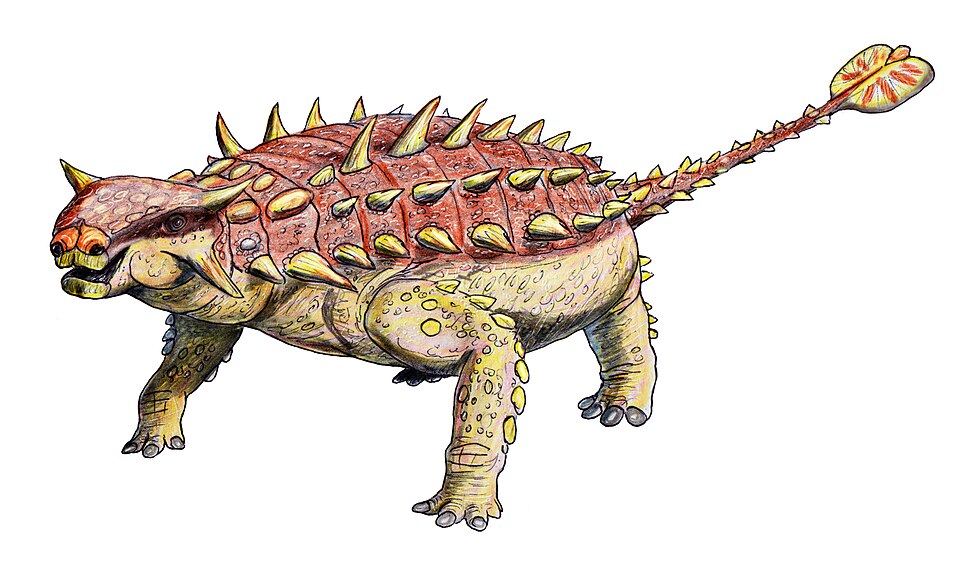
Pinacosaurus was an armoured dinosaur that looked like a living tank. It had bony plates on its head and a heavy club at the end of its tail to fight off predators. Many young Pinacosaurus fossils have been found huddled together, probably killed by a sandstorm.1
When did it live?
How big was it?
Fun facts
At least 24 Pinacosaurus skeletons have been found, more than for any other ankylosaur.1
Most Pinacosaurus fossils are from juveniles, and adults have never been found in groups.1
Each nostril of Pinacosaurus was a large depression with three to five smaller holes, and scientists are not sure what they were for.1
Pinacosaurus had a tail club made of bone, which it probably used to defend itself against predators.1
A juvenile Pinacosaurus fossil shows large tongue bones, suggesting it had a strong, muscular tongue to help gather food.1
The first Pinacosaurus fossils were found in 1923 by Walter W. Granger at the Flaming Cliffs in Mongolia.1
Pinacosaurus lived during the Late Cretaceous, about 81 to 75 million years ago.2
For dino experts
- Scientific name
- Pinacosaurus
- Named by
- Gilmore 19333
- Group
- Armoured dinos
- Family / clade
- Ankylosauridae3
- Classification
- Ornithischia > Ankylosauria > Ankylosauridae > Thyreophora3
- Age of the rocks
- 90 to 72 million years (Coniacian to Campanian)3
- Rock formations
- Djadokhta, Bayan Mandahu, Baruungoyot3
- Countries
- Mongolia, China3
- Fossil records
- 24 in the Paleobiology Database3
- Also known as
- Syrmosaurus (older names now counted as the same animal)3
- Discovery
- Pinacosaurus was named by Charles Whitney Gilmore in 1933, based on fossils found in 1923 by Walter W. Granger in the Gobi Desert of Mongolia.1
- Still debated
- Scientists are still unsure why the nostrils of Pinacosaurus had several small holes instead of one large opening.1
Where the facts come from
- Pinacosaurus - Wikipedia (en.wikipedia.org)
- Pinacosaurus | Natural History Museum (nhm.ac.uk)
- Pinacosaurus in The Paleobiology Database (CC BY 4.0): age, places, rock formations, classification.
Every fact on this page has a number that points to its source. If we got something wrong, sorry, we are dino fans, not a science journal. Tell us at [email protected] and we will fix it.
 Rex is hungry! Dino Wiki is free with no ads. Grown-ups can feed Rex a snack to keep it that way.Feed Rex
 Ankylosaurus
 Sauropelta
 Scutellosaurus
 Struthiosaurus
 Euoplocephalus
 Edmontonia
 Triceratops
 Velociraptor
 Spinosaurus
 Parasaurolophus
 Pteranodon