
Struthiosaurus
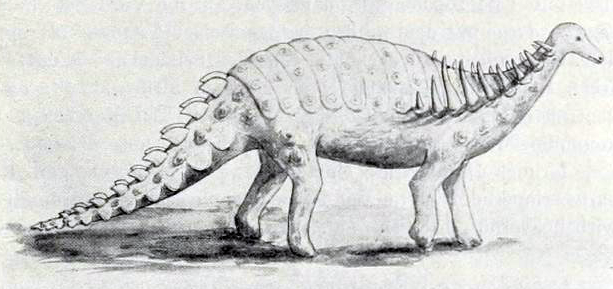
Struthiosaurus was a small armoured dinosaur that lived on islands in Europe. It had bony plates on its back for protection and ate plants. Scientists think it was a dwarf ankylosaur because it was much smaller than its relatives.21
When did it live?
How big was it?
Fun facts
Struthiosaurus had very poor hearing and relied mostly on its armour for defence.1
It was one of the smallest armoured dinosaurs, only about 2 to 3 metres long.1
Struthiosaurus lived on islands in Europe during the Late Cretaceous, which may have made it a dwarf species.2
Its name means 'ostrich lizard' because the first skull piece found looked bird-like.1
Scientists think Struthiosaurus was a slow and solitary animal.1
Three valid species of Struthiosaurus are known: S. austriacus, S. transylvanicus, and S. languedocensis.1
Myth buster
Myth: Some people think Struthiosaurus was a giant dinosaur.
Truth: It was actually one of the smallest armoured dinosaurs, only 2 to 3 metres long.1
For dino experts
- Scientific name
- Struthiosaurus
- Named by
- Bunzel 18703
- Group
- Armoured dinos
- Family / clade
- Nodosauridae3
- Classification
- Ornithischia > Ankylosauria > Nodosauridae > Thyreophora3
- Age of the rocks
- 84 to 66 million years (Campanian to Maastrichtian)3
- Rock formations
- Grünbach, Sebeş, Râul Mare3
- Countries
- Romania, Austria, Spain, France3
- Fossil records
- 23 in the Paleobiology Database3
- Also known as
- Crataeomus, Danubiosaurus, Leipsanosaurus, Pleuropeltus (older names now counted as the same animal)3
- Discovery
- The first fossils were found in 1859 in a coal mine in Austria by geologist Eduard Suess. The dinosaur was named Struthiosaurus by Emanuel Bunzel in 1871.1
- Still debated
- Scientists still debate whether Struthiosaurus was one of the most primitive nodosaurids or more advanced.1
Where the facts come from
- Struthiosaurus (en.wikipedia.org)
- Struthiosaurus | Natural History Museum (nhm.ac.uk)
- Struthiosaurus in The Paleobiology Database (CC BY 4.0): age, places, rock formations, classification.
Every fact on this page has a number that points to its source. If we got something wrong, sorry, we are dino fans, not a science journal. Tell us at [email protected] and we will fix it.
 Rex is hungry! Dino Wiki is free with no ads. Grown-ups can feed Rex a snack to keep it that way.Feed Rex
 Ankylosaurus
 Sauropelta
 Pinacosaurus
 Scutellosaurus
 Euoplocephalus
 Edmontonia
 Triceratops
 Velociraptor
 Spinosaurus
 Parasaurolophus
 Pteranodon