
Plesiopterys
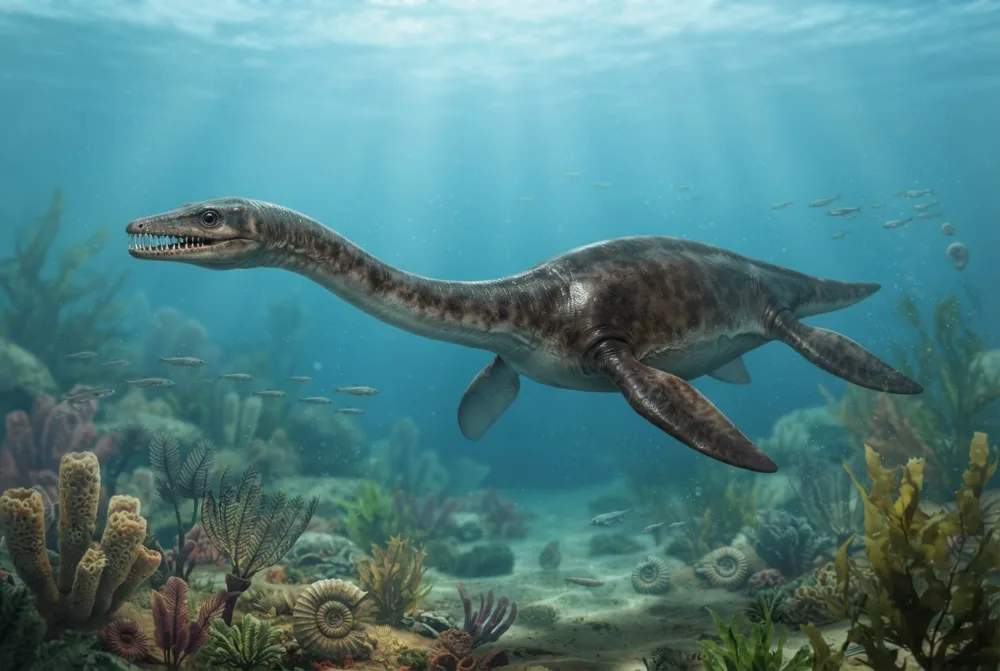
Plesiopterys was a small, long-necked marine reptile that swam in the warm seas of Early Jurassic Germany. It had flippers like paddles and a mouth full of sharp teeth for catching fish and squid.1
When did it live?
How big was it?
How long was it?
How big was Plesiopterys compared to YOU?
Just maths in your browser. Nothing is saved or sent anywhere.
Fun facts
Plesiopterys had 39 neck vertebrae, giving it a long, flexible neck.2
One fossil of Plesiopterys preserves traces of scaly skin on its front flipper and smooth skin on its tail.1
The tail skin of that fossil also contains dark-colored melanosomes, which are pigment cells that may have given the animal a dark color.1
Plesiopterys is one of the most primitive plesiosaurs known, meaning it had many features from earlier ancestors.2
Its skull was small compared to its neck, only about 17 percent of the neck length.2
The name Plesiopterys also refers to the pterygoid bones in the roof of its mouth, which are important for identifying the species.1

Ask Rex about Plesiopterys
Rex only answers questions about this page. 3 questions a day.
Rex is an AI and can make mistakes. He runs on servers in the EU and questions are never saved. Never type your name or other personal things.
For dino experts
- Scientific name
- Plesiopterys
- Named by
- O'Keefe 20043
- Group
- Plesiosaurs
- Family / clade
- Plesiosauroidea3
- Classification
- Plesiosauria > Sauropterygia3
- Age of the rocks
- 184 to 183 million years (Toarcian)3
- Rock formations
- Posidonienschiefer3
- Countries
- Germany3
- Fossil records
- 1 in the Paleobiology Database3
- Discovery
- Plesiopterys was named in 2004 by paleontologist F. Robin O'Keefe, based on a skeleton found in the 19th century near Holzmaden, Germany. The species name P. wildi honors German paleontologist Rupert Wild.12
- Still debated
- Scientists debate whether Plesiopterys is a separate species or the same as another plesiosaur called Seeleyosaurus guilelmiimperatoris.1
Where the facts come from
- Plesiopterys (en.wikipedia.org)
- pleo_78_511.973_988.tp (doc.rero.ch)
- Plesiopterys in The Paleobiology Database (CC BY 4.0): age, places, rock formations, classification.
Every fact on this page has a number that points to its source. If we got something wrong, sorry, we are dino fans, not a science journal. Tell us at [email protected] and we will fix it.
 Rex is hungry! Dino Wiki is a dad's project for his dino-loving son, free with no ads. Grown-ups can feed Rex a snack to help keep it online.Feed Rex
 Elasmosaurus
 Pliosaurus
 Plesiosaurus
 Cimoliasaurus
 Colymbosaurus
 Trinacromerum
 Dilophosaurus
 Stenopterygius
 Dorygnathus
 Lufengosaurus
 Scutellosaurus
 Yunnanosaurus