
Portunatasaurus
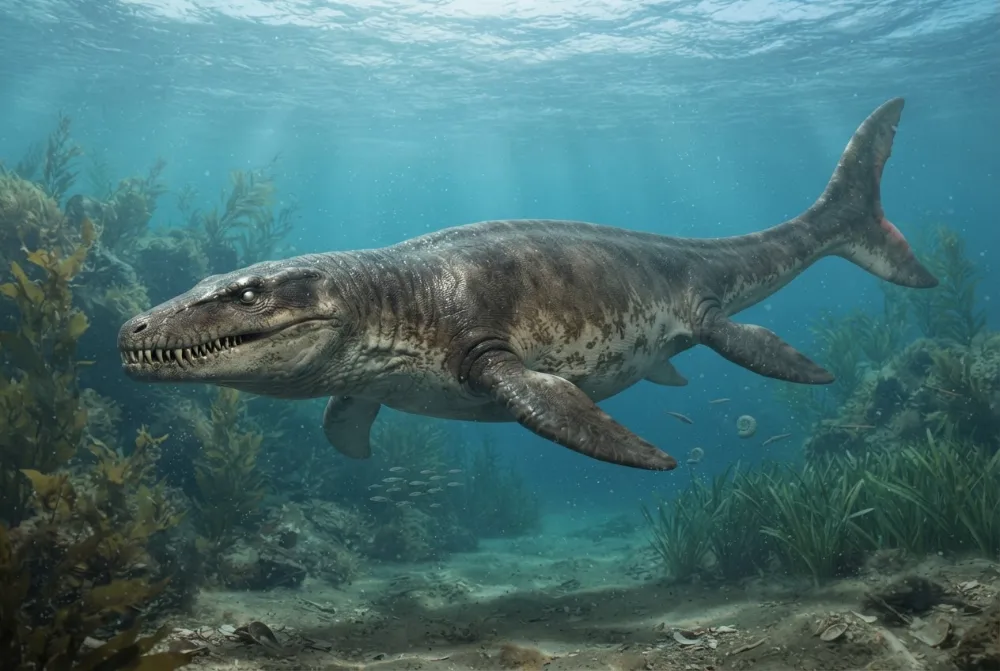
Portunatasaurus was a small marine lizard that swam in warm seas during the time of the dinosaurs. It was only about 1 meter long, as long as a big skateboard, and had a long body and special flipper-like arms.12
When did it live?
How big was it?
How long was it?
How big was Portunatasaurus compared to YOU?
Just maths in your browser. Nothing is saved or sent anywhere.
Fun facts
Portunatasaurus had 10 small bones in its wrist, like land lizards, but also a flattened first finger bone like later sea lizards.2
Its arm was a mix between a walking leg and a swimming paddle, showing how lizards slowly turned into sea swimmers.2
The only skeleton found was almost complete from the neck to the hips, with a perfectly preserved right arm.2
It lived about 100 to 90 million years ago, during the Cenomanian and Turonian ages of the Late Cretaceous.3
Portunatasaurus is the third and youngest aigialosaur (a type of early marine lizard) found in Croatia.2
Most asked questions about Portunatasaurus

Ask Rex about Portunatasaurus
Rex only answers questions about this page. 10 questions a month.
Rex is an AI and can make mistakes. He runs on servers in the EU and questions are never saved. Never type your name or other personal things.
For dino experts
- Scientific name
- Portunatasaurus
- Named by
- Campbell Mekarski et al. 20194
- Group
- Mosasaurs
- Family / clade
- Mosasauroidea4
- Classification
- Mosasauroidea4
- Age of the rocks
- 100 to 90 million years (Cenomanian / Turonian)4
- Countries
- Croatia4
- Fossil records
- 1 in the Paleobiology Database4
- Discovery
- The skeleton was found in 2008 on the island of Dugi Otok in Croatia. Scientists Michelle Mekarski, Dražen Japundžić, Katarina Krizmanić and Michael Caldwell named it Portunatasaurus krambergeri in 2019.12
- Still debated
- Scientists are still debating whether its paddle-like arm evolved earlier in mosasaur history or evolved more than once.2
Where the facts come from
- Portunatasaurus (en.wikipedia.org)
- Description of a new basal mosasauroid from the Late Cretaceous of Croatia, with comments on the evolution of the mosasauroid forelimb (exa.ai)
- PBDB Taxon (paleobiodb.org)
- Portunatasaurus in The Paleobiology Database (CC BY 4.0): age, places, rock formations, classification.
Every fact on this page has a number that points to its source. If we got something wrong, sorry, we are dino fans, not a science journal. Tell us at [email protected] and we will fix it.
 Rex is hungry! Dino Wiki is a dad's project for his dino-loving son, free with no ads. Grown-ups can feed Rex a snack to help keep it online.Feed Rex
 Mosasaurus
 Prognathodon
 Tylosaurus
 Platecarpus
 Clidastes
 Globidens
 Tyrannosaurus
 Triceratops
 Velociraptor
 Spinosaurus
 Ankylosaurus
 Parasaurolophus