
Psephochelys
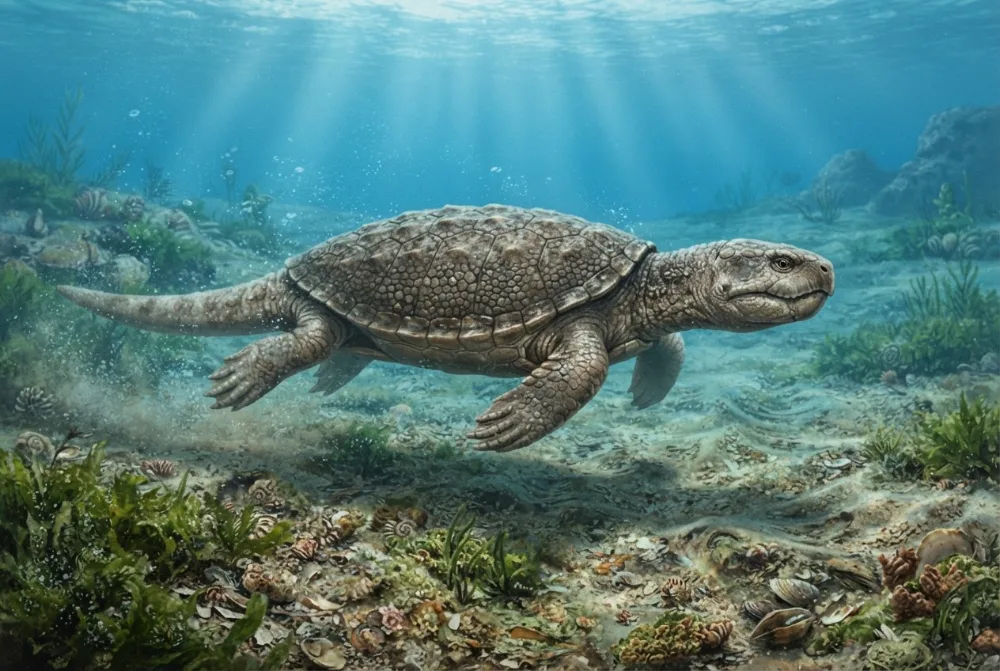
Psephochelys was a turtle-like marine reptile that lived in the Late Triassic period, about 233 to 227 million years ago. It had a shell on its back made of many small bony plates, but no shell on its belly, just loose bones. It swam in warm seas where China is today.12
When did it live?
Fun facts
Psephochelys is known from only one species, Psephochelys polyosteoderma, and the first fossil was a partial skeleton found in the Falong Formation in China.1
Unlike turtles, Psephochelys had no hard shell on its belly. Instead, it had rib-like bones and small bony plates that were loosely connected.1
A subadult specimen shows that the shell of Psephochelys grew by fusing small plates together, starting from the middle and edges, similar to how a turtle's shell develops.3
Psephochelys belonged to a group called placodonts, which were marine reptiles that looked like turtles but are not closely related to them.1
The name Psephochelys means 'pebbly turtle' because its shell was made of many small, pebble-like bony plates.1
Psephochelys lived during the Carnian age of the Late Triassic, between about 233 and 227 million years ago.2

Ask Rex about Psephochelys
Rex only answers questions about this page. 10 questions a month.
Rex is an AI and can make mistakes. He runs on servers in the EU and questions are never saved. Never type your name or other personal things.
For dino experts
- Scientific name
- Psephochelys
- Named by
- Li and Rieppel 20024
- Group
- Sea reptiles
- Family / clade
- Placochelyidae4
- Classification
- Placodontia > Sauropterygia4
- Age of the rocks
- 234 to 227 million years (Carnian)4
- Rock formations
- Xiaowa4
- Countries
- China4
- Fossil records
- 1 in the Paleobiology Database4
- Discovery
- Psephochelys was named by Chinese paleontologist Chun Li and Swiss paleontologist Olivier Rieppel in 2002, based on a single partial skeleton found in Guizhou, China.12
- Still debated
- Scientists are still debating exactly how Psephochelys is related to other placodonts, and whether its shell grew in a way that hints at a common ancestor with turtles.3
Where the facts come from
- Psephochelys (en.wikipedia.org)
- PBDB Taxon (paleobiodb.org)
- First subadult specimen of Psephochelys polyosteoderma (Sauropterygia, Placodontia) implies turtle-like fusion pattern of the carapace (onlinelibrary.wiley.com)
- Psephochelys in The Paleobiology Database (CC BY 4.0): age, places, rock formations, classification.
Every fact on this page has a number that points to its source. If we got something wrong, sorry, we are dino fans, not a science journal. Tell us at [email protected] and we will fix it.
 Rex is hungry! Dino Wiki is a dad's project for his dino-loving son, free with no ads. Grown-ups can feed Rex a snack to help keep it online.Feed Rex
 Nothosaurus
 Placodus
 Lariosaurus
 Cyamodus
 Cymatosaurus
 Proneusticosaurus
 Massospondylus
 Plateosaurus
 Coelophysis
 Podokesaurus
 Thecodontosaurus
 Eudimorphodon