
Psephosaurus
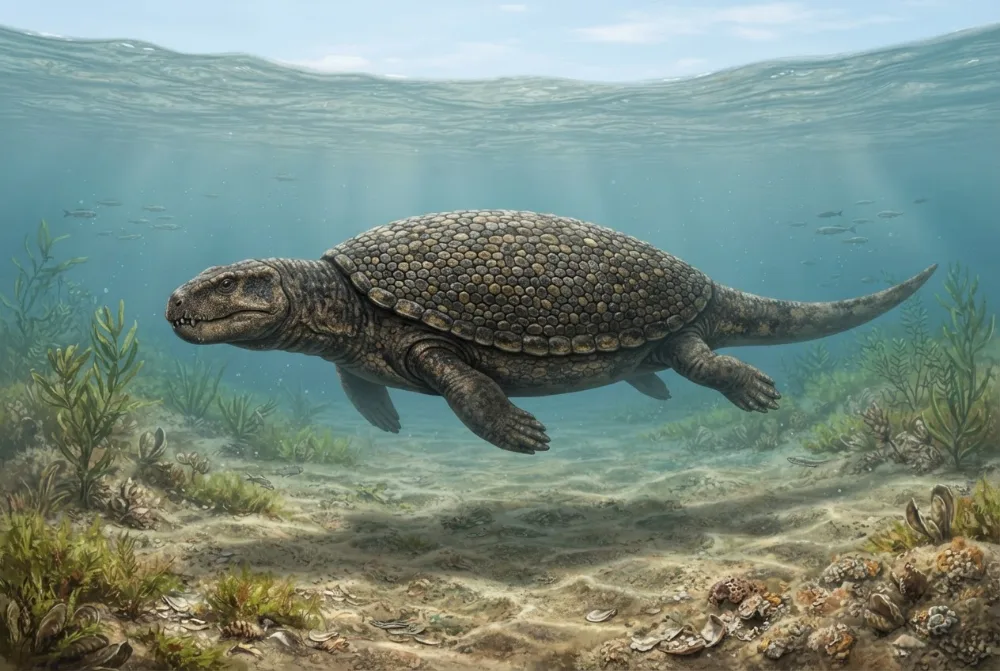
Psephosaurus was a marine reptile that lived in the Middle Triassic seas, about 243 to 237 million years ago. It had a shell made of many small, pebble-like bones that protected its body. It swam in warm, shallow waters where it probably ate tiny floating creatures.11
When did it live?
Fun facts
Psephosaurus had a carapace, or shell, made of many small, irregular bone plates called osteoderms. The big plates were separated by smaller pentagonal or hexagonal ones.2
Its name means 'pebble lizard' because its shell looked like a bunch of pebbles.1
Psephosaurus belonged to a group called placodonts, which were marine reptiles that often had crushing teeth for eating shellfish. But Psephosaurus may have been a filter feeder instead.11
The first fossils of Psephosaurus were found in Germany in the Hoheneck limestone, which was once an ancient estuary or bay.1

Ask Rex about Psephosaurus
Rex only answers questions about this page. 3 questions a day.
Rex is an AI and can make mistakes. He runs on servers in the EU and questions are never saved. Never type your name or other personal things.
For dino experts
- Scientific name
- Psephosaurus
- Named by
- Fraas 18963
- Group
- Other sea reptiles
- Family / clade
- Placochelyidae3
- Classification
- Placodontia > Sauropterygia3
- Age of the rocks
- 247 to 237 million years ()3
- Rock formations
- Tarasci, Erfurt3
- Countries
- Israel, Turkey, Germany3
- Fossil records
- 4 in the Paleobiology Database3
- Discovery
- Psephosaurus was named by German scientist Eberhard Fraas in 1896. The first fossils were found at Kugelberg near Ludwigsburg-Hoheneck in Germany, and they were pieces of a poorly preserved partial shell.12
- Still debated
- Scientists are not sure exactly what Psephosaurus ate. The PBDB lists its diet as 'suspension feeder', but other placodonts usually crushed shellfish, so its feeding habits are still debated.11
Where the facts come from
- PBDB Taxon (paleobiodb.org)
- Psephosaurus suevicus E. Fraas 1896 (exa.ai)
- Psephosaurus in The Paleobiology Database (CC BY 4.0): age, places, rock formations, classification.
Every fact on this page has a number that points to its source. If we got something wrong, sorry, we are dino fans, not a science journal. Tell us at [email protected] and we will fix it.
Rex is hungry! Dino Wiki is a dad's project for his dino-loving son, free with no ads. Grown-ups can feed Rex a snack to help keep it online.Feed Rex Nothosaurus
 Placodus
 Lariosaurus
 Cyamodus
 Cymatosaurus
 Proneusticosaurus
 Chonespondylus
 Cymbospondylus
 Phalarodon
 Mixosaurus
 Chaohusaurus
 Chensaurus