 Home
 All dinos
 Dino groups
 Explore
 Dinos by country
 Dino vs dino
 How big were they?
 Dinos A to Z
 Who ate what?
 What dino are you? Quiz
 Dino games
 Dino battle
 Dino race
 Dino mini-games
 Sticker album
 Dino TOP lists
 Timeline
 Surprise me!
 Language: English

Saraikisaurus
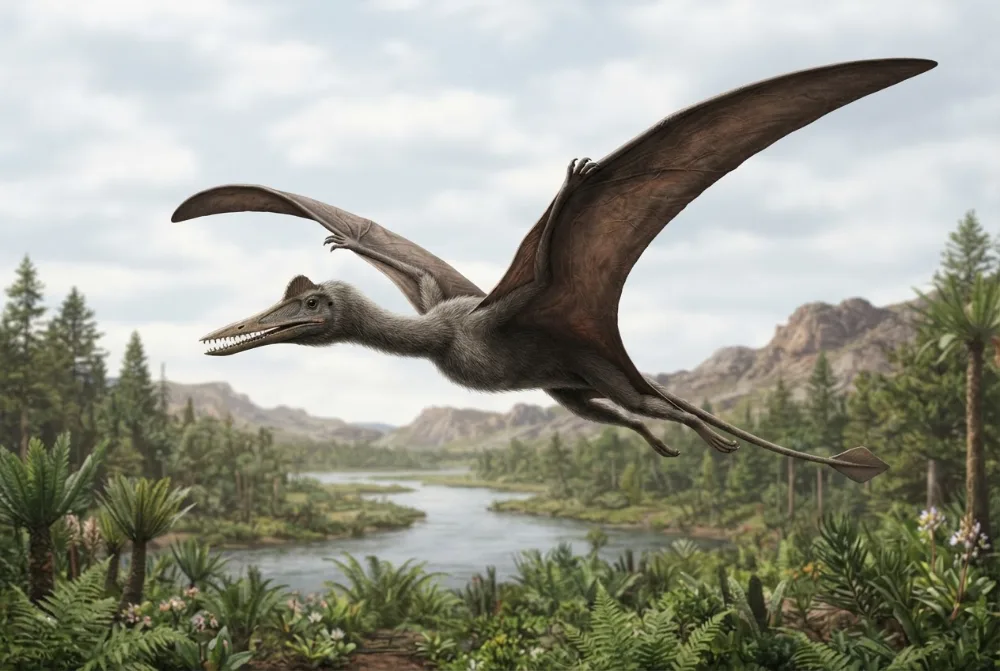
Saraikisaurus is known from a single piece of toothed jaw found in what is now Pakistan. It lived at the very end of the Age of Dinosaurs and was first described as a pterosaur, a flying cousin of the dinosaurs.112
 Pakistan
When did it live?
Saraikisaurus: 72 to 66 million years ago
How fast was it?


Fun facts
Saraikisaurus lived between 72 and 66 million years ago, during the Maastrichtian stage of the Late Cretaceous.1
Its fossil was found at Top Kinwa in the Barkhan District of Balochistan, Pakistan, in rocks of the Vitakri Formation.12
The only known fossil of Saraikisaurus is part of a lower jaw bone with some teeth still in place, about 5.8 cm long.12
It was first described as a pterosaur with teeth, but in 2025 the scientist who named it said the jaw belonged to a small meat-eating dinosaur called a noasaurid instead.12
The name Saraikisaurus honors the Saraiki people and language of central Pakistan.1
Most asked questions about Saraikisaurus
?Is Saraikisaurus a dinosaur?
Nobody is sure. It was first described as a pterosaur, a flying reptile that is not a dinosaur, but in 2025 the scientist who named it said the jaw came from a small meat-eating dinosaur instead.4
?How big was Saraikisaurus?
Scientists do not know its full size because only part of a lower jaw has been found. That piece of jaw is about 5.8 cm long.3
?What did Saraikisaurus eat?
Nobody knows for sure. It was first described as a fish-eating pterosaur, but with only part of one jaw found, its diet is uncertain.43
?When did Saraikisaurus live?
Saraikisaurus lived at the very end of the Cretaceous Period, between about 72 and 66 million years ago.4
For dino experts
- Scientific name
- Saraikisaurus
- Named by
- Malkani 20144
- Group
- Flying reptiles
- Family / clade
- Saraikisauridae4
- Classification
- Pterosauria > Pterodactyloidea4
- Age of the rocks
- 72 to 66 million years (Maastrichtian)4
- Rock formations
- Vitakri4
- Countries
- Pakistan4
- Fossil records
- 1 in the Paleobiology Database4
- Discovery
- Saraikisaurus was named by Pakistani paleontologist M. Sadiq Malkani in 2014, based on a jaw bone found in the Vitakri Formation of Balochistan, Pakistan.11
- Still debated
- Scientists are not sure what kind of animal Saraikisaurus was or how big it was, because only one small piece of jaw has been found and few scientists have studied it.12
Where the facts come from
- PBDB Taxon (paleobiodb.org)
- scirp.org ojg2025151 21211828.pdf (scirp.org)
- Pterosaurs from Indo-Pakistan subcontinent; Were Cretaceous pterosaurs tooth bearing? Diagnostic features of Saraikisaurus minhui a toothed, youngest and latest Cretaceous pterosaur (researchgate.net)
- Saraikisaurus in The Paleobiology Database (CC BY 4.0): age, places, rock formations, classification.
Every fact on this page has a number that points to its source. If we got something wrong, sorry, we are dino fans, not a science journal. Tell us at hello@dinowiki.app and we will fix it.
 Rex is hungry! Dino Wiki is a dad's project for his dino-loving son, free with no ads and no cookies. Grown-ups can feed Rex a snack to help keep it online.Feed Rex
 Pteranodon
 Quetzalcoatlus
 Dorygnathus
 Rhamphorhynchus
 Anhanguera
 Pterodactylus
 Tyrannosaurus
 Triceratops
 Velociraptor
 Spinosaurus
 Ankylosaurus
 Parasaurolophus