
Schleitheimia
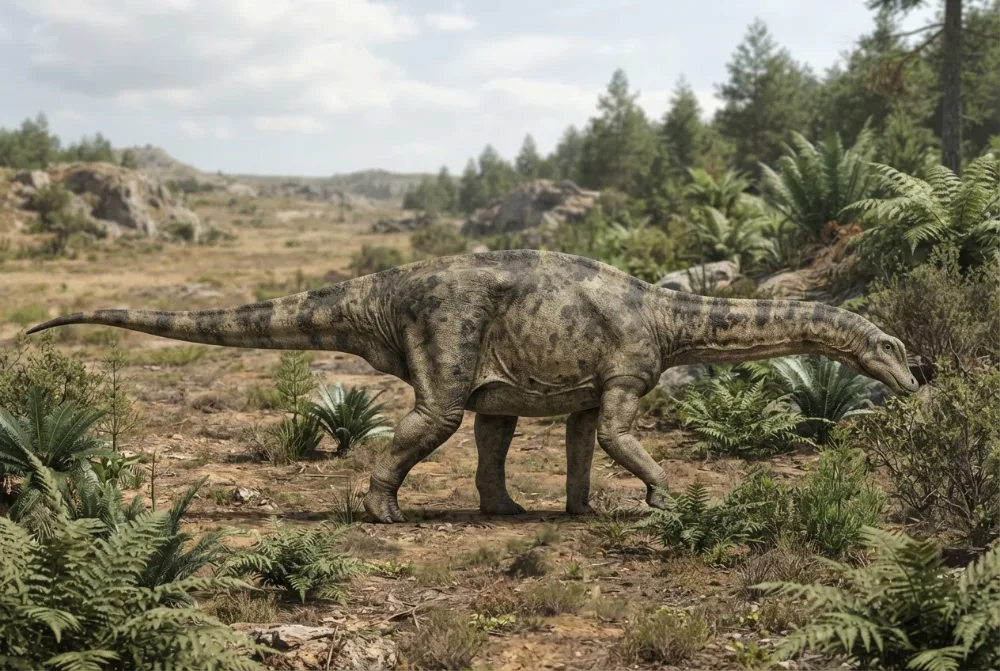
Schleitheimia was a huge, long-necked plant-eater that lived in what is now Switzerland during the Late Triassic. It was one of the closest relatives of the giant sauropods like Brachiosaurus, but it lived millions of years before them.12
When did it live?
How big was it?
How long was it?
How heavy was it?
How big was Schleitheimia compared to YOU?
Just maths in your browser. Nothing is saved or sent anywhere.
How fast was it?
Fun facts
Schleitheimia was named in 2020, making it a very recently discovered dinosaur.1
Its fossils were first found between 1952 and 1954 by a man named Emil Schutz, but scientists originally thought they belonged to a different dinosaur called Plateosaurus.1
The only known part of its hip bone, the ilium, has a unique big rounded ridge that no other dinosaur has.1
Schleitheimia is the most advanced sauropodomorph known from the Late Triassic of Europe, meaning it was very close to becoming a true sauropod.2
It lived during the Norian stage, about 222 to 209 million years ago.1
The fossils were found in the Gruhalde Member of the Klettgau Formation in Switzerland.1
Most asked questions about Schleitheimia
?How big was Schleitheimia?
Scientists do not know its exact size because only a few bones have been found, but it was a large, robustly built sauropodomorph, probably similar in size to other big early relatives of sauropods.14
?What did Schleitheimia eat?
It was a plant-eater, like all sauropodomorph dinosaurs.1
?When did Schleitheimia live?
It lived during the Norian stage of the Late Triassic, about 222 to 209 million years ago.1

Ask Rex about Schleitheimia
Rex only answers questions about this page. 10 questions a month.
Rex is an AI and can make mistakes. He runs on servers in the EU and questions are never saved. Never type your name or other personal things.
For dino experts
- Scientific name
- Schleitheimia
- Named by
- Rauhut et al. 20205
- Group
- Long-necks
- Family / clade
- Sauropodiformes5
- Classification
- Sauropodomorpha5
- Age of the rocks
- 227 to 206 million years (Norian)5
- Rock formations
- Klettgau5
- Countries
- Switzerland5
- Fossil records
- 1 in the Paleobiology Database5
- Discovery
- Schleitheimia was named in 2020 by Oliver Rauhut, Femke Holwerda, and Heinz Furrer. The fossils were collected between 1952 and 1954 by Emil Schutz and were later recognized as a new dinosaur.1
- Still debated
- Scientists are still debating whether Schleitheimia was a very close cousin of sauropods or actually one of the earliest sauropods.1
Where the facts come from
- Schleitheimia (en.wikipedia.org)
- A derived sauropodiform dinosaur and other sauropodomorph material from the Late Triassic of Canton Schaffhausen, Switzerland - FAU CRIS (cris.fau.de)
- Schleitheimia schutzi | Dinosaur Database by DinoAnimals.com (dinoanimals.com)
- A derived sauropodiform dinosaur and other sauropodomorph material from the Late Triassic of Canton Schaffhausen, Switzerland (dinosaurier-info.de)
- Schleitheimia in The Paleobiology Database (CC BY 4.0): age, places, rock formations, classification.
Every fact on this page has a number that points to its source. If we got something wrong, sorry, we are dino fans, not a science journal. Tell us at [email protected] and we will fix it.
 Rex is hungry! Dino Wiki is a dad's project for his dino-loving son, free with no ads. Grown-ups can feed Rex a snack to help keep it online.Feed Rex
 Brachiosaurus
 Diplodocus
 Brontosaurus
 Argentinosaurus
 Camarasaurus
 Morosaurus
 Nothosaurus
 Coelophysis
 Podokesaurus
 Simosaurus
 Eudimorphodon
 Herrerasaurus