
Serendipaceratops
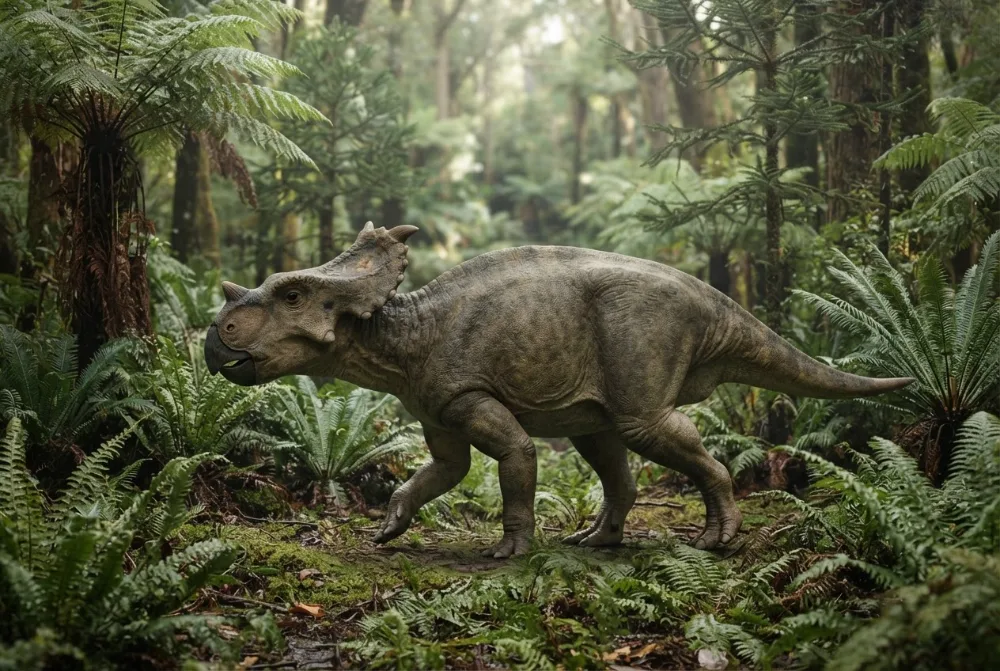
Serendipaceratops was a plant-eating dinosaur that lived in Australia during the Early Cretaceous, about 115 million years ago. It is known from just one arm bone, but that bone tells a big story!1
When did it live?
Fun facts
Serendipaceratops is known from just one bone, a left ulna (lower arm bone) that is about 16 centimetres long.1
The bone was discovered in 1993 during the Dinosaur Cove project, in a small area of sea-floor protected by a dam.1
Scientists first thought the bone might be from a theropod, but later noticed it looked like the arm bone of a horned dinosaur called Leptoceratops.1
The species name, arthurcclarkei, honors science fiction writer Arthur C. Clarke, who was a friend of the scientists that named it.1
Some scientists think Serendipaceratops might actually be an ankylosaur, not a horned dinosaur, because the arm bone is robust.1
The fossil was found in the Wonthaggi Formation, which is about 115 million years old.1
Most asked questions about Serendipaceratops
?What did Serendipaceratops eat?
Serendipaceratops was a herbivore, meaning it ate plants.1
?How big was Serendipaceratops?
Nobody knows for sure, because only one arm bone has been found. That bone is about 16 centimetres (6 inches) long.1
?When did Serendipaceratops live?
It lived during the Early Cretaceous Period, about 115 million years ago.1
?Was Serendipaceratops a dinosaur?
It is a type of ornithischian dinosaur, possibly an ankylosaur.1
?Why is it called Serendipaceratops?
The name means 'serendipitous horned face', because scientists were surprised to find a horned dinosaur bone in Australia. It was named by luck or serendipity.1
?Was Serendipaceratops a ceratopsian?
Scientists disagree. Some think it was a ceratopsian, but others think it was an ankylosaur because the arm bone is robust.1

Ask Rex about Serendipaceratops
Rex only answers questions about this page. 3 questions a day.
Rex is an AI and can make mistakes. He runs on servers in the EU and questions are never saved. Never type your name or other personal things.
Myth buster
Myth: Some people think Serendipaceratops was definitely a horned dinosaur like Triceratops.
Truth: Scientists are not sure. Some studies say it is a ceratopsian, but others say it might be an ankylosaur because the arm bone is robust.1
For dino experts
- Scientific name
- Serendipaceratops
- Named by
- Rich and Vickers-Rich 20032
- Group
- Horned dinos
- Family / clade
- Ceratopsia2
- Classification
- Ornithischia > Ceratopsia2
- Age of the rocks
- 121 to 120 million years (Aptian)2
- Rock formations
- Wonthaggi2
- Countries
- Australia2
- Fossil records
- 1 in the Paleobiology Database2
- Discovery
- The bone was found in 1993 near Kilcunda, Australia, and the dinosaur was named by Tom Rich and Patricia Vickers-Rich in 2003. The name came after a colleague pointed out the bone looked like a horned dinosaur's arm bone.1
- Still debated
- Scientists still debate whether Serendipaceratops is a ceratopsian or an ankylosaur, because only one bone is known and it may be deformed.1
Where the facts come from
- Serendipaceratops (en.wikipedia.org)
- Serendipaceratops in The Paleobiology Database (CC BY 4.0): age, places, rock formations, classification.
Every fact on this page has a number that points to its source. If we got something wrong, sorry, we are dino fans, not a science journal. Tell us at [email protected] and we will fix it.
Rex is hungry! Dino Wiki is a dad's project for his dino-loving son, free with no ads. Grown-ups can feed Rex a snack to help keep it online.Feed Rex Triceratops
 Protoceratops
 Ojoceratops
 Tatankaceratops
 Psittacosaurus
 Centrosaurus
 Stegosaurus
 Iguanodon
 Archaeopteryx
 Giganotosaurus
 Microraptor
 Deinonychus