
Simurghia
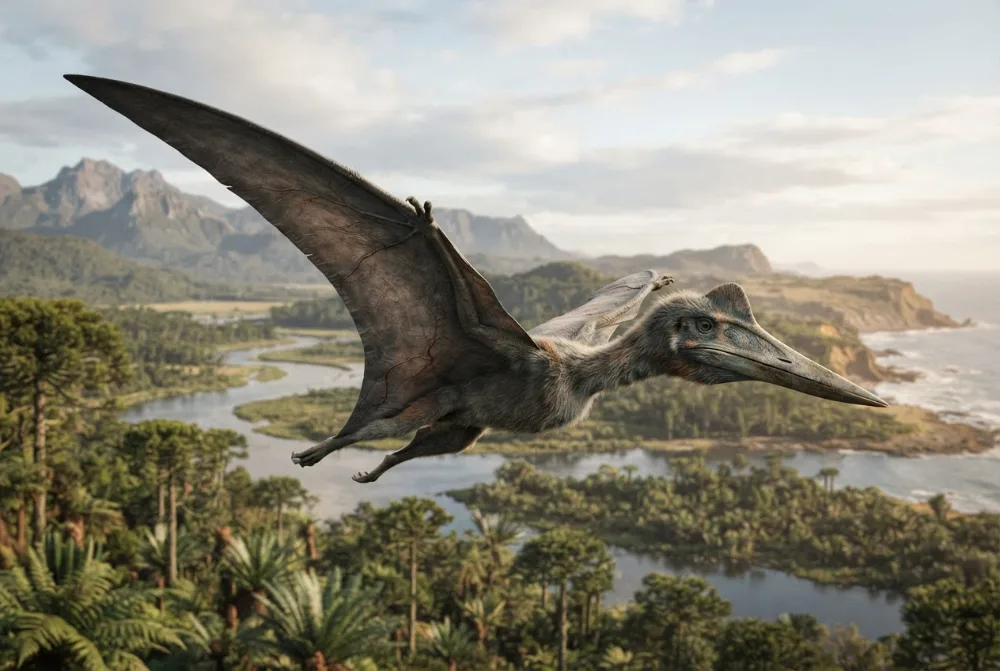
Simurghia was a big flying reptile that lived near the end of the age of dinosaurs. It had a wingspan as wide as a small car and probably soared over the ocean hunting for fish.1
When did it live?
How big was it?
How wide were its wings?
How big was Simurghia compared to YOU?
Just maths in your browser. Nothing is saved or sent anywhere.
Fun facts
Simurghia was named in 2018 along with two other pterosaurs from the same area: Alcione and Barbaridactylus.1
Its name comes from the Simurgh, a giant bird-like creature in Persian myths.1
Simurghia lived about 66 million years ago, just before the big extinction that killed the dinosaurs.1
All known fossils of Simurghia were found during a three-year dig that uncovered about 200 pterosaur specimens.1
Simurghia was much bigger than its close relative Alcione, weighing about 560 percent more.1
The type specimen is just a single upper arm bone (humerus), but it is enough to tell this was a distinct species.1
Most asked questions about Simurghia
?How big was Simurghia?
Simurghia had a wingspan of about 5 metres (16 feet), as wide as a small car. It weighed about 6.6 times as much as its relative Alcione.1
?What did Simurghia eat?
Simurghia was a fish-eater. It likely soared over the ocean and hunted for fish.12
?When did Simurghia live?
Simurghia lived about 66 million years ago, during the Late Cretaceous period, just before the big extinction that killed the dinosaurs.1

Ask Rex about Simurghia
Rex only answers questions about this page. 3 questions a day.
Rex is an AI and can make mistakes. He runs on servers in the EU and questions are never saved. Never type your name or other personal things.
For dino experts
- Scientific name
- Simurghia
- Named by
- Longrich et al. 20183
- Group
- Flying reptiles
- Family / clade
- Aponyctosauria3
- Classification
- Pterosauria > Pterodactyloidea3
- Age of the rocks
- 72 to 66 million years (Maastrichtian)3
- Rock formations
- Couche III3
- Countries
- Morocco3
- Fossil records
- 1 in the Paleobiology Database3
- Discovery
- Simurghia was named in 2018 by paleontologists Nicholas Longrich, David Martill, and Brian Andres. The fossils were found in phosphate mines in Morocco.1
- Still debated
- Scientists are not sure if a pterosaur from Brazil called 'Nyctosaurus' lamegoi is also a species of Simurghia.1
Where the facts come from
- Simurghia (en.wikipedia.org)
- A Dinosaur A Day: Simurghia (a-dinosaur-a-day.com)
- Simurghia in The Paleobiology Database (CC BY 4.0): age, places, rock formations, classification.
Every fact on this page has a number that points to its source. If we got something wrong, sorry, we are dino fans, not a science journal. Tell us at [email protected] and we will fix it.
 Rex is hungry! Dino Wiki is a dad's project for his dino-loving son, free with no ads. Grown-ups can feed Rex a snack to help keep it online.Feed Rex
 Pteranodon
 Quetzalcoatlus
 Dorygnathus
 Rhamphorhynchus
 Anhanguera
 Pterodactylus
 Tyrannosaurus
 Triceratops
 Velociraptor
 Spinosaurus
 Ankylosaurus
 Parasaurolophus