
Sinocyamodus
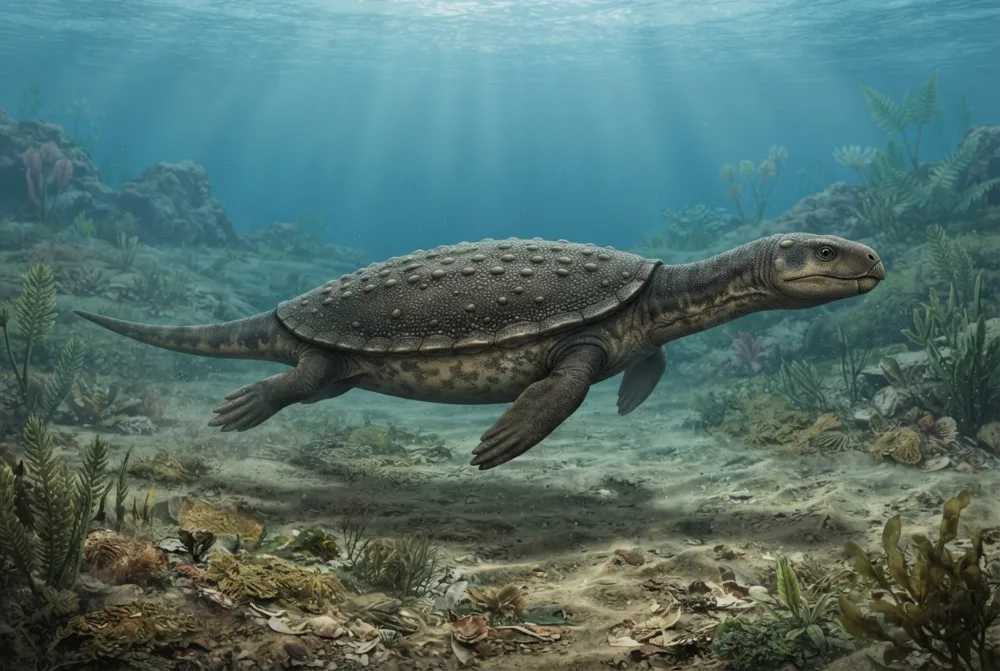
Sinocyamodus was a marine reptile that lived during the Late Triassic, about 232 to 222 million years ago. It looked like a turtle with a flat, bony shell and a beak for crushing shellfish. This placodont was the first of its kind found in the eastern Tethys Ocean, changing what scientists thought about where these reptiles lived.1
When did it live?
Fun facts
Sinocyamodus was a placodont, a group of marine reptiles that were not dinosaurs but relatives of modern turtles.1
It was the first placodont discovered in the eastern Tethys Ocean, showing that these reptiles were not only found in the western Tethys as scientists once thought.1
Only one species is known: Sinocyamodus xinpuensis.1
The first adult specimen was reported in 2018, and it looked different from younger fossils, showing that Sinocyamodus changed as it grew.1

Ask Rex about Sinocyamodus
Rex only answers questions about this page. 3 questions a day.
Rex is an AI and can make mistakes. He runs on servers in the EU and questions are never saved. Never type your name or other personal things.
For dino experts
- Scientific name
- Sinocyamodus
- Named by
- unknown3
- Group
- Other sea reptiles
- Family / clade
- Cyamodontidae3
- Classification
- Placodontia > Sauropterygia3
- Age of the rocks
- 234 to 227 million years (Carnian)3
- Rock formations
- Xiaowa3
- Countries
- China3
- Fossil records
- 1 in the Paleobiology Database3
- Discovery
- Sinocyamodus was named by Li Chun in 2000 based on fossils from the Late Triassic of Guizhou, southwest China. It was the first placodont reptile found in the eastern Tethys region.1
- Still debated
- Scientists are still unsure about the exact size and weight of Sinocyamodus, as only a few fossils have been found.1
Where the facts come from
- Sinocyamodus (en.wikipedia.org)
- PBDB Taxon (paleobiodb.org)
- Sinocyamodus in The Paleobiology Database (CC BY 4.0): age, places, rock formations, classification.
Every fact on this page has a number that points to its source. If we got something wrong, sorry, we are dino fans, not a science journal. Tell us at [email protected] and we will fix it.
Rex is hungry! Dino Wiki is a dad's project for his dino-loving son, free with no ads. Grown-ups can feed Rex a snack to help keep it online.Feed Rex Nothosaurus
 Placodus
 Lariosaurus
 Cyamodus
 Cymatosaurus
 Proneusticosaurus
 Massospondylus
 Plateosaurus
 Coelophysis
 Podokesaurus
 Thecodontosaurus
 Eudimorphodon