
Spitrasaurus
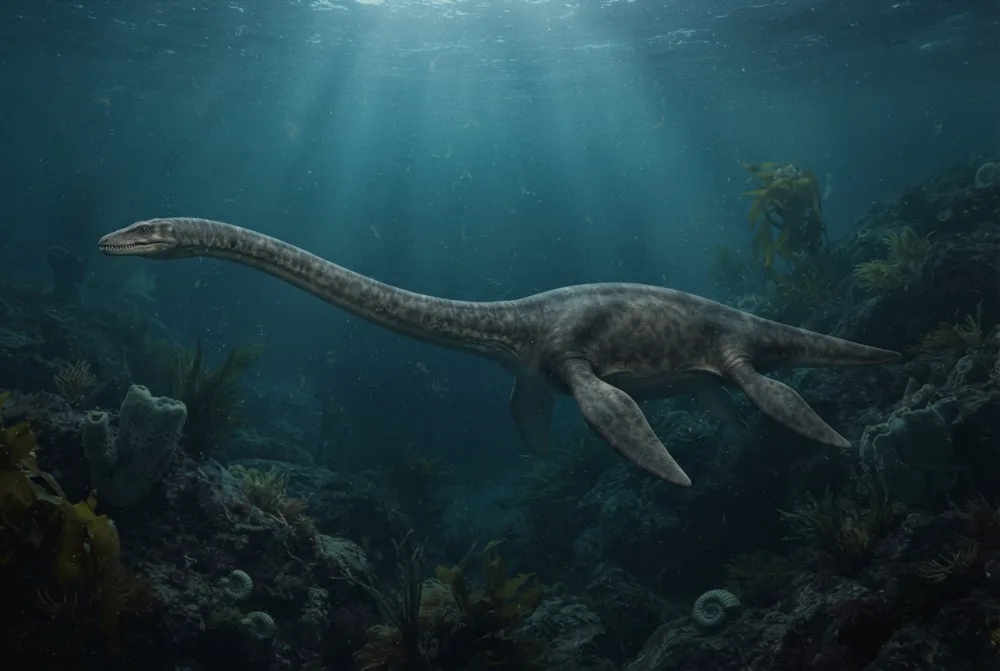
Spitrasaurus was a long-necked marine reptile that swam in the Jurassic seas. It had an incredibly long neck with at least 60 vertebrae, more than most other plesiosaurs. It lived in the cold waters near what is now Svalbard, Norway.1
When did it live?
Fun facts
Spitrasaurus had at least 60 neck bones (cervical vertebrae), which is more than most other Jurassic plesiosaurs. Only some Cretaceous elasmosaurids had more.1
The neck bones of Spitrasaurus had a prominent ridge on the side, a feature not seen in many related plesiosaurs like Djupedalia or Kimmerosaurus.1
Two species of Spitrasaurus have been named: S. wensaasi and S. larseni. They differ in the shape of their neck bones and ribs.1
The first specimen of Spitrasaurus (S. wensaasi) was a juvenile, because its vertebrae were not fully fused. It was preserved lying on its back in black mudstone.1
Spitrasaurus lived about 149 to 143 million years ago, during the Tithonian stage of the Jurassic period. Its fossils were found in the Slottsmøya Member of the Agardhfjellet Formation.21
The name Spitrasaurus honors Spitsbergen Travel, a local travel company that helped support the research.1

Ask Rex about Spitrasaurus
Rex only answers questions about this page. 3 questions a day.
Rex is an AI and can make mistakes. He runs on servers in the EU and questions are never saved. Never type your name or other personal things.
For dino experts
- Scientific name
- Spitrasaurus
- Named by
- Knutsen et al. 20122
- Group
- Plesiosaurs
- Family / clade
- Cryptoclididae2
- Classification
- Plesiosauria > Sauropterygia2
- Age of the rocks
- 149 to 143 million years (Tithonian)2
- Rock formations
- Agardhfjellet2
- Countries
- Norway2
- Fossil records
- 2 in the Paleobiology Database2
- Discovery
- Spitrasaurus was named in 2012 by Espen Knutsen, Patrick Druckenmiller, and Jørn Hurum. The fossils were found on the north slope of Janusfjellet mountain on Spitsbergen, Svalbard, Norway.21
- Still debated
- Scientists are not sure exactly how long Spitrasaurus was, because no complete skeleton has been found. The known specimens are missing parts of the tail and skull.1
Where the facts come from
- Two new species of long-necked plesiosaurians (Reptilia: Sauropterygia) from the Upper Jurassic (Middle Volgian) Agardhfjellet Formation of central Spitsbergen (geologi.no)
- Spitrasaurus in The Paleobiology Database (CC BY 4.0): age, places, rock formations, classification.
Every fact on this page has a number that points to its source. If we got something wrong, sorry, we are dino fans, not a science journal. Tell us at [email protected] and we will fix it.
Rex is hungry! Dino Wiki is a dad's project for his dino-loving son, free with no ads. Grown-ups can feed Rex a snack to help keep it online.Feed Rex Elasmosaurus
 Pliosaurus
 Plesiosaurus
 Cimoliasaurus
 Colymbosaurus
 Trinacromerum
 Brachiosaurus
 Diplodocus
 Allosaurus
 Brontosaurus
 Compsognathus
 Camarasaurus