 Home
 All dinos
 Dino groups
 Explore
 Dinos by country
 Dino vs dino
 How big were they?
 Dinos A to Z
 Who ate what?
 What dino are you? Quiz
 Dino games
 Dino battle
 Dino race
 Dino mini-games
 Sticker album
 Dino TOP lists
 Timeline
 Surprise me!
 Language: English

Titanopteryx
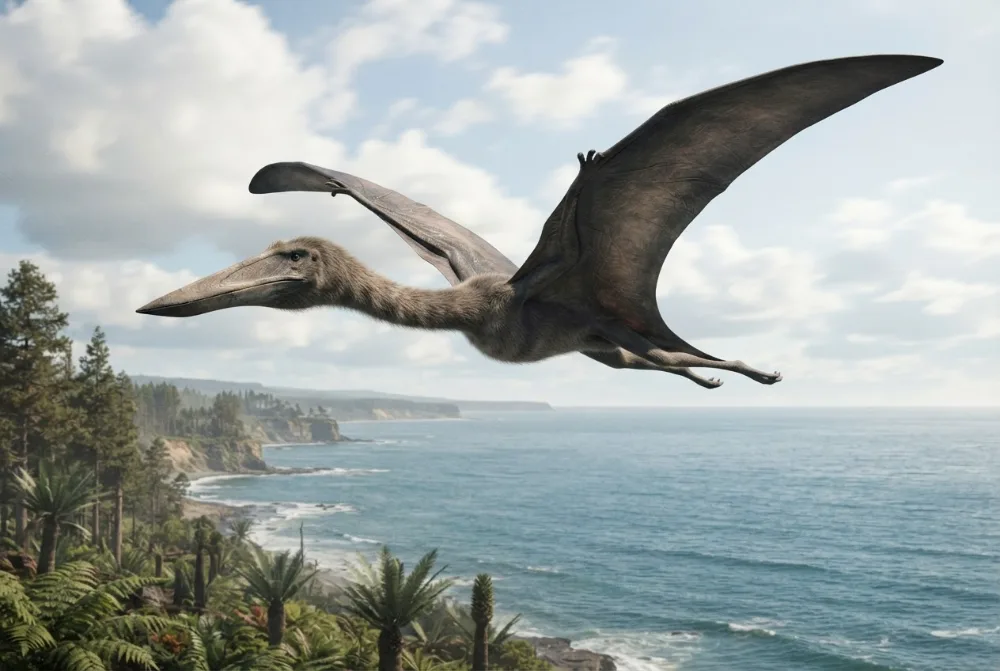
Titanopteryx was a giant flying reptile that lived during the time of the dinosaurs. It was one of the biggest pterosaurs ever, with a wingspan as wide as a small airplane. It soared over ancient seas and coasts, hunting for fish.31
 Israel
 USA
When did it live?
Titanopteryx: 84 to 66 million years ago
How big was it?
How wide were its wings?
 wings as wide as 3 cars in a row⚽could fly across a whole football pitch in 3.8 seconds
How big was Titanopteryx compared to YOU?
Just maths in your browser. Nothing is saved or sent anywhere.
How fast was it?


Fun facts
Titanopteryx was first thought to be a wing bone, but scientists later realized it was a neck vertebra from a giant pterosaur.1
The name Titanopteryx was already used for a tiny black fly, so scientists renamed it Arambourgiania.1
Titanopteryx fossils have been found in rocks that are between 83 and 66 million years old.3
This pterosaur belonged to the Azhdarchidae family, which includes some of the largest flying animals ever.3
Titanopteryx lived near shallow seas and rivers, where it could easily find fish to eat.1
Most asked questions about Titanopteryx
For dino experts
- Scientific name
- Titanopteryx
- Named by
- Arambourg 19593
- Group
- Flying reptiles
- Family / clade
- Azhdarchidae3
- Classification
- Pterosauria > Pterodactyloidea > Azhdarchidae3
- Age of the rocks
- 84 to 66 million years (Campanian / Maastrichtian)3
- Rock formations
- Mishash, Paki, Navesink3
- Countries
- Israel, Senegal, USA3
- Fossil records
- 3 in the Paleobiology Database3
- Discovery
- Titanopteryx was named by French paleontologist Camille Arambourg in 1959, based on a fossil from Jordan that was first mistaken for a wing bone.31
- Still debated
- Scientists are not sure exactly how big Titanopteryx was, because only a few bones have been found.1
Where the facts come from
- Review of taxonomy, geographic distribution, and paleoenvironments of Azhdarchidae (Pterosauria) (pmc.ncbi.nlm.nih.gov)
- en.wikipedia.org Arambourgiania (en.wikipedia.org)
- Titanopteryx in The Paleobiology Database (CC BY 4.0): age, places, rock formations, classification.
Every fact on this page has a number that points to its source. If we got something wrong, sorry, we are dino fans, not a science journal. Tell us at hello@dinowiki.app and we will fix it.
 Rex is hungry! Dino Wiki is a dad's project for his dino-loving son, free with no ads and no cookies. Grown-ups can feed Rex a snack to help keep it online.Feed Rex
 Pteranodon
 Quetzalcoatlus
 Dorygnathus
 Rhamphorhynchus
 Anhanguera
 Pterodactylus
 Tyrannosaurus
 Triceratops
 Velociraptor
 Spinosaurus
 Ankylosaurus
 Parasaurolophus