
Turanoceratops
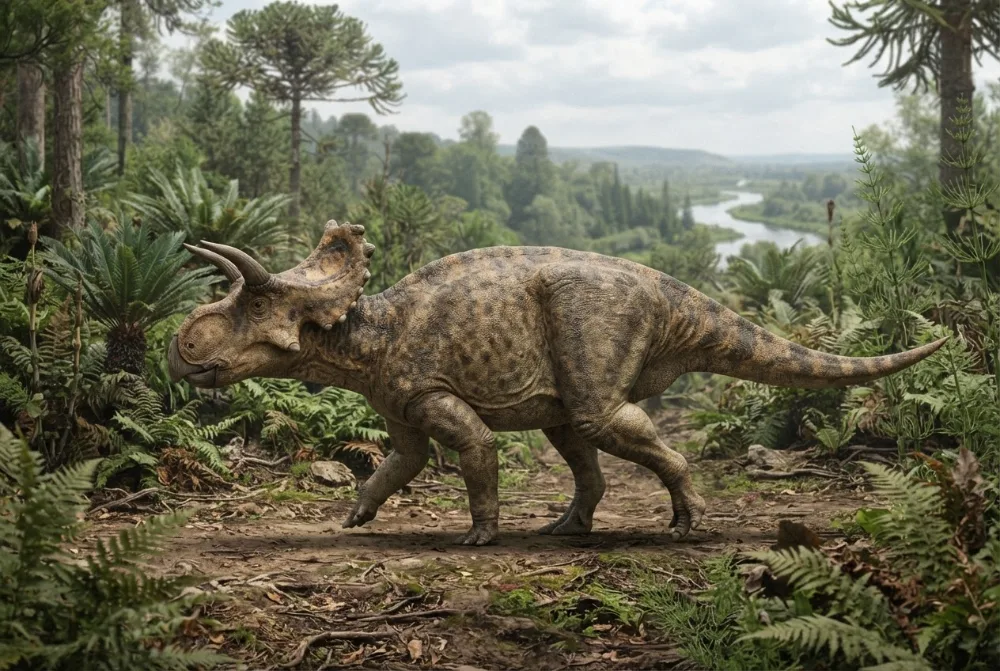
Turanoceratops was a small, plant-eating dinosaur with a parrot-like beak and two long horns above its eyes. It lived in what is now Uzbekistan about 90 million years ago. Scientists think it was a close cousin of the famous horned dinosaurs like Triceratops.12
When did it live?
How big was it?
How big was Turanoceratops compared to YOU?
Just maths in your browser. Nothing is saved or sent anywhere.
Fun facts
Turanoceratops had two long horns above its eyes, like the later ceratopsids, but it lacked a nose horn.2
Its teeth had two roots each, which is a more advanced feature than in earlier horned dinosaurs like Zuniceratops.2
Turanoceratops lived during the Turonian stage, about 90 million years ago, making it one of the oldest known ceratopsids or their close relatives.13
The first fossils of Turanoceratops were found in the 1920s by Soviet scientists, but it was not officially named until 1989.1
Some scientists think Turanoceratops was a true ceratopsid, which would make it the only one known from Asia. Others disagree and place it just outside the group.12
The name Turanoceratops means 'Turan horned face', after the ancient Persian name for the region where it was found.1
Most asked questions about Turanoceratops
?How big was Turanoceratops?
Turanoceratops was a relatively small dinosaur. In 2010, Gregory S. Paul estimated its length at about 2 metres (6.6 ft) and its weight at 175 kilograms (386 lb).1
?What did Turanoceratops eat?
Turanoceratops was a herbivore, meaning it ate plants. It likely fed on ferns and conifers, using its sharp beak to bite off leaves or needles.1

Ask Rex about Turanoceratops
Rex only answers questions about this page. 3 questions a day.
Rex is an AI and can make mistakes. He runs on servers in the EU and questions are never saved. Never type your name or other personal things.
For dino experts
- Scientific name
- Turanoceratops
- Named by
- Nessov et al. 19894
- Group
- Horned dinos
- Family / clade
- Ceratopsoidea4
- Classification
- Ornithischia > Ceratopsia4
- Age of the rocks
- 94 to 90 million years (Turonian)4
- Rock formations
- Bissekty4
- Countries
- Uzbekistan4
- Fossil records
- 6 in the Paleobiology Database4
- Discovery
- Turanoceratops was named in 1989 by Lev Nesov and colleagues based on a damaged upper jaw bone found near Dzharakuduk, Uzbekistan. The species name 'tardabilis' means 'retarding' in Latin, referring to the slow research process.1
- Still debated
- Scientists still debate whether Turanoceratops was a true member of the Ceratopsidae family or just a close relative.12
Where the facts come from
- Turanoceratops (en.wikipedia.org)
- Turanoceratops tardabilis--the first ceratopsid dinosaur from Asia (pubmed.ncbi.nlm.nih.gov)
- PBDB Taxon (paleobiodb.org)
- Turanoceratops in The Paleobiology Database (CC BY 4.0): age, places, rock formations, classification.
Every fact on this page has a number that points to its source. If we got something wrong, sorry, we are dino fans, not a science journal. Tell us at [email protected] and we will fix it.
Rex is hungry! Dino Wiki is a dad's project for his dino-loving son, free with no ads. Grown-ups can feed Rex a snack to help keep it online.Feed Rex Triceratops
 Protoceratops
 Ojoceratops
 Tatankaceratops
 Psittacosaurus
 Centrosaurus
 Velociraptor
 Spinosaurus
 Ankylosaurus
 Parasaurolophus
 Pteranodon