
Vagaceratops
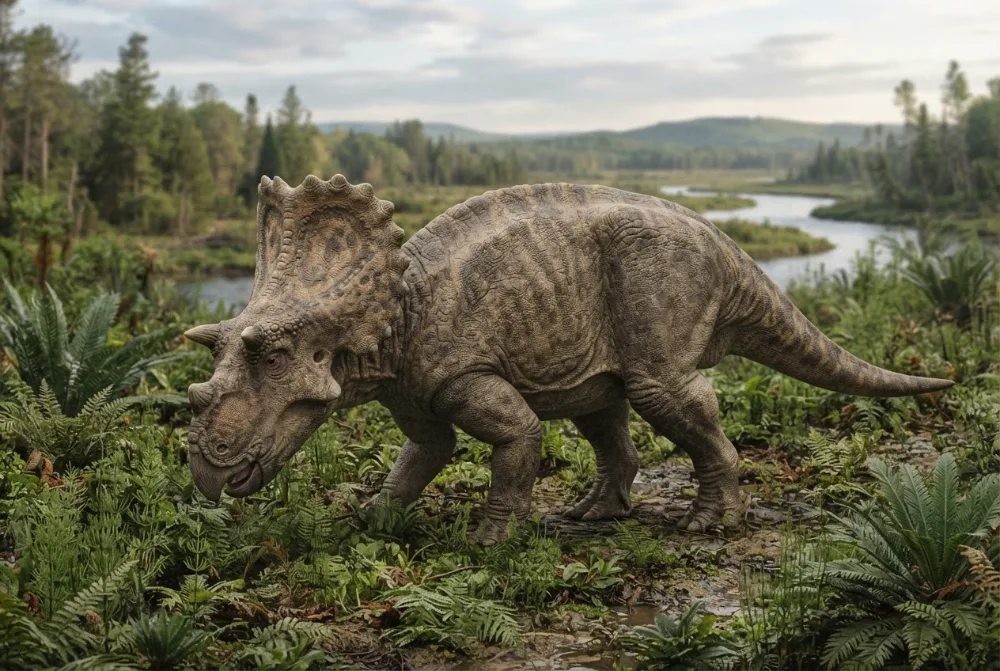
Vagaceratops was a plant-eating dinosaur with a big, square frill on its head. It had short brow horns that looked like bumps and a weird, wavy edge on its frill made of flat bones. It lived in what is now Canada and the USA about 76 million years ago.1
When did it live?
How big was it?
How long was it?
How heavy was it?
How big was Vagaceratops compared to YOU?
Just maths in your browser. Nothing is saved or sent anywhere.
Fun facts
Vagaceratops had ten epoccipitals, which are small bones around its frill. Eight of them were flat and curved forward, making a jagged edge.1
Its frill was wider than it was long, which is unusual for chasmosaurine dinosaurs.1
Vagaceratops was first thought to be a species of Chasmosaurus, called Chasmosaurus irvinensis, before being given its own name in 2010.1
Scientists are not sure if Vagaceratops is more closely related to Kosmoceratops from Utah or to Chasmosaurus.1
The name Vagaceratops means 'wandering horned face' because it is closely related to Kosmoceratops, which lived far away in Utah.1
Vagaceratops lived during the Late Cretaceous period, about 76.2 million years ago.1
Most asked questions about Vagaceratops
?How big was Vagaceratops?
Vagaceratops was a medium sized ceratopsian, reaching about 4.5 metres (15 feet) in length and weighing about 1.2 tonnes (1.3 short tons).1
?What did Vagaceratops eat?
Vagaceratops was a plant-eating dinosaur. It had a parrot-like beak for cropping plants.1
?Why is it called Vagaceratops?
The name means 'wandering horned face' because it is closely related to Kosmoceratops, which lived far away in Utah.1
?Is Vagaceratops the same as Chasmosaurus?
Scientists disagree. Some think Vagaceratops is its own genus, while others think it is a species of Chasmosaurus called Chasmosaurus irvinensis.1
Ask Rex about Vagaceratops
Rex only answers questions about this page. 3 questions a day.
Rex is an AI and can make mistakes. He runs on servers in the EU and questions are never saved. Never type your name or other personal things.
Myth buster
Myth: Vagaceratops had long, sharp horns on its brow like Triceratops.
Truth: Vagaceratops had very short brow horns that were reduced to low bumps, not long spikes.1
For dino experts
- Scientific name
- Vagaceratops
- Named by
- Sampson 20102
- Group
- Horned dinos
- Family / clade
- Ceratopsidae2
- Classification
- Ornithischia > Ceratopsia > Ceratopsidae2
- Age of the rocks
- 84 to 72 million years (Campanian)2
- Rock formations
- Dinosaur Park, Oldman, Judith River2
- Countries
- Canada, USA2
- Fossil records
- 7 in the Paleobiology Database2
- Also known as
- Mercuriceratops (older names now counted as the same animal)2
- Discovery
- Vagaceratops was named by paleontologist Scott D. Sampson and colleagues in 2010. The fossils were originally described in 2001 as a species of Chasmosaurus, but later moved to a new genus.1
- Still debated
- Scientists still debate whether Vagaceratops should be its own genus or just a species of Chasmosaurus.1
Where the facts come from
- Vagaceratops (en.wikipedia.org)
- Vagaceratops in The Paleobiology Database (CC BY 4.0): age, places, rock formations, classification.
Every fact on this page has a number that points to its source. If we got something wrong, sorry, we are dino fans, not a science journal. Tell us at [email protected] and we will fix it.
 Rex is hungry! Dino Wiki is a dad's project for his dino-loving son, free with no ads. Grown-ups can feed Rex a snack to help keep it online.Feed Rex
 Triceratops
 Protoceratops
 Ojoceratops
 Tatankaceratops
 Psittacosaurus
 Centrosaurus
 Tyrannosaurus
 Velociraptor
 Spinosaurus
 Ankylosaurus
 Parasaurolophus
 Pteranodon