
Wendiceratops
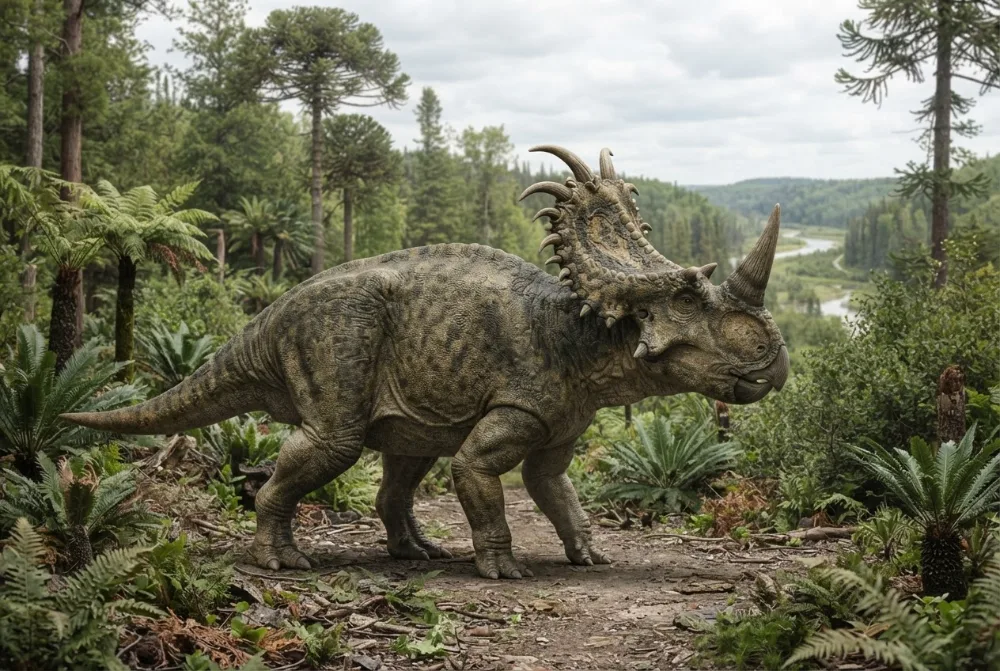
Wendiceratops was a plant-eating dinosaur with a huge bony frill on its head and a big upright horn above its nose. It lived about 78 to 79 million years ago in what is now Alberta, Canada. This dinosaur is one of the oldest horned dinosaurs with a tall nose horn ever found.1
When did it live?
How big was it?
How long was it?
How tall was it?
at the hips
How heavy was it?
How big was Wendiceratops compared to YOU?
Just maths in your browser. Nothing is saved or sent anywhere.
Fun facts
Wendiceratops had a frill decorated with many curved, forward-pointing spikes that made it look very fancy.1
Its name honors Canadian fossil hunter Wendy Sloboda, who discovered the bonebed where this dinosaur was found.1
Over 200 bones from many different Wendiceratops individuals were found together in one bonebed, making it one of the best-known early horned dinosaurs.1
Wendiceratops lived about 78 to 79 million years ago, during the Campanian stage of the Late Cretaceous.1
Scientists think the tall nose horn of Wendiceratops evolved separately from the nose horns of later horned dinosaurs like Triceratops.1
The ischium, a hip bone, of Wendiceratops had a wide, rectangular end, which is a unique feature not seen in other horned dinosaurs.1
Most asked questions about Wendiceratops
?How big was Wendiceratops?
Wendiceratops reached about 6 metres (20 feet) in length and weighed about 1.5 metric tons (1.7 short tons).2
?What did Wendiceratops eat?
Wendiceratops was a herbivore, eating low-lying plants. It cropped them with a parrot-like beak and sliced them with leaf-shaped teeth.3
?Why did Wendiceratops have a nose horn?
The tall nose horn was likely used for display or defense, but scientists aren't sure exactly. It evolved separately from the nose horns of later horned dinosaurs like Triceratops.3
?When did Wendiceratops live?
Wendiceratops lived about 78 to 79 million years ago, during the Campanian stage of the Late Cretaceous.3

Ask Rex about Wendiceratops
Rex only answers questions about this page. 3 questions a day.
Rex is an AI and can make mistakes. He runs on servers in the EU and questions are never saved. Never type your name or other personal things.
Myth buster
Myth: Wendiceratops had a long nose horn like a rhino.
Truth: Wendiceratops had an upright nasal horn, but its exact shape is unknown because the nasal bone is incomplete.1
For dino experts
- Scientific name
- Wendiceratops
- Named by
- Evans and Ryan 20154
- Group
- Horned dinos
- Family / clade
- Ceratopsidae4
- Classification
- Ornithischia > Ceratopsia > Ceratopsidae4
- Age of the rocks
- 84 to 72 million years (Campanian)4
- Rock formations
- Oldman4
- Countries
- Canada4
- Fossil records
- 1 in the Paleobiology Database4
- Discovery
- Wendiceratops was named by paleontologists David Evans and Michael Ryan in 2015 based on fossils from a bonebed in Alberta, Canada. The bonebed was discovered by fossil hunter Wendy Sloboda, and the dinosaur was named in her honor.1
- Still debated
- Scientists are not sure exactly how tall or curved the nose horn of Wendiceratops was, because the nasal bone is not completely preserved.1
Where the facts come from
- Cranial Anatomy of Wendiceratops pinhornensis gen. et sp ... (journals.plos.org)
- Wendiceratops (Wikipedia) (Wikipedia)
- Introducing Wendiceratops: A remarkable new horned dinosaur | Royal Ontario Museum (rom.on.ca)
- Wendiceratops in The Paleobiology Database (CC BY 4.0): age, places, rock formations, classification.
Every fact on this page has a number that points to its source. If we got something wrong, sorry, we are dino fans, not a science journal. Tell us at [email protected] and we will fix it.
 Rex is hungry! Dino Wiki is a dad's project for his dino-loving son, free with no ads. Grown-ups can feed Rex a snack to help keep it online.Feed Rex
 Triceratops
 Protoceratops
 Ojoceratops
 Tatankaceratops
 Psittacosaurus
 Centrosaurus
 Tyrannosaurus
 Velociraptor
 Spinosaurus
 Ankylosaurus
 Parasaurolophus
 Pteranodon