
Wulatelong
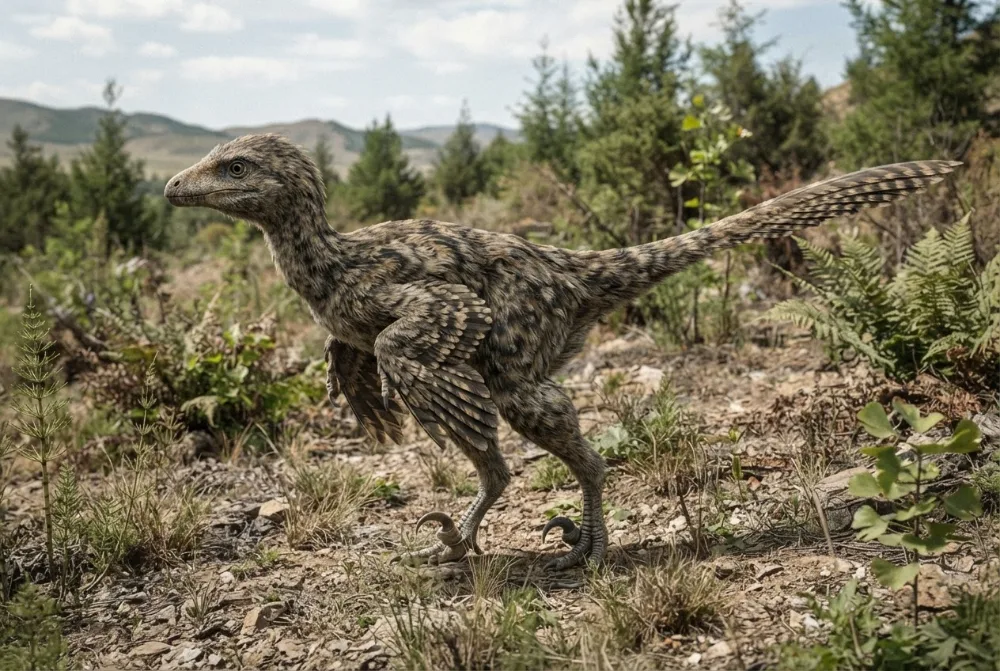
Wulatelong was a bird-like dinosaur with a toothless, parrot-like beak. It lived in the Late Cretaceous period, about 83 to 72 million years ago, in what is now China. It probably used its beak to eat plants and small animals.15
When did it live?
How big was it?
How heavy was it?
How big was Wulatelong compared to YOU?
Just maths in your browser. Nothing is saved or sent anywhere.
Fun facts
Wulatelong had a toothless, parrot-like beak, which is unusual for a theropod dinosaur.1
It is known from a nearly complete skeleton, which is rare for oviraptorid dinosaurs.1
Wulatelong lived alongside famous dinosaurs like Velociraptor and Protoceratops.1
Its name comes from the Wulate area in China, where it was found, and 'long' means dragon in Chinese.1
Ask Rex about Wulatelong
Rex only answers questions about this page. 3 questions a day.
Rex is an AI and can make mistakes. He runs on servers in the EU and questions are never saved. Never type your name or other personal things.
Myth buster
Myth: Some people think Wulatelong was a bird because it had feathers and a beak.
Truth: Wulatelong was a dinosaur, not a bird, even though it was bird-like and related to birds.1
For dino experts
- Scientific name
- Wulatelong
- Named by
- Xu et al. 20135
- Group
- Odd feathered dinos
- Family / clade
- Oviraptoridae5
- Classification
- Theropoda > Oviraptorosauria5
- Age of the rocks
- 84 to 72 million years (Campanian)5
- Rock formations
- Wulansuhai5
- Countries
- China5
- Fossil records
- 1 in the Paleobiology Database5
- Discovery
- The fossils were discovered in 2009 in the Bayan Mandahu area of Inner Mongolia, China. It was named by Xu Xing and colleagues in 2013.12
- Still debated
- Scientists are still debating whether Wulatelong was more closely related to other oviraptorids or to more basal oviraptorosaurs.12
Where the facts come from
- Wulatelong (en.wikipedia.org)
- A new oviraptorid from the Upper Cretaceous of Nei Mongol, China, and its stratigraphic implications (vertpala.ac.cn)
- A New Oviraptorid Dinosaur:<em>Wulatelong gobiensis</em>----Institute of Vertebrate Paleontology and Paleoanthropology, Chinese Academy of Sciences (english.ivpp.cas.cn)
- A new oviraptorid from the Upper Cretaceous of Nei Mongol, China, and its stratigraphic implications (ivpp.cas.cn)
- Wulatelong in The Paleobiology Database (CC BY 4.0): age, places, rock formations, classification.
Every fact on this page has a number that points to its source. If we got something wrong, sorry, we are dino fans, not a science journal. Tell us at [email protected] and we will fix it.
 Rex is hungry! Dino Wiki is a dad's project for his dino-loving son, free with no ads. Grown-ups can feed Rex a snack to help keep it online.Feed Rex
 Therizinosaurus
 Oviraptor
 Chirostenotes
 Citipes
 Leptorhynchos
 Avimimus
 Tyrannosaurus
 Triceratops
 Velociraptor
 Spinosaurus
 Ankylosaurus
 Parasaurolophus