
Xenovenator
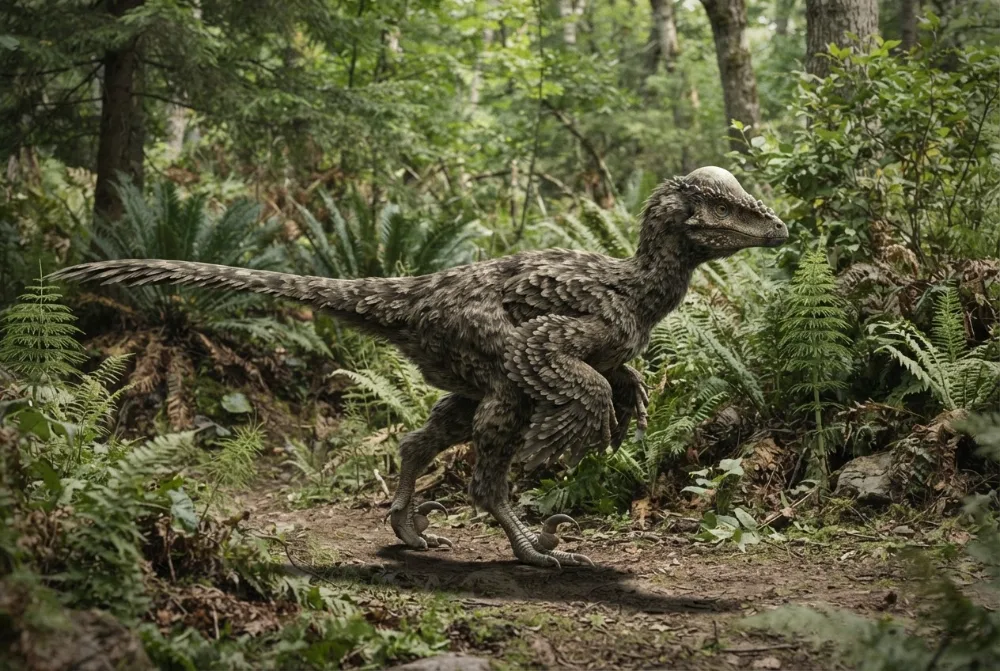
Xenovenator was a small, bird-like dinosaur that lived in North America near the end of the Age of Dinosaurs. It had a thick, bony dome on its skull, which it may have used to head-butt rivals like some sheep do today.1
When did it live?
Fun facts
Xenovenator is a troodontid, a group of smart, bird-like dinosaurs that were close relatives of birds.1
The skull roof of Xenovenator was unusually thick and bumpy, similar to the dome of a pachycephalosaur.1
Scientists think Xenovenator may have head-butted other members of its species, a behavior never before seen in this group of dinosaurs.1
The dome on the skull may have grown larger and more fused as the animal got older.1
Xenovenator lived about 74 to 72 million years ago, during the late Campanian stage of the Late Cretaceous.1
Most asked questions about Xenovenator
?How big was Xenovenator?
About the size of a cassowary, roughly 1.5 metres (4.9 feet) tall.2
?Where was Xenovenator found?
In the Cerro del Pueblo Formation of Coahuila, Mexico.1
?What does the name Xenovenator mean?
It means 'strange hunter' in Greek and Latin.1
?Was Xenovenator a dinosaur?
Yes, it was a small, bird-like theropod dinosaur.1

Ask Rex about Xenovenator
Rex only answers questions about this page. 3 questions a day.
Rex is an AI and can make mistakes. He runs on servers in the EU and questions are never saved. Never type your name or other personal things.
For dino experts
- Scientific name
- Xenovenator
- Named by
- Rivera-Sylva et al. 20263
- Group
- Raptors
- Family / clade
- Troodontidae3
- Classification
- Theropoda > Troodontidae3
- Age of the rocks
- 84 to 72 million years (Campanian)3
- Rock formations
- Kirtland, Cerro del Pueblo3
- Countries
- USA, Mexico3
- Fossil records
- 5 in the Paleobiology Database3
- Discovery
- Xenovenator was named in 2026 by Héctor Rivera-Sylva and colleagues based on skull bones found in the Cerro del Pueblo Formation of Mexico. The first bones were collected in 2000 by Martha Aguillón-Martinez.1
- Still debated
- Scientists are not sure whether the dome was present only in adults or only in one sex, because some specimens lack the dome.1
Where the facts come from
- Xenovenator (en.wikipedia.org)
- You Wouldn’t Want to Butt Heads With This Small Dinosaur - The New York Times (nytimes.com)
- Xenovenator in The Paleobiology Database (CC BY 4.0): age, places, rock formations, classification.
Every fact on this page has a number that points to its source. If we got something wrong, sorry, we are dino fans, not a science journal. Tell us at [email protected] and we will fix it.
Rex is hungry! Dino Wiki is a dad's project for his dino-loving son, free with no ads. Grown-ups can feed Rex a snack to help keep it online.Feed Rex Velociraptor
 Microraptor
 Deinonychus
 Asiamericana
 Richardoestesia
 Saurornitholestes
 Triceratops
 Spinosaurus
 Ankylosaurus
 Parasaurolophus
 Pteranodon