
Yulong
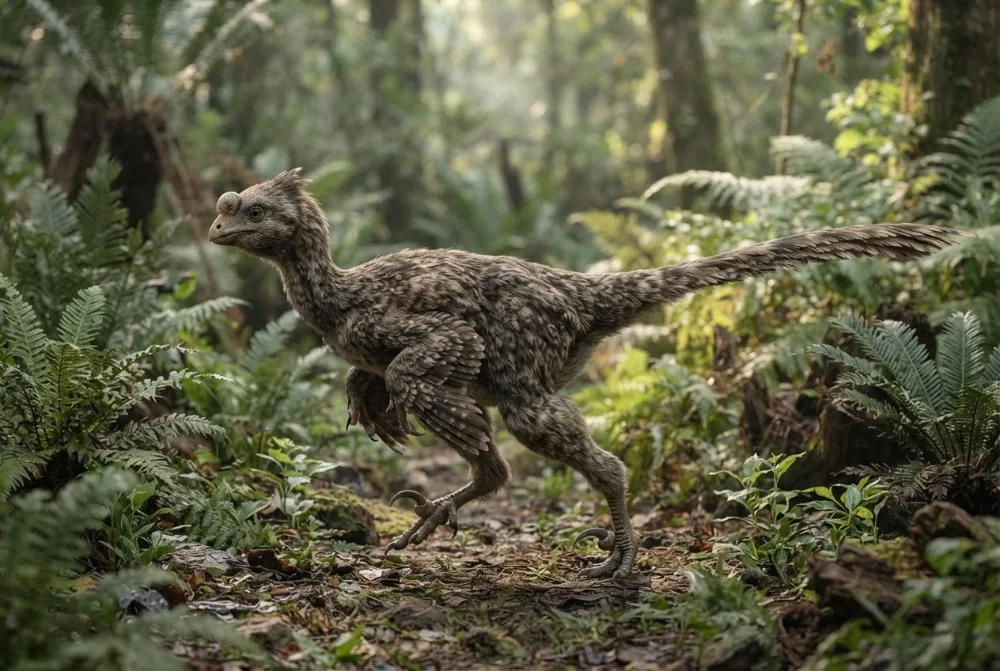
Yulong was a tiny, chicken-sized dinosaur that lived in what is now China. It had a beak and probably ate plants and small animals. Some of the smallest oviraptorid dinosaurs ever found belong to this species.12
When did it live?
How big was it?
How long was it?
How big was Yulong compared to YOU?
Just maths in your browser. Nothing is saved or sent anywhere.
Fun facts
Yulong is known from several juvenile skeletons and even an embryo inside an egg, making it one of the best-known baby oviraptorids.1
The name Yulong comes from 'Yu', the short name for Henan Province, and 'long', meaning dragon in Chinese.1
Most Yulong individuals were only 25 to 50 centimetres long, about the size of a chicken.1
Scientists think Yulong was more advanced than the giant oviraptorid Gigantoraptor, but its exact family tree is still uncertain.1
One nest of 26 eggs was found, and one of the eggs contained a well-preserved Yulong embryo.1
Yulong lived during the very end of the Age of Dinosaurs, about 72 to 66 million years ago.3

Ask Rex about Yulong
Rex only answers questions about this page. 3 questions a day.
Rex is an AI and can make mistakes. He runs on servers in the EU and questions are never saved. Never type your name or other personal things.
For dino experts
- Scientific name
- Yulong
- Named by
- Lü et al. 20133
- Group
- Odd feathered dinos
- Family / clade
- Oviraptoridae3
- Classification
- Theropoda > Oviraptorosauria3
- Age of the rocks
- 72 to 66 million years (Maastrichtian)3
- Rock formations
- Qiupa3
- Countries
- China3
- Fossil records
- 2 in the Paleobiology Database3
- Discovery
- Yulong was named in 2013 by Junchang Lü and colleagues based on five juvenile skeletons found near Qiupa Town in Henan, China.12
- Still debated
- Scientists are not sure exactly where Yulong fits on the oviraptorid family tree, because the known specimens are mostly young and may look more primitive than adults.1
Where the facts come from
- Yulong mini (en.wikipedia.org)
- PaleoCodex :: Yulong (paleocodex.com)
- Yulong in The Paleobiology Database (CC BY 4.0): age, places, rock formations, classification.
Every fact on this page has a number that points to its source. If we got something wrong, sorry, we are dino fans, not a science journal. Tell us at [email protected] and we will fix it.
 Rex is hungry! Dino Wiki is a dad's project for his dino-loving son, free with no ads. Grown-ups can feed Rex a snack to help keep it online.Feed Rex
 Therizinosaurus
 Oviraptor
 Chirostenotes
 Citipes
 Leptorhynchos
 Avimimus
 Tyrannosaurus
 Triceratops
 Velociraptor
 Spinosaurus
 Ankylosaurus
 Parasaurolophus