 Home
 All dinos
 Dino groups
 Explore
 Dinos by country
 Dino vs dino
 How big were they?
 Dinos A to Z
 Who ate what?
 What dino are you? Quiz
 Dino games
 Dino battle
 Dino race
 Dino mini-games
 Sticker album
 Dino TOP lists
 Timeline
 Surprise me!
 Language: English

Zuniceratops
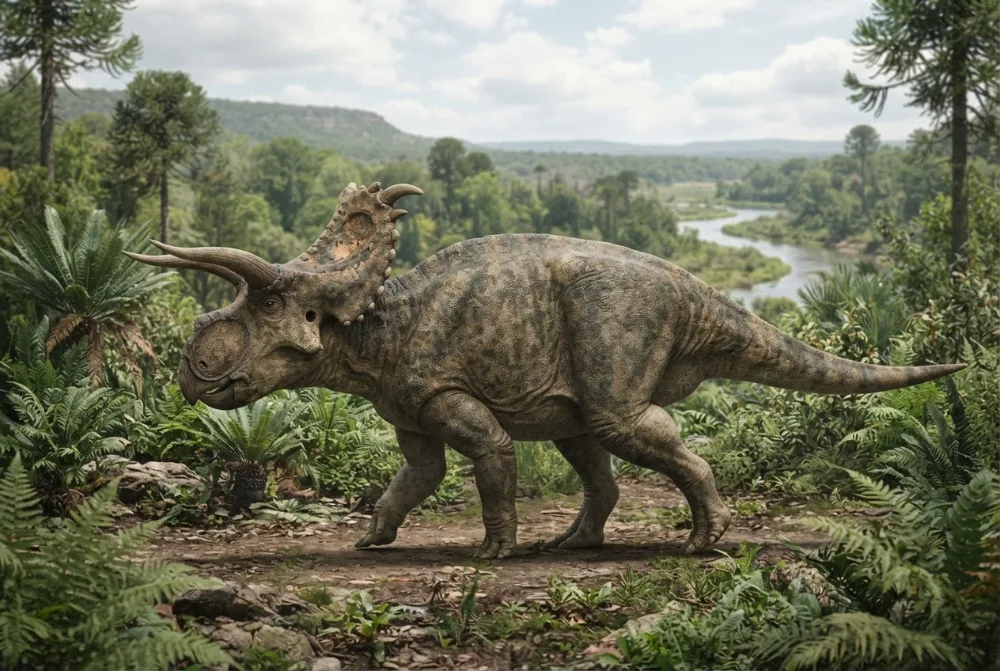
Zuniceratops was a small, plant-eating dinosaur that lived about 90 million years ago. It had a pair of long brow horns and a frill on its head, but no nose horn. It is one of the earliest horned dinosaurs to show how bigger, later horned dinosaurs like Triceratops evolved.1
 USA
When did it live?
Zuniceratops: 94 to 90 million years ago
How big was it?
How long was it?
How tall was it?
at the hips
How heavy was it?
 as long as 4 dogs nose to tail🍌as long as 19 bananas end to end🍉as heavy as 35 watermelons🧸as heavy as 9 kindergarten kids🎒as heavy as 5 school kids🏃could run 100 metres in 9.7 seconds (the fastest human needs 9.6)
How big was Zuniceratops compared to YOU?
Just maths in your browser. Nothing is saved or sent anywhere.
How fast was it?


Fun facts
Zuniceratops was discovered in 1996 by eight-year-old Christopher James Wolfe, the son of a paleontologist, while exploring in New Mexico.1
Young Zuniceratops had single-rooted teeth, but as they grew older their teeth became double-rooted. This change with age is unusual among horned dinosaurs.1
Zuniceratops lived alongside other dinosaurs like the tyrannosaur Suskityrannus, the big-clawed Nothronychus, and the plant-eating ornithopod Jeyawati.12
Fossils of several Zuniceratops individuals have been found together in a bonebed, suggesting they may have lived in groups.1
Zuniceratops had no nose horn, but it had well-developed brow horns that look like those of later, bigger horned dinosaurs.1
Zuniceratops is an important piece of evidence that horned dinosaurs may have evolved in North America, not Asia.1
Most asked questions about Zuniceratops
?How big was Zuniceratops?
Zuniceratops was about 2.2 to 3.5 meters (7.2 to 11.5 ft) long, 1 meter (3.3 ft) tall at the hips, and weighed around 175 kilograms (386 lb).1
?What did Zuniceratops eat?
Zuniceratops was a plant-eater (herbivore).3
?When did Zuniceratops live?
Zuniceratops lived during the Late Cretaceous period, about 90.9 to 88.6 million years ago.1
?Who discovered Zuniceratops?
Zuniceratops was discovered in 1996 by eight-year-old Christopher James Wolfe, son of paleontologist Douglas G. Wolfe.1
?Did Zuniceratops have horns?
Yes, Zuniceratops had a pair of well-developed brow horns, but it had no nose horn.1
?Is Zuniceratops a dinosaur?
Yes, Zuniceratops is a dinosaur. It is a ceratopsian, a group of horned, plant-eating dinosaurs.1
For dino experts
- Scientific name
- Zuniceratops
- Named by
- Wolfe and Kirkland 19984
- Group
- Horned dinos
- Family / clade
- Ceratopsoidea4
- Classification
- Ornithischia > Ceratopsia4
- Age of the rocks
- 94 to 90 million years (Turonian)4
- Rock formations
- Moreno Hill4
- Countries
- USA4
- Fossil records
- 3 in the Paleobiology Database4
- Discovery
- Zuniceratops was named in 1998 by paleontologists Douglas Wolfe and James Kirkland. The first fossils, including a skull and bones from several individuals, were found in the Moreno Hill Formation in New Mexico in 1996. The species name, christopheri, honors the discoverer, Christopher James Wolfe.14
- Still debated
- Scientists are still debating exactly how Zuniceratops is related to the later, larger horned dinosaurs called ceratopsids.1
Where the facts come from
- Zuniceratops (en.wikipedia.org)
- en.wikipedia.org Jeyawati (en.wikipedia.org)
- Ceratopsia (en.wikipedia.org)
- Zuniceratops in The Paleobiology Database (CC BY 4.0): age, places, rock formations, classification.
Every fact on this page has a number that points to its source. If we got something wrong, sorry, we are dino fans, not a science journal. Tell us at hello@dinowiki.app and we will fix it.
 Rex is hungry! Dino Wiki is a dad's project for his dino-loving son, free with no ads and no cookies. Grown-ups can feed Rex a snack to help keep it online.Feed Rex
 Triceratops
 Protoceratops
 Ojoceratops
 Tatankaceratops
 Psittacosaurus
 Centrosaurus
 Tyrannosaurus
 Velociraptor
 Spinosaurus
 Ankylosaurus
 Parasaurolophus
 Pteranodon