 Kwizi: Oli dayinoso ki?
 Olutalo lwa dayinoso
 Empaka z'emisinde gya dayinoso
 Emizannyo emitono egya dayinoso
 Alubaamu ya sitika
 Enkalala za dayinoso eza TOP
 Mpa ekyewuunyisa!
Alanqa
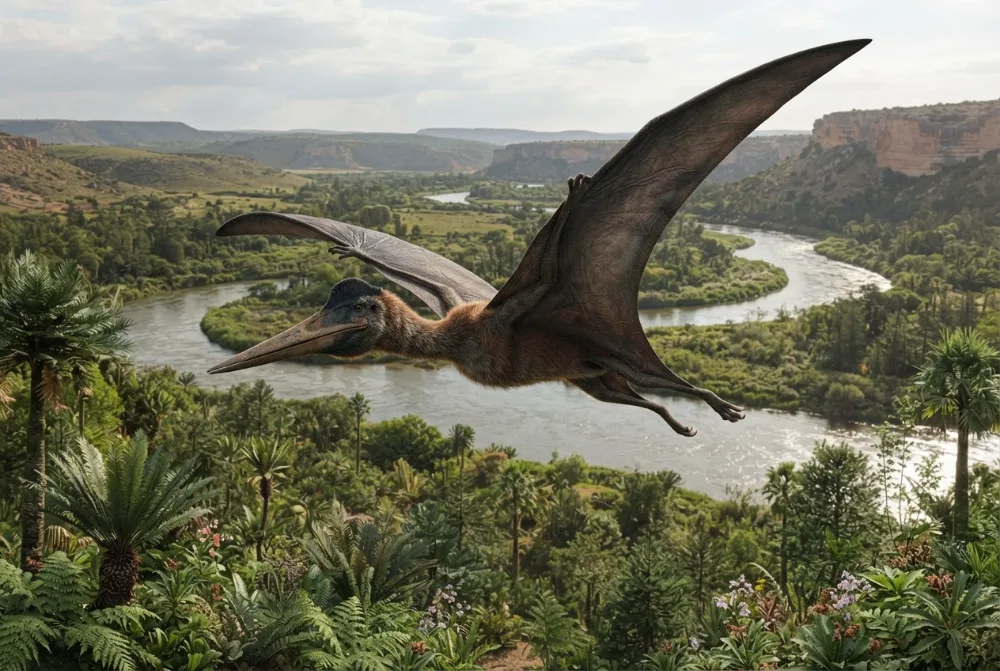
Alanqa was a giant flying reptile that soared over ancient rivers in what is now Morocco. It had a long, straight, pointed beak with no teeth, perfect for scooping up fish and other small animals.2
Yabeerawo ddi?
Yali munene atya?
Ebiwaawaatiro bye byali bigazi kwenkana wa?
Yali muzito kwenkana wa?

 ebiwaawaatiro bigazi ng'obugaali 3 mu lunyiriri🍉obuzito ng'obwa wotamerooni 7⚽yandibuuse okusomoka ekisaawe ky'omupiira kyonna mu sikonda 5.1
Alanqa yali munene atya bw'ogeraageranya ku GGWE?
Kubala kwokka mu browser yo. Tewali kiterekebwa wadde okusindikibwa wonna.
Yali wa mbiro kwenkana wa?


Ebyewuunyisa
Alanqa is known from only five jaw fragments and possibly one neck vertebra, so scientists have not found a full skeleton yet.1
Its beak was straight and pointed, like a spear, and it had a raised bump on the top of its lower jaw near the back.2
The largest Alanqa individuals may have had a wingspan as wide as a small airplane, about 6 meters (20 feet).21
Alanqa lived alongside huge meat-eating dinosaurs like Spinosaurus and Carcharodontosaurus, which might have hunted it.1
The Kem Kem Beds where Alanqa was found were once a freshwater delta, full of rivers and swamps.1
Two of the jaw fragments were first described in 1999 but were not named until 2010, when scientists realized they belonged to a new species.1
Ebibuuzo ebisinga okubuuzibwa ku Alanqa
?How big was Alanqa?
Most Alanqa individuals had a wingspan of about 4 meters (13 feet), but a larger neck vertebra suggests some reached 6 meters (20 feet). An individual of that size would have weighed 16 to 37 kilograms (35 to 82 pounds).1
?What did Alanqa eat?
Alanqa probably ate small animals like crustaceans, mollusks, amphibians, small reptiles, and even small or juvenile dinosaurs. Grooves in its jaw suggest it also crushed hard foods like mollusks and seeds.1
?Is Alanqa a dinosaur?
No, Alanqa is a pterosaur, a flying reptile that is not a dinosaur.1
?Where was Alanqa found?
Alanqa was found in the Kem Kem Group of southeastern Morocco, in a place called Aferdou N'Chaft near the village of Begaa.1
?When did Alanqa live?
Alanqa lived during the Late Cretaceous period, specifically the Cenomanian stage, about 100 to 93 million years ago.1
?Did Alanqa have teeth?
No, Alanqa had no teeth. Its jaws were straight and pointed, like a spear, perfect for scooping up food.1
Eri abakugu mu dayinoso
- Erinnya lya ssaayansi
- Alanqa
- Yatuumibwa
- Ibrahim et al. 20104
- Ekibinja
- Ebyewalula ebibuuka
- Ekika / ekibinja
- Azhdarchidae4
- Engabanya
- Pterosauria > Pterodactyloidea > Azhdarchidae4
- Emyaka gy'enjazi
- emyaka obukadde 100 okutuuka ku 94 (Cenomanian)4
- Ensengeka z'enjazi
- Ifezouane4
- Ensi
- Moroko4
- Ebisigalira ebyazuulibwa
- 4 mu The Paleobiology Database4
- Okuzuulibwa
- Alanqa was named in 2010 by Ibrahim and colleagues based on a nearly complete lower jaw found at Aferdou N'Chaft, Morocco, in 2008.21
- Kikyakubaganyizibwako ebirowoozo
- Scientists are not sure if the large neck vertebra really belongs to Alanqa or to a different, even bigger pterosaur.21
Ebituufu gye biva
- Alanqa (en.wikipedia.org)
- A New Pterosaur (Pterodactyloidea: Azhdarchidae) from the Upper Cretaceous of Morocco - PMC (pmc.ncbi.nlm.nih.gov)
- PBDB Taxon (paleobiodb.org)
- Alanqa in The Paleobiology Database (CC BY 4.0): emyaka, ebifo, ensengeka z'enjazi, engabanya.
Buli kituufu ku lupapula luno kirina ennamba eraga ensibuko yaakyo. Bwe tuba nga tukoze ensobi, tusonyiwe, ffe tuli bawagizi ba dayinoso, so si magazini ya ssaayansi. Tubuulire ku [email protected] tujja kugitereeza.
 Rex alumwa enjala! Dino Wiki pulojekiti ya taata eri mutabani we ayagala ennyo dayinoso, ya bwereere, tewali bulango era tewali bikulondoola. Abakulu basobola okuwa Rex akantu ak'okulya okuyamba okugikuuma ku mutimbagano.Liisa Rex
 Pteranodon
 Quetzalcoatlus
 Dorygnathus
 Rhamphorhynchus
 Anhanguera
 Pterodactylus
 Tyrannosaurus
 Triceratops
 Velociraptor
 Spinosaurus
 Ankylosaurus
 Parasaurolophus