 Kwizi: Oli dayinoso ki?
 Olutalo lwa dayinoso
 Empaka z'emisinde gya dayinoso
 Emizannyo emitono egya dayinoso
 Alubaamu ya sitika
 Enkalala za dayinoso eza TOP
 Mpa ekyewuunyisa!
Anurognathus
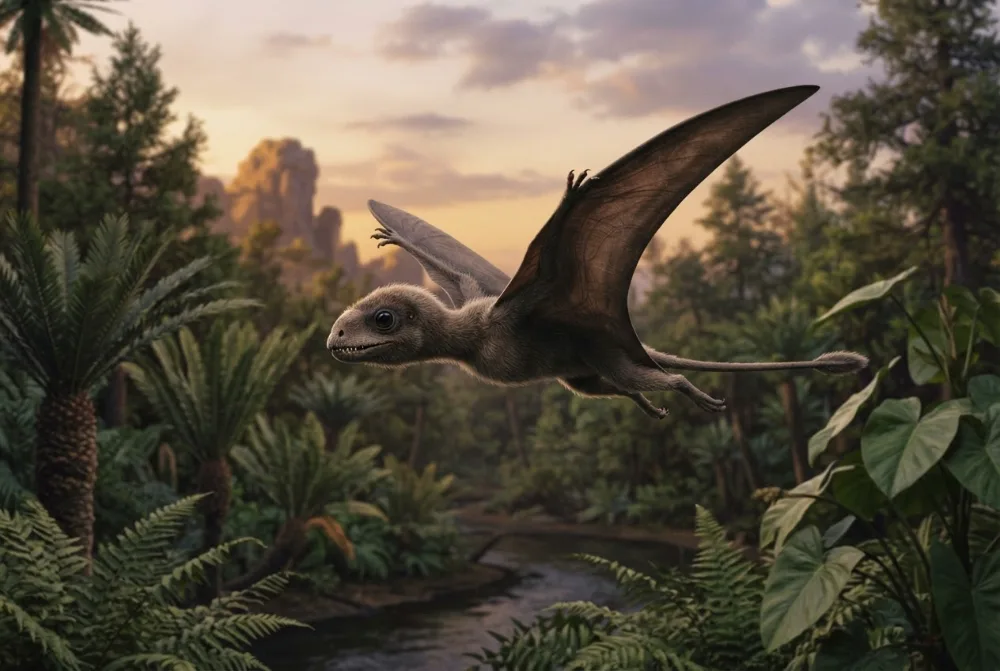
Anurognathus was a tiny pterosaur that lived in the Late Jurassic. It had a very short, wide head and big eyes, like a little flying frog. It probably hunted insects at dusk.12
Yabeerawo ddi?
Yali munene atya?
Yali muwanvu kwenkana wa?
Yali muzito kwenkana wa?
Anurognathus yali munene atya bw'ogeraageranya ku GGWE?
Kubala kwokka mu browser yo. Tewali kiterekebwa wadde okusindikibwa wonna.
Yali wa mbiro kwenkana wa?


Ebyewuunyisa
Anurognathus had a very short tail, unlike most early pterosaurs. This made it more maneuverable when hunting insects.1
Its skull was wider than it was long, and its eyes were huge. This helped it see well in dim light.12
Anurognathus weighed only about 40 grams (1.4 ounces), as light as a small bird.1
Scientists think Anurognathus had bristles around its mouth, like a fringe, to help catch insects.12
Only two fossils of Anurognathus have been found, both in Germany. One is a juvenile.1
Ebibuuzo ebisinga okubuuzibwa ku Anurognathus
?How big was Anurognathus?
Anurognathus was tiny, with a wingspan of about 35 cm (14 in) and a weight of only 40 grams (1.4 oz), as light as a small bird.1
?What did Anurognathus eat?
It ate insects. Its pin-like teeth and small mouth were perfect for catching tiny bugs about 11 mm long.1
?Could Anurognathus fly?
Yes, it was a pterosaur and could fly. It had short, broad wings and probably flew slowly and maneuvered well to catch insects at dusk.1
?Did Anurognathus have feathers?
No, it did not have feathers. It had a fuzzy coat of hair-like fibers called pycnofibers, and possibly bristles around its mouth.1
?When did Anurognathus live?
Anurognathus lived during the Late Jurassic period, about 150 to 148 million years ago.1
?Why did Anurognathus have big eyes?
Its huge eyes helped it see well in dim light, so it could hunt insects at dusk or in the dark.1
?Is Anurognathus a dinosaur?
No, Anurognathus is a pterosaur, a flying reptile that is not a dinosaur.1
?How many fossils of Anurognathus have been found?
Only two fossils have been found, both in Germany. One is a juvenile, and the other is a subadult.1
Omumenyi w'enfumo
Enfumo: Some people think Anurognathus was a dinosaur.
Amazima: Anurognathus was a pterosaur, a flying reptile that is not a dinosaur.4
Eri abakugu mu dayinoso
- Erinnya lya ssaayansi
- Anurognathus
- Yatuumibwa
- Döderlein 19234
- Ekibinja
- Ebyewalula ebibuuka
- Ekika / ekibinja
- Anurognathidae4
- Engabanya
- Pterosauria4
- Emyaka gy'enjazi
- emyaka obukadde 149 okutuuka ku 145 (Tithonian)4
- Ensengeka z'enjazi
- Solnhofener Plattenkalk4
- Ensi
- Bugirimaani4
- Ebisigalira ebyazuulibwa
- 1 mu The Paleobiology Database4
- Okuzuulibwa
- Anurognathus was named by Ludwig Döderlein in 1923. He bought the first fossil from a collector in 1922. It was found in the Solnhofen limestone of Germany.1
- Kikyakubaganyizibwako ebirowoozo
- Scientists still debate whether Anurognathus was a fast flyer that surprised its prey, or a slow, maneuverable hunter like a nightjar.1
Ebituufu gye biva
- Anurognathus (en.wikipedia.org)
- A second specimen of the pterosaurAnurognathus ammoni | PalZ | Springer Nature Link (link.springer.com)
- PaleoCodex :: Anurognathus (paleocodex.com)
- Anurognathus in The Paleobiology Database (CC BY 4.0): emyaka, ebifo, ensengeka z'enjazi, engabanya.
Buli kituufu ku lupapula luno kirina ennamba eraga ensibuko yaakyo. Bwe tuba nga tukoze ensobi, tusonyiwe, ffe tuli bawagizi ba dayinoso, so si magazini ya ssaayansi. Tubuulire ku [email protected] tujja kugitereeza.
 Rex alumwa enjala! Dino Wiki pulojekiti ya taata eri mutabani we ayagala ennyo dayinoso, ya bwereere, tewali bulango era tewali bikulondoola. Abakulu basobola okuwa Rex akantu ak'okulya okuyamba okugikuuma ku mutimbagano.Liisa Rex
 Pteranodon
 Quetzalcoatlus
 Dorygnathus
 Rhamphorhynchus
 Anhanguera
 Pterodactylus
 Brachiosaurus
 Diplodocus
 Allosaurus
 Brontosaurus
 Compsognathus
 Camarasaurus