 Kwizi: Oli dayinoso ki?
 Olutalo lwa dayinoso
 Empaka z'emisinde gya dayinoso
 Emizannyo emitono egya dayinoso
 Alubaamu ya sitika
 Enkalala za dayinoso eza TOP
 Mpa ekyewuunyisa!
Yabeerawo ddi?

Yali munene atya?
Yali muwanvu kwenkana wa?
Yali mugulumivu kwenkana wa?
kuteebereza
Yali muzito kwenkana wa?

 obuwanvu ng'embwa 6, ennyindo ku mukira🍌obuwanvu ng'amenvu 36 nga gaddiriŋŋana
 obuzito ng'obw'enjovu🍉obuzito ng'obwa wotamerooni 1000🎒obuzito ng'obw'ebibiina 6 ebijjuvu eby'abaana b'essomero🐻❄️obuzito ng'obwa ddubu enjeru 11🏃yandidduse mita 100 mu sikonda 28 (omuntu asinga embiro yeetaaga 9.6)
Hesperosaurus yali munene atya bw'ogeraageranya ku GGWE?
Kubala kwokka mu browser yo. Tewali kiterekebwa wadde okusindikibwa wonna.
Yali wa mbiro kwenkana wa?


Ebyewuunyisa
Hesperosaurus is known from a nearly complete skeleton and skull, which is rare for stegosaurs.3
One fossil preserves the first known impression of the horn sheath on a stegosaur back plate.1
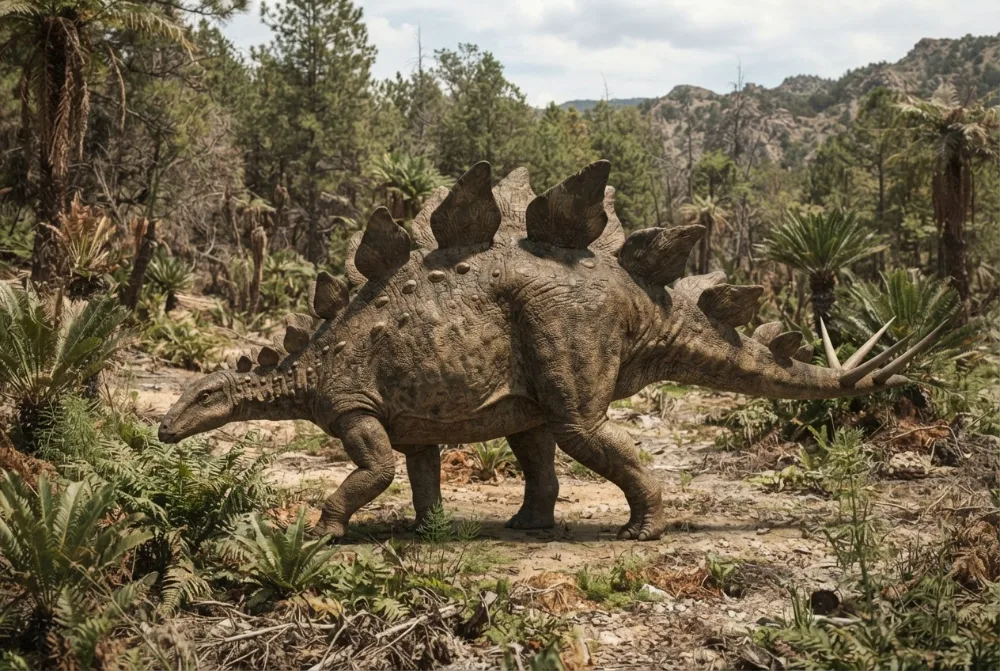
Its back plates were longer and lower than those of its close relative Stegosaurus.1
Hesperosaurus lived a little earlier than other stegosaurs from the Morrison Formation.1
The tail spikes, called a thagomizer, had two pairs: the front pair thicker and the rear pair thinner and more horizontal.1
Scientists have debated whether Hesperosaurus should be its own genus or a species of Stegosaurus.1
Ebibuuzo ebisinga okubuuzibwa ku Hesperosaurus
?How big was Hesperosaurus?
Hesperosaurus was a large stegosaur, reaching about 6.5 metres (21 feet) in length and weighing around 3.5 metric tons (3.9 short tons). Some large individuals may have reached 5 metric tons (5.5 short tons).1
?What did Hesperosaurus eat?
Hesperosaurus was a herbivore, meaning it ate plants. It was a quadrupedal plant-eater, like other stegosaurs.13
?When did Hesperosaurus live?
Hesperosaurus lived during the Late Jurassic period, about 156 million years ago. It lived a little earlier than other stegosaurs from the Morrison Formation.13
?Where was Hesperosaurus found?
Fossils of Hesperosaurus have been found in the states of Wyoming and Montana in the United States of America. They were first discovered in 1985.1
?Did Hesperosaurus have plates or spikes?
Hesperosaurus had two rows of bony plates on its back and four spikes on its tail. The tail spikes, called a thagomizer, had two pairs: the front pair thicker and the rear pair thinner and more horizontal.1
Eri abakugu mu dayinoso
- Erinnya lya ssaayansi
- Hesperosaurus
- Yatuumibwa
- Carpenter et al. 20014
- Ekibinja
- Dayinoso ez'ebipande
- Ekika / ekibinja
- Stegosauridae4
- Engabanya
- Ornithischia > Stegosauria > Thyreophora4
- Emyaka gy'enjazi
- emyaka obukadde 158 okutuuka ku 143 ()4
- Ensengeka z'enjazi
- Morrison4
- Ensi
- Amerika4
- Ebisigalira ebyazuulibwa
- 8 mu The Paleobiology Database4
- Okuzuulibwa
- Hesperosaurus was named in 2001 by Kenneth Carpenter, Clifford Miles, and Karen Cloward. The first fossils were found in 1985 on a ranch in Johnson County, Wyoming, USA.1
- Kikyakubaganyizibwako ebirowoozo
- Scientists still debate whether Hesperosaurus is a separate genus from Stegosaurus or just a species of Stegosaurus.1
Ebituufu gye biva
- Hesperosaurus (en.wikipedia.org)
- PBDB Taxon (paleobiodb.org)
- Hesperosaurus | Natural History Museum (nhm.ac.uk)
- Hesperosaurus in The Paleobiology Database (CC BY 4.0): emyaka, ebifo, ensengeka z'enjazi, engabanya.
Buli kituufu ku lupapula luno kirina ennamba eraga ensibuko yaakyo. Bwe tuba nga tukoze ensobi, tusonyiwe, ffe tuli bawagizi ba dayinoso, so si magazini ya ssaayansi. Tubuulire ku [email protected] tujja kugitereeza.
 Rex alumwa enjala! Dino Wiki pulojekiti ya taata eri mutabani we ayagala ennyo dayinoso, ya bwereere, tewali bulango era tewali bikulondoola. Abakulu basobola okuwa Rex akantu ak'okulya okuyamba okugikuuma ku mutimbagano.Liisa Rex
 Stegosaurus
 Diracodon
 Hypsirophus
 Dacentrurus
 Miragaia
 Kentrosaurus
 Brachiosaurus
 Diplodocus
 Allosaurus
 Brontosaurus
 Compsognathus
 Camarasaurus