 Kwizi: Oli dayinoso ki?
 Olutalo lwa dayinoso
 Empaka z'emisinde gya dayinoso
 Emizannyo emitono egya dayinoso
 Alubaamu ya sitika
 Enkalala za dayinoso eza TOP
 Mpa ekyewuunyisa!
Kunpengopterus
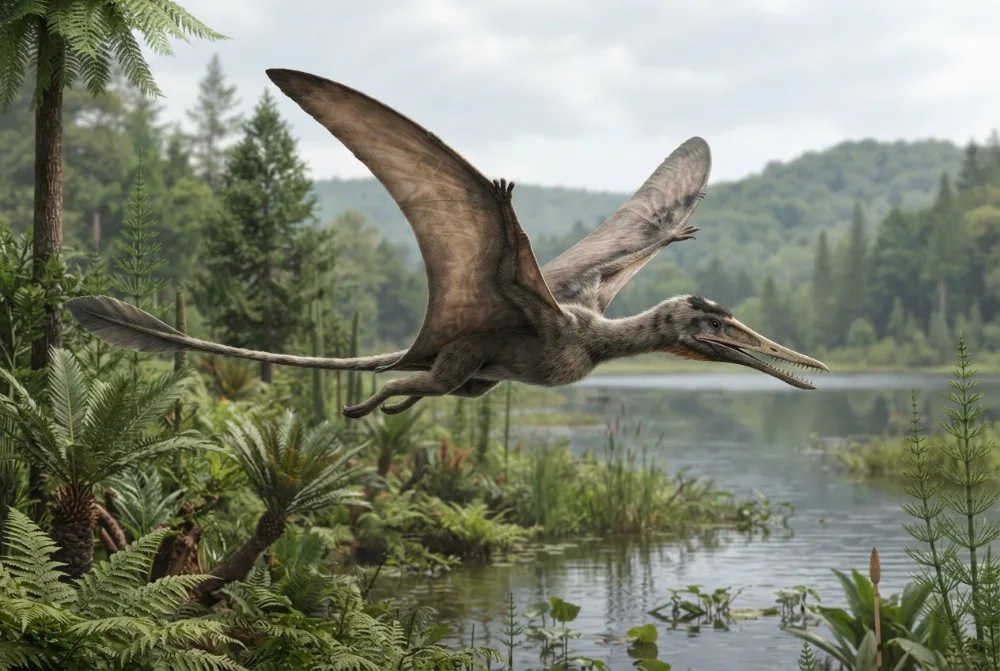
Kunpengopterus was a flying reptile that lived in what is now China during the Jurassic Period. It had a long tail and a head like a bird, and it ate fish.23
Yabeerawo ddi?
Yali munene atya?
Yali muzito kwenkana wa?
Kunpengopterus yali munene atya bw'ogeraageranya ku GGWE?
Kubala kwokka mu browser yo. Tewali kiterekebwa wadde okusindikibwa wonna.
Yali wa mbiro kwenkana wa?


Ebyewuunyisa
Kunpengopterus sinensis is known from two nearly complete skeletons, one adult and one juvenile, found with fossilized vomit pellets nearby.3
The vomit pellets contain scales of palaeonisciform fish, proving that Kunpengopterus ate fish and could vomit indigestible parts.3
Both the adult and juvenile Kunpengopterus had similar teeth and could fly soon after hatching, like some other pterosaurs.3
The name Kunpengopterus comes from Chinese mythology: the Kun was a giant fish that could turn into the Peng, a huge bird.1
Kunpengopterus lived between about 168 and 152 million years ago, during the Late Jurassic Period.2
The type specimen of Kunpengopterus sinensis is an almost complete skeleton with a full skull and lower jaws.1
Ebibuuzo ebisinga okubuuzibwa ku Kunpengopterus
?How big was Kunpengopterus?
Its head was about 10.7 centimetres (4.2 inches) long. The whole body was small, like a modern bird.1
?Did Kunpengopterus have feathers?
No, it did not have feathers. It had pycnofibers, which are thin, hair-like fibers, on its body.4
?What did Kunpengopterus eat?
It ate fish, especially palaeonisciform fish. Scientists know this because fossilized vomit pellets containing fish scales were found with its skeletons.5
?Could Kunpengopterus fly?
Yes, it could fly. Even young Kunpengopterus could fly soon after hatching, just like adults.5
Eri abakugu mu dayinoso
- Erinnya lya ssaayansi
- Kunpengopterus
- Yatuumibwa
- Wang et al. 20106
- Ekibinja
- Ebyewalula ebibuuka
- Ekika / ekibinja
- Wukongopteridae6
- Engabanya
- Pterosauria6
- Emyaka gy'enjazi
- emyaka obukadde 168 okutuuka ku 152 (Bathonian / Kimmeridgian)6
- Ensengeka z'enjazi
- Tiaojishan6
- Ensi
- Cayina6
- Ebisigalira ebyazuulibwa
- 2 mu The Paleobiology Database6
- Okuzuulibwa
- Kunpengopterus sinensis was named by Wang Xiaolin and colleagues in 2010, based on a fossil found in the Tiaojishan Formation of Liaoning, China.12
- Kikyakubaganyizibwako ebirowoozo
- Scientists are not sure about the exact age of the rocks that contain Kunpengopterus fossils, which may be from the Middle or Late Jurassic.1
Ebituufu gye biva
- Kunpengopterus (en.wikipedia.org)
- PBDB Taxon (paleobiodb.org)
- Two emetolite-pterosaur associations from the Late Jurassic of China: showing the first evidence for antiperistalsis in (royalsocietypublishing.org)
- New long-tailed pterosaurs (Wukongopteridae) from western Liaoning, China (dinodata.de)
- Two emetolite-pterosaur associations from the Late Jurassic of China: showing the first evidence for antiperistalsis in pterosaurs (pmc.ncbi.nlm.nih.gov)
- Kunpengopterus in The Paleobiology Database (CC BY 4.0): emyaka, ebifo, ensengeka z'enjazi, engabanya.
Buli kituufu ku lupapula luno kirina ennamba eraga ensibuko yaakyo. Bwe tuba nga tukoze ensobi, tusonyiwe, ffe tuli bawagizi ba dayinoso, so si magazini ya ssaayansi. Tubuulire ku [email protected] tujja kugitereeza.
 Rex alumwa enjala! Dino Wiki pulojekiti ya taata eri mutabani we ayagala ennyo dayinoso, ya bwereere, tewali bulango era tewali bikulondoola. Abakulu basobola okuwa Rex akantu ak'okulya okuyamba okugikuuma ku mutimbagano.Liisa Rex
 Pteranodon
 Quetzalcoatlus
 Dorygnathus
 Rhamphorhynchus
 Anhanguera
 Pterodactylus
 Brachiosaurus
 Diplodocus
 Allosaurus
 Brontosaurus
 Compsognathus
 Camarasaurus