 Kwizi: Oli dayinoso ki?
 Olutalo lwa dayinoso
 Empaka z'emisinde gya dayinoso
 Emizannyo emitono egya dayinoso
 Alubaamu ya sitika
 Enkalala za dayinoso eza TOP
 Mpa ekyewuunyisa!
Sinomacrops
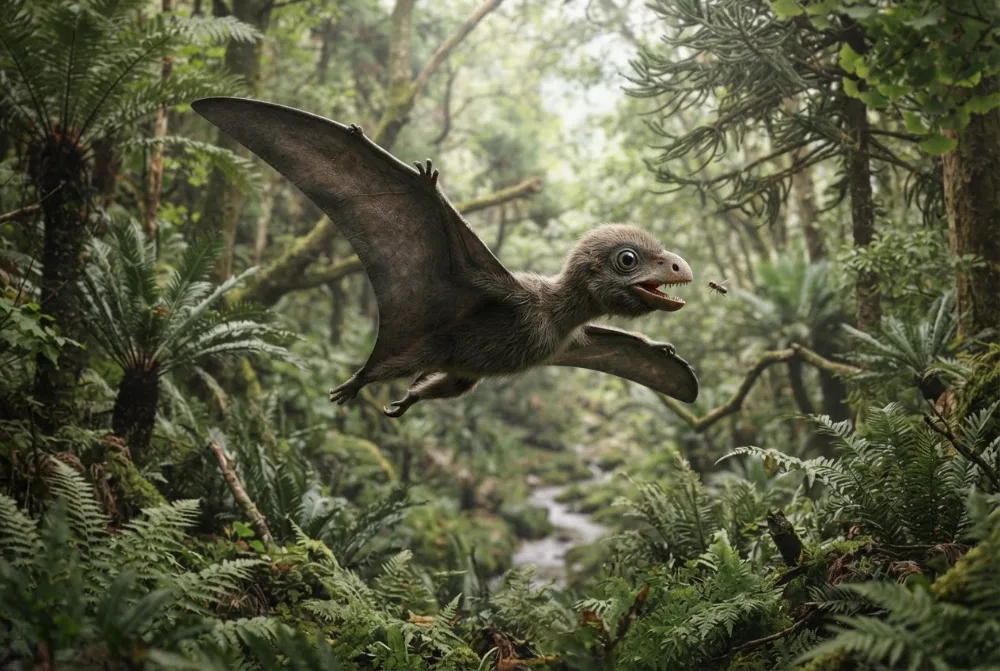
Sinomacrops was a tiny flying reptile that lived about 160 million years ago. It had huge eyes and a short, rounded snout, and it probably fluttered between trees catching insects.1
Yabeerawo ddi?
Yali munene atya?
Yali muwanvu kwenkana wa?
Sinomacrops yali munene atya bw'ogeraageranya ku GGWE?
Kubala kwokka mu browser yo. Tewali kiterekebwa wadde okusindikibwa wonna.
Yali wa mbiro kwenkana wa?


Ebyewuunyisa
Sinomacrops is known from a single crushed skeleton, but it is the first anurognathid skull seen from the side.1
Its lower leg bone, the tibiotarsus, was twice as long as its thigh bone, which is unusual.1
It had three closely spaced teeth in the front of its upper jaw, a feature unique to this species.1
Sinomacrops is the second anurognathid pterosaur found in the Tiaojishan Formation in China.1
Its closest relative is Batrachognathus, and together they form a group called Batrachognathinae.1
The fossil was found in rocks that are between 165 and 155 million years old, from the Middle to Late Jurassic.3
Ebibuuzo ebisinga okubuuzibwa ku Sinomacrops
?Was Sinomacrops a dinosaur?
No, Sinomacrops was a pterosaur, a flying reptile that lived at the same time as dinosaurs, but it was not a dinosaur itself.2
?How big was Sinomacrops?
It was tiny, but the exact size is not known because only one crushed skeleton has been found. It was small enough to flutter between trees.2
?What did Sinomacrops eat?
It probably ate insects. Its short snout and teeth suggest it caught bugs while flying, like other anurognathid pterosaurs.1
?When did Sinomacrops live?
It lived about 164 to 158 million years ago, during the Middle to Late Jurassic period.2
Omumenyi w'enfumo
Enfumo: Some people think Sinomacrops was a dinosaur because it lived with dinosaurs.
Amazima: Sinomacrops was a pterosaur, a flying reptile, not a dinosaur.1
Eri abakugu mu dayinoso
- Erinnya lya ssaayansi
- Sinomacrops
- Yatuumibwa
- Wei et al. 20213
- Ekibinja
- Ebyewalula ebibuuka
- Ekika / ekibinja
- Anurognathidae3
- Engabanya
- Pterosauria3
- Emyaka gy'enjazi
- emyaka obukadde 165 okutuuka ku 155 (Callovian / Oxfordian)3
- Ensengeka z'enjazi
- Tiaojishan3
- Ensi
- Cayina3
- Ebisigalira ebyazuulibwa
- 1 mu The Paleobiology Database3
- Okuzuulibwa
- Scientists named Sinomacrops in 2021 after studying a fossil found at Mutoudeng in China. The species name bondei honors paleontologist Niels Bonde.1
- Kikyakubaganyizibwako ebirowoozo
- Scientists still debate exactly where anurognathids like Sinomacrops fit in the pterosaur family tree, and whether they lived mostly in trees.1
Ebituufu gye biva
- Sinomacrops bondei , a new anurognathid pterosaur from the Jurassic of China and comments on the group (pmc.ncbi.nlm.nih.gov)
- Sinomacrops (en.wikipedia.org)
- Sinomacrops in The Paleobiology Database (CC BY 4.0): emyaka, ebifo, ensengeka z'enjazi, engabanya.
Buli kituufu ku lupapula luno kirina ennamba eraga ensibuko yaakyo. Bwe tuba nga tukoze ensobi, tusonyiwe, ffe tuli bawagizi ba dayinoso, so si magazini ya ssaayansi. Tubuulire ku [email protected] tujja kugitereeza.
 Rex alumwa enjala! Dino Wiki pulojekiti ya taata eri mutabani we ayagala ennyo dayinoso, ya bwereere, tewali bulango era tewali bikulondoola. Abakulu basobola okuwa Rex akantu ak'okulya okuyamba okugikuuma ku mutimbagano.Liisa Rex
 Pteranodon
 Quetzalcoatlus
 Dorygnathus
 Rhamphorhynchus
 Anhanguera
 Pterodactylus
 Brachiosaurus
 Diplodocus
 Allosaurus
 Brontosaurus
 Compsognathus
 Camarasaurus