 Kwizi: Oli dayinoso ki?
 Olutalo lwa dayinoso
 Empaka z'emisinde gya dayinoso
 Emizannyo emitono egya dayinoso
 Alubaamu ya sitika
 Enkalala za dayinoso eza TOP
 Mpa ekyewuunyisa!
Yabeerawo ddi?

Yali munene atya?
Yali muwanvu kwenkana wa?
Yali mugulumivu kwenkana wa?
Yali muzito kwenkana wa?

 obuwanvu ng'embwa 7, ennyindo ku mukira🍌obuwanvu ng'amenvu 39 nga gaddiriŋŋanaobuzito ng'obw'embwa 140🍉obuzito ng'obwa wotamerooni 560🎒obuzito ng'obw'ebibiina 4 ebijjuvu eby'abaana b'essomero🐻❄️obuzito ng'obwa ddubu enjeru 6🏃yandidduse mita 100 mu sikonda 21 (omuntu asinga embiro yeetaaga 9.6)
Tuojiangosaurus yali munene atya bw'ogeraageranya ku GGWE?
Kubala kwokka mu browser yo. Tewali kiterekebwa wadde okusindikibwa wonna.
Yali wa mbiro kwenkana wa?


Ebyewuunyisa
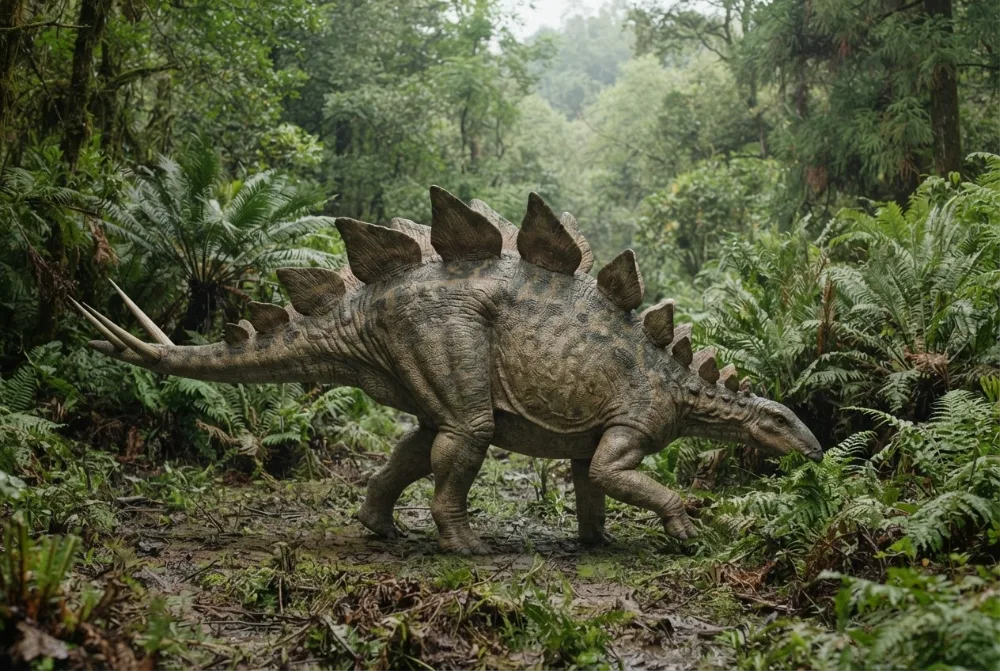
Tuojiangosaurus had about 17 pairs of plates and spikes along its back and tail.2
The spikes at the end of its tail pointed outward at about 45 degrees and are called a 'thagomizer'.2
Unlike Stegosaurus, the plates on Tuojiangosaurus were parallel to each other, not alternating.2
Its front legs were quite short compared to its back legs.2
Tuojiangosaurus lived during the Late Jurassic, about 157 to 154 million years ago.1
The first fossil was found in 1974 during construction of a dam in Zigong, Sichuan.2
Ebibuuzo ebisinga okubuuzibwa ku Tuojiangosaurus
?How big was Tuojiangosaurus?
It was about 6.5 to 7 metres long (21 to 23 feet) and weighed around 2.8 metric tons (3.1 short tons).2
?What did Tuojiangosaurus eat?
It ate low-lying plants like ferns, horsetails, and cycads. It had small snipping teeth and a beaked mouth for plucking vegetation.21
?Did Tuojiangosaurus have a thagomizer?
Yes, it had at least two spikes on each side of its tail tip, pointing outward at about 45 degrees. This spike cluster is called a thagomizer.2
?Where was Tuojiangosaurus found?
Its fossils were discovered in Sichuan Province, China, in 1974 during construction of the Wujiaba dam.2
?Could Tuojiangosaurus stand on its hind legs?
Probably not. Its backbone lacked the special vertebrae needed to rear up, so it likely only ate plants close to the ground.4
?How many plates did Tuojiangosaurus have?
It had about 17 pairs of plates and spikes running along its back and tail. The plates were parallel to each other, unlike Stegosaurus.2
Eri abakugu mu dayinoso
- Erinnya lya ssaayansi
- Tuojiangosaurus
- Yatuumibwa
- Dong et al. 19775
- Ekibinja
- Dayinoso ez'ebipande
- Ekika / ekibinja
- Stegosauridae5
- Engabanya
- Ornithischia > Stegosauria > Thyreophora5
- Emyaka gy'enjazi
- emyaka obukadde 168 okutuuka ku 162 (Bathonian / Callovian)5
- Ensengeka z'enjazi
- Shaximiao5
- Ensi
- Cayina5
- Ebisigalira ebyazuulibwa
- 1 mu The Paleobiology Database5
- Okuzuulibwa
- Tuojiangosaurus was named and described in 1977 by Dong Zhiming, Zhou Shiwu, Li Xuanmin and Chang Yijong, exactly 100 years after Stegosaurus was named. The holotype skeleton is one of the most complete stegosaur skeletons found in Asia.2
- Kikyakubaganyizibwako ebirowoozo
- Scientists are not sure exactly where Tuojiangosaurus fits in the stegosaur family tree. Some studies place it outside Stegosauridae, while others group it with Huayangosaurus.2
Ebituufu gye biva
- Tuojiangosaurus | Natural History Museum (nhm.ac.uk)
- Tuojiangosaurus (en.wikipedia.org)
- Tuojiangosaurus - Wikidata (wikidata.org)
- Tuojiangosaurus | Earth and Atmospheric Sciences | Research Starters | EBSCOhost (ebsco.com)
- Tuojiangosaurus in The Paleobiology Database (CC BY 4.0): emyaka, ebifo, ensengeka z'enjazi, engabanya.
Buli kituufu ku lupapula luno kirina ennamba eraga ensibuko yaakyo. Bwe tuba nga tukoze ensobi, tusonyiwe, ffe tuli bawagizi ba dayinoso, so si magazini ya ssaayansi. Tubuulire ku [email protected] tujja kugitereeza.
 Rex alumwa enjala! Dino Wiki pulojekiti ya taata eri mutabani we ayagala ennyo dayinoso, ya bwereere, tewali bulango era tewali bikulondoola. Abakulu basobola okuwa Rex akantu ak'okulya okuyamba okugikuuma ku mutimbagano.Liisa Rex
 Stegosaurus
 Diracodon
 Hypsirophus
 Dacentrurus
 Miragaia
 Kentrosaurus
 Ichthyosaurus
 Khudiakovia
 Ophthalmosaurus
 Pterodactylus
 Peloneustes
 Rhamphocephalus