 Ozali dino nini? Kwizi
 Etumba ya badino
 Mbangu ya badino
 Masano mike ya badino
 Albumu ya bastika
 Bilisti TOP ya badino
 Kamwisa ngai!
Comptonatus
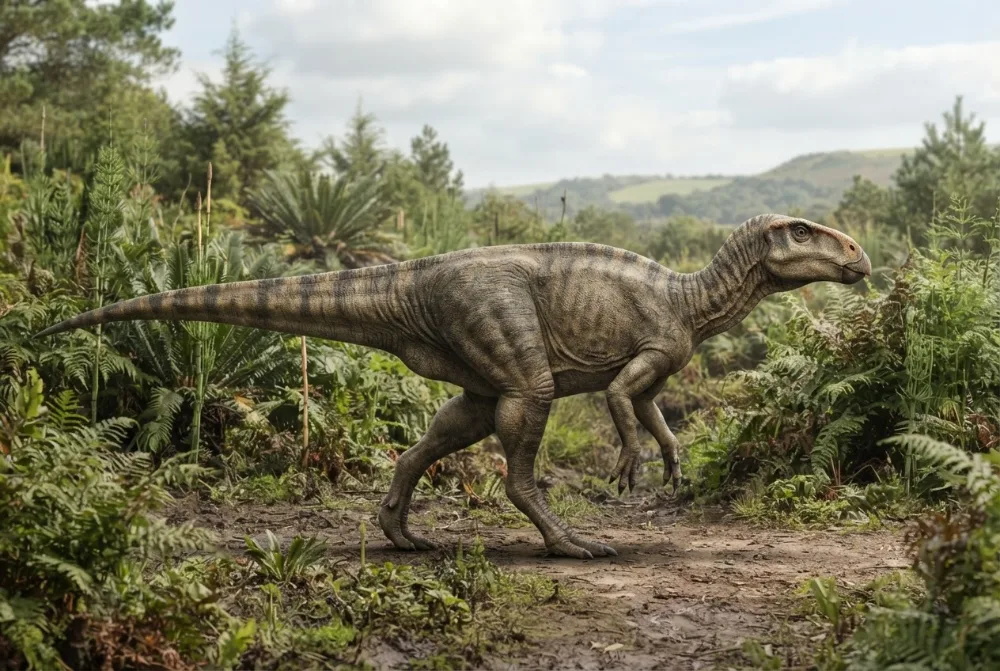
Comptonatus was a big, plant-eating dinosaur that lived on the Isle of Wight in England about 125 million years ago. It had a beak and walked on two legs, munching on ferns and cycads. Its skeleton is the most complete iguanodontian dinosaur found in the Wealden Group in a hundred years!61
Azalaki na bomoi ntango nini?
Azalaki monene boni?
Azalaki molai boni?
Azalaki molai boni na likolo?
kokanisa
Azalaki kilo boni?
 molai lokola bambwa 6 zolo kino mokila🍌molai lokola matoko 34 oyo balandani🍉kilo lokola bapasteke 210🧸kilo lokola bana 55 ya eteyelo ya bana mike🎒kilo lokola bana 33 ya kelasi🐻❄️kilo lokola ba-urs ya pembe 2,5🏃akokaki kopota metele 100 na sekonde 11 (moto oyo aleki mbangu asalelaka 9,6)
Comptonatus azalaki monene boni soki tokokanisi na YO?
Kaka matematiki na navigatere na yo. Eloko moko te ebombami to etindami esika moko.
Azalaki na mbangu boni?


Makambo ya kosepelisa
Comptonatus was named in 2024, making it one of the newest dinosaur species.6
Its name means 'the Compton thunderer' because it was found at Compton Bay and was a large animal.1
The skeleton was discovered in 2013 by fossil collector Nick Chase, and it took over a decade to study and name.1
Comptonatus had a straight lower jaw bone (dentary) and a very wide prepubic blade, which are unique features.1
It lived alongside other dinosaurs like Mantellisaurus, Brighstoneus, and Iguanodon in the same area.1
The fossils were found in a plant debris bed that also contained fish scales, crocodile teeth, and conifer trunks.1
Mituna oyo batunaka mingi na ntina na Comptonatus
?How big was Comptonatus?
About 4 metres (13 feet) long. That is roughly the length of a small car.4
?What did Comptonatus eat?
It was a herbivore, eating plants like conifers, cycads and tree-ferns that grew in its environment.4
?Did Comptonatus have any special features?
Yes, it had a straight lower jaw bone and a very wide prepubic blade. It also had large thumb spikes that may have been used for defense or fighting.41
?When did Comptonatus live?
It lived during the early Cretaceous period, about 125 million years ago.5
Mpo na bayebi ya badino
- Nkombo ya siansi
- Comptonatus
- Nkombo epesamaki na
- Lockwood et al. 20246
- Lisanga
- Badino ya monoko ya ndeke
- Libota / klade
- Hadrosauriformes6
- Klasifikasio
- Ornithischia > Ornithopoda > Iguanodontia6
- Mbula ya mabanga
- mbula milio 126 kino 121 (Barremian)6
- Milongo ya mabanga
- Wessex6
- Bikolo
- Angeletere6
- Bafosile oyo ekomami
- 1 na The Paleobiology Database6
- Ntango bamonaki yango
- Comptonatus chasei was discovered in 2013 by Nick Chase on National Trust land at Compton Bay, Isle of Wight. It was named by Jeremy Lockwood, David Martill, and Susannah Maidment in 2024.1
- Naino bazali kowelana
- Scientists are still debating exactly how Comptonatus is related to other iguanodontian dinosaurs, because it has a mix of features seen in different groups.1
Esika makambo euti
- Full article: Comptonatus chasei, a new iguanodontian dinosaur from the Lower Cretaceous Wessex Formation of the Isle of Wight, southern England (tandfonline.com)
- Comptonatus chasei | Dinosaur Database by DinoAnimals.com (dinoanimals.com)
- The most complete UK dinosaur in a century found on the Isle of Wight | Natural History Museum (nhm.ac.uk)
- Comptonatus, an iguanodontian dinosaur from the Isle of Wight - DinoWight (dinowight.org.uk)
- Comptonatus (en.wikipedia.org)
- Comptonatus in The Paleobiology Database (CC BY 4.0): mbula, bisika, milongo ya mabanga, klasifikasio.
Likambo nyonso na lokasa oyo ezali na nimero oyo elakisi liziba na yango. Soki tosali libunga, limbisa biso, tozali bato balingaka badino, zulunalo ya siansi te. Yebisa biso na [email protected] mpe tokobongisa yango.
 Rex azali na nzala! Dino Wiki ezali mosala ya tata moko mpo na mwana na ye ya mobali oyo alingaka badino, ofele, piblisite te mpe batrakere te. Bato bakolo bakoki kopesa Rex biskwi mpo na kosalisa ete etikala na internet.Leisa Rex
 Iguanodon
 Tenontosaurus
 Thescelosaurus
 Zalmoxes
 Camptosaurus
 Rhabdodon
 Stegosaurus
 Archaeopteryx
 Giganotosaurus
 Microraptor
 Deinonychus
 Baryonyx