 Ozali dino nini? Kwizi
 Etumba ya badino
 Mbangu ya badino
 Masano mike ya badino
 Albumu ya bastika
 Bilisti TOP ya badino
 Kamwisa ngai!
Iguanacolossus
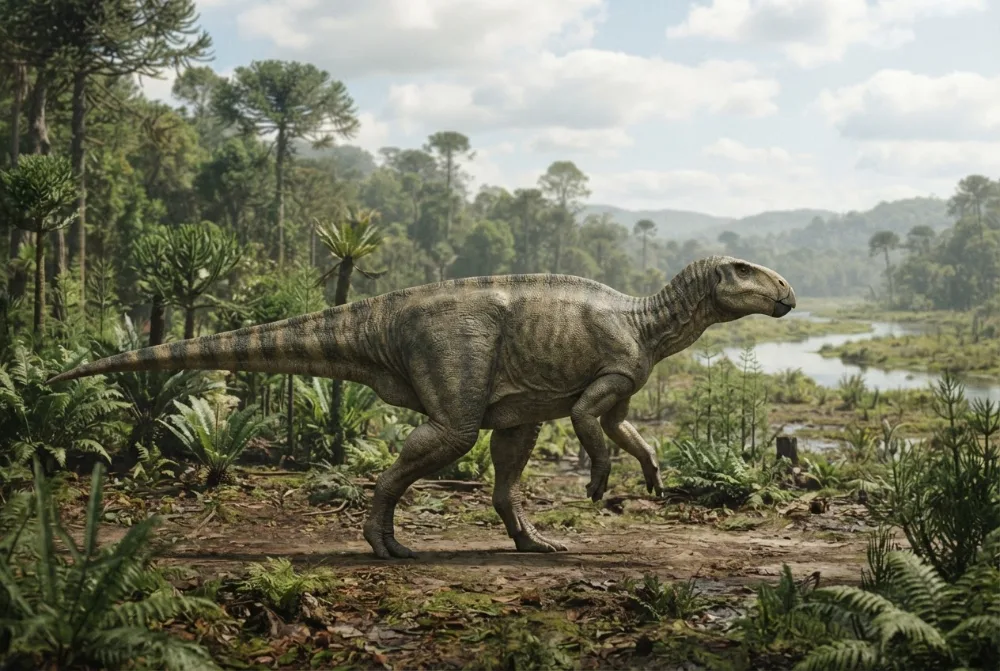
Iguanacolossus was a huge, plant-eating dinosaur that lived about 139 to 132 million years ago. It had a beak and walked on four sturdy legs, but could also stand on two legs. Its name means 'mighty iguana colossus' because it was as big as a giant iguana!12
Azalaki na bomoi ntango nini?
Azalaki monene boni?
Azalaki molai boni?
Azalaki molai boni na likolo?
kokanisa
Azalaki kilo boni?
 molai lokola bamotuka 2 oyo batelemi na molongo🍌molai lokola matoko 50 oyo balandani
 pene kilo lokola nzoku🍉kilo lokola bapasteke 1000🎒kilo lokola bakelasi 6 mobimba ya bana🐻❄️kilo lokola ba-urs ya pembe 11🏃akokaki kopota metele 100 na sekonde 17 (moto oyo aleki mbangu asalelaka 9,6)
Iguanacolossus azalaki monene boni soki tokokanisi na YO?
Kaka matematiki na navigatere na yo. Eloko moko te ebombami to etindami esika moko.
Azalaki na mbangu boni?


Makambo ya kosepelisa
Iguanacolossus was a styracosternan, a group of iguanodont dinosaurs that often had thumb spikes.1
Its fossils were found at a site called Don's Ridge in Utah, named after the discoverer Don DeBlieux.1
Only one skeleton of Iguanacolossus has been found, including parts of the skull, backbone, and hips.1
Iguanacolossus lived during the Early Cretaceous period, when Utah was a warm, dry land with rivers and forests.1
Scientists think Iguanacolossus was about 9 meters (30 feet) long, as big as a school bus.1
It had a special sinuous (wavy) contact on its skull that is unique to this dinosaur.1
Mituna oyo batunaka mingi na ntina na Iguanacolossus
?How big was Iguanacolossus?
It was about 9 metres (30 feet) long and weighed around 5 tonnes (11,000 pounds), about as big as a school bus.4
?What did Iguanacolossus eat?
It was a plant-eater. It had a beak and teeth shaped like shields and lozenges for chewing tough plants.4
?When did Iguanacolossus live?
It lived during the Early Cretaceous period, about 139 to 132 million years ago.4
?Is Iguanacolossus a dinosaur?
Yes, it is a dinosaur. It was an iguanodontian ornithopod, a type of plant-eating dinosaur.4
Mpo na bayebi ya badino
- Nkombo ya siansi
- Iguanacolossus
- Nkombo epesamaki na
- McDonald et al. 20105
- Lisanga
- Badino ya monoko ya ndeke
- Libota / klade
- Styracosterna5
- Klasifikasio
- Ornithischia > Ornithopoda > Iguanodontia5
- Mbula ya mabanga
- mbula milio 139 kino 133 (Berriasian / Valanginian)5
- Milongo ya mabanga
- Cedar Mountain5
- Bikolo
- Amerika5
- Bafosile oyo ekomami
- 2 na The Paleobiology Database5
- Ntango bamonaki yango
- Iguanacolossus was named in 2010 by Andrew McDonald and colleagues. The skeleton was discovered in 2005 by Don DeBlieux in the Cedar Mountain Formation of Utah.1
- Naino bazali kowelana
- Scientists are not sure exactly how old the lower Yellow Cat Member rocks are, so the age of Iguanacolossus is still debated.1
Esika makambo euti
- New Basal Iguanodonts from the Cedar Mountain Formation of Utah and the Evolution of Thumb-Spiked Dinosaurs | PLOS One (journals.plos.org)
- PBDB Taxon (paleobiodb.org)
- Iguanacolossus - Wikipedia (en.wikipedia.org)
- Iguanacolossus (en.m.wikipedia.org)
- Iguanacolossus in The Paleobiology Database (CC BY 4.0): mbula, bisika, milongo ya mabanga, klasifikasio.
Likambo nyonso na lokasa oyo ezali na nimero oyo elakisi liziba na yango. Soki tosali libunga, limbisa biso, tozali bato balingaka badino, zulunalo ya siansi te. Yebisa biso na [email protected] mpe tokobongisa yango.
 Rex azali na nzala! Dino Wiki ezali mosala ya tata moko mpo na mwana na ye ya mobali oyo alingaka badino, ofele, piblisite te mpe batrakere te. Bato bakolo bakoki kopesa Rex biskwi mpo na kosalisa ete etikala na internet.Leisa Rex
 Iguanodon
 Tenontosaurus
 Thescelosaurus
 Zalmoxes
 Camptosaurus
 Rhabdodon
 Stegosaurus
 Archaeopteryx
 Giganotosaurus
 Microraptor
 Deinonychus
 Baryonyx