 Ozali dino nini? Kwizi
 Etumba ya badino
 Mbangu ya badino
 Masano mike ya badino
 Albumu ya bastika
 Bilisti TOP ya badino
 Kamwisa ngai!
Kaikaifilu
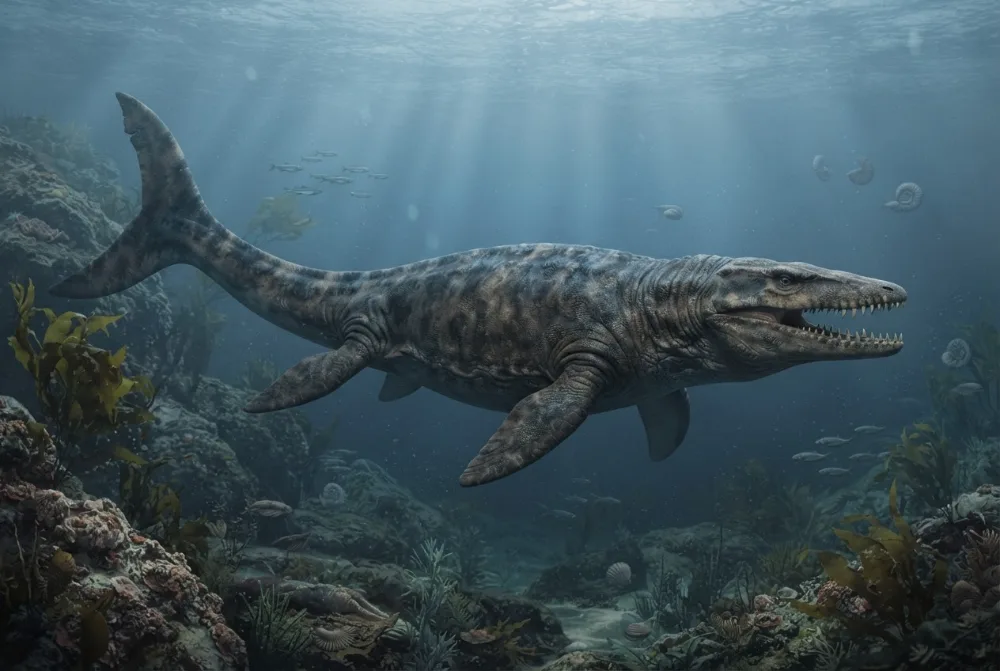
Kaikaifilu was a giant marine lizard that swam in the cold seas near Antarctica 66 million years ago. It was one of the biggest mosasaurs in the Southern Hemisphere, with a skull as long as a tall child!1
Azalaki na bomoi ntango nini?
Azalaki monene boni?
Azalaki molai boni?
 molai lokola bamotuka 2 oyo batelemi na molongo🍌molai lokola matoko 56 oyo balandani🏊akokaki kobeta mai bolai ya pisine monene (50 m) na sekonde 5,5
Kaikaifilu azalaki monene boni soki tokokanisi na YO?
Kaka matematiki na navigatere na yo. Eloko moko te ebombami to etindami esika moko.
Azalaki na mbangu boni?


Makambo ya kosepelisa
Kaikaifilu had different types of teeth in its mouth, which is rare for mosasaurs. This is called heterodont dentition.1
Its skull was about 1.1 to 1.2 metres long, almost twice as long as the skull of another Antarctic mosasaur called Taniwhasaurus antarcticus.1
Kaikaifilu lived in waters that could be as cold as 6 °C, and sometimes the sea surface temperature dropped below freezing.1
It lived right at the end of the Age of Dinosaurs, during the Cretaceous-Paleogene extinction event, and was one of the last mosasaurs to exist.1
The only known fossil of Kaikaifilu is a partial skull and a humerus (upper arm bone), found in 2011 by a Chilean expedition.2
Scientists think Kaikaifilu might belong to the Tylosaurinae group, but some features make this uncertain.1
Mituna oyo batunaka mingi na ntina na Kaikaifilu
?How big was Kaikaifilu?
About 10 metres long, making it the largest mosasaur known from the Southern Hemisphere.13
?What did Kaikaifilu eat?
It was an apex predator that ate fish, plesiosaurs, other mosasaurs, and filter-feeding marine reptiles.13
?When did Kaikaifilu live?
It lived about 66 million years ago, right at the end of the Age of Dinosaurs, during the Cretaceous-Paleogene extinction event.13
?Where was Kaikaifilu found?
Its fossil was found on Seymour Island in Antarctica, by a Chilean expedition in 2011.1
?Why did Kaikaifilu have different teeth?
It had different types of teeth (heterodont dentition), which is rare for mosasaurs and helped it eat a variety of prey.1
Mpo na bayebi ya badino
- Nkombo ya siansi
- Kaikaifilu
- Nkombo epesamaki na
- Otero et al. 20174
- Lisanga
- Bamozazore
- Libota / klade
- Mosasauridae4
- Klasifikasio
- Mosasauroidea4
- Mbula ya mabanga
- mbula milio 72 kino 66 (Maastrichtian)4
- Milongo ya mabanga
- Lopez de Bertodano4
- Bikolo
- Antarktika4
- Bafosile oyo ekomami
- 1 na The Paleobiology Database4
- Ntango bamonaki yango
- Kaikaifilu was named in 2017 by Rodrigo Otero and colleagues, based on a fossil found in January 2011 on Seymour Island, Antarctica, by a Chilean expedition.42
- Naino bazali kowelana
- Scientists are not sure if Kaikaifilu truly belongs to the Tylosaurinae group, because some of its features are different from other tylosaurines.1
Esika makambo euti
- Kaikaifilu (en.wikipedia.org)
- Kaikaifilu hervei gen. et sp. nov., a new large mosasaur (Squamata, Mosasauridae) from the upper Maastrichtian of Antarctica (sciencedirect.com)
- A giant predatory lizard swam in Antarctic seas near the end of the dinosaur age | ScienceDaily (sciencedaily.com)
- Kaikaifilu in The Paleobiology Database (CC BY 4.0): mbula, bisika, milongo ya mabanga, klasifikasio.
Likambo nyonso na lokasa oyo ezali na nimero oyo elakisi liziba na yango. Soki tosali libunga, limbisa biso, tozali bato balingaka badino, zulunalo ya siansi te. Yebisa biso na [email protected] mpe tokobongisa yango.
 Rex azali na nzala! Dino Wiki ezali mosala ya tata moko mpo na mwana na ye ya mobali oyo alingaka badino, ofele, piblisite te mpe batrakere te. Bato bakolo bakoki kopesa Rex biskwi mpo na kosalisa ete etikala na internet.Leisa Rex
 Mosasaurus
 Prognathodon
 Tylosaurus
 Platecarpus
 Clidastes
 Globidens
 Tyrannosaurus
 Triceratops
 Velociraptor
 Spinosaurus
 Ankylosaurus
 Parasaurolophus