 Ozali dino nini? Kwizi
 Etumba ya badino
 Mbangu ya badino
 Masano mike ya badino
 Albumu ya bastika
 Bilisti TOP ya badino
 Kamwisa ngai!
Azalaki na bomoi ntango nini?

Azalaki monene boni?
Azalaki molai boni?
Azalaki molai boni na likolo?
Azalaki kilo boni?
 molai lokola bapusu 4 ya ndako zolo kino mokila🍌molai lokola matoko 10 oyo balandanipene kilo lokola pusu ya ndako🍌kilo lokola matoko 33🪑moke ete akoka koleka na nse ya kiti🏃akokaki kopota metele 100 na sekonde 14 (moto oyo aleki mbangu asalelaka 9,6)
Leaellynasaura azalaki monene boni soki tokokanisi na YO?
Kaka matematiki na navigatere na yo. Eloko moko te ebombami to etindami esika moko.
Azalaki na mbangu boni?


Makambo ya kosepelisa
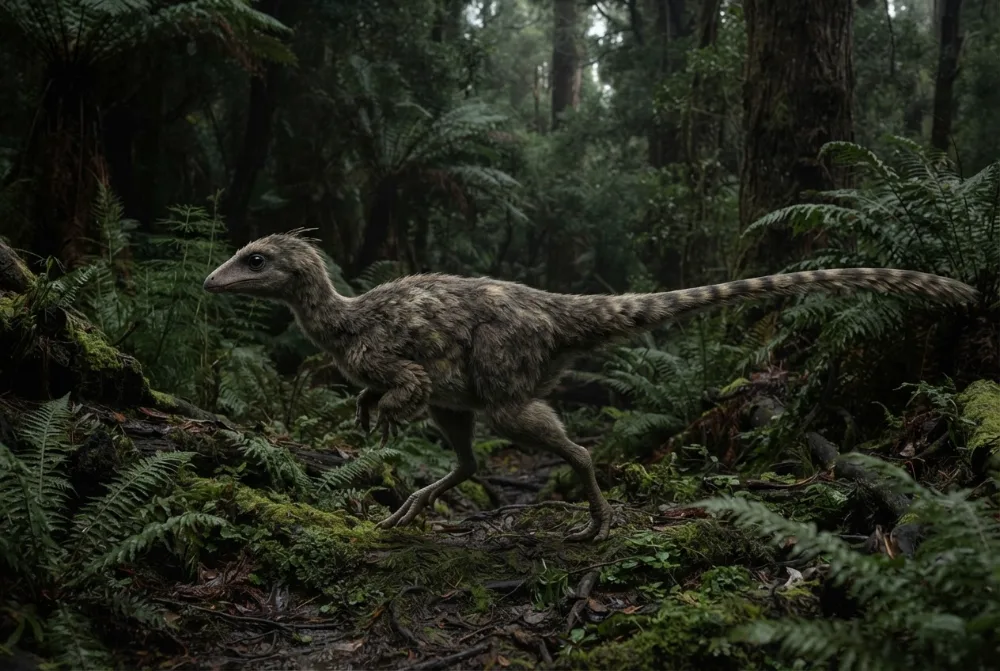
Leaellynasaura lived inside the Antarctic Circle during the Early Cretaceous, about 118 to 110 million years ago, when the climate was warmer than today.1
Its tail was extremely long, about three times the length of the rest of its body, and had more tail bones than most other plant-eating dinosaurs.1
It had enlarged eye sockets and large optic lobes in its brain, which helped it see in the dim light of polar winters.21
Bone growth lines show that Leaellynasaura grew continuously all year, meaning it did not hibernate or slow down much during the cold, dark winter.2
It may have lived in small herds or flocks, and dinosaur burrows found in Victoria suggest some small ornithopods might have sheltered underground in the coldest months.2
Its teeth had five ridges on each side, fewer than other small Victorian ornithopods like Qantassaurus and Atlascopcosaurus, which had at least eight.2
Mituna oyo batunaka mingi na ntina na Leaellynasaura
?How big was Leaellynasaura?
About 1.8 metres (6 feet) long including its tail, but some estimates based on a juvenile specimen suggest about 1 metre (3.3 feet).12
?What did Leaellynasaura eat?
It was a plant-eater that ate low-growing plants like horsetails, cycads, and ferns.12
?Did Leaellynasaura have feathers?
Scientists think it might have had hair-like filaments on its skin, but no feathers have been found yet.4
?Where was Leaellynasaura found?
It was discovered in Dinosaur Cove, Victoria, Australia, in rocks that were once inside the Antarctic Circle.12
?How fast could Leaellynasaura run?
Nobody knows for sure, but as a small, lightweight dinosaur it was probably quick and agile.1
Mpo na bayebi ya badino
- Nkombo ya siansi
- Leaellynasaura
- Nkombo epesamaki na
- Rich and Vickers-Rich 19895
- Lisanga
- Badino ya monoko ya ndeke
- Libota / klade
- Elasmaria5
- Klasifikasio
- Ornithischia > Ornithopoda > Iguanodontia5
- Mbula ya mabanga
- mbula milio 113 kino 110 (Albian)5
- Milongo ya mabanga
- Eumeralla5
- Bikolo
- Ositrali5
- Bafosile oyo ekomami
- 4 na The Paleobiology Database5
- Ntango bamonaki yango
- Leaellynasaura was discovered in Dinosaur Cove, Australia, and named in 1989 by Tom Rich and Patricia Vickers-Rich. They named it after their daughter Leaellyn.15
- Naino bazali kowelana
- Scientists are not sure which fossils belong to Leaellynasaura, because most were found scattered, and some long-tailed skeletons may belong to a different dinosaur.1
Esika makambo euti
- Leaellynasaura (en.wikipedia.org)
- Dinosaurs - Leaellynasaura amicagraphica - The Australian Museum (australian.museum)
- LEAELLYNASAURA - DinoChecker dinosaur archive (dinochecker.com)
- Leaellynasaura | Western Australian Museum (museum.wa.gov.au)
- Leaellynasaura in The Paleobiology Database (CC BY 4.0): mbula, bisika, milongo ya mabanga, klasifikasio.
Likambo nyonso na lokasa oyo ezali na nimero oyo elakisi liziba na yango. Soki tosali libunga, limbisa biso, tozali bato balingaka badino, zulunalo ya siansi te. Yebisa biso na [email protected] mpe tokobongisa yango.
 Rex azali na nzala! Dino Wiki ezali mosala ya tata moko mpo na mwana na ye ya mobali oyo alingaka badino, ofele, piblisite te mpe batrakere te. Bato bakolo bakoki kopesa Rex biskwi mpo na kosalisa ete etikala na internet.Leisa Rex
 Iguanodon
 Tenontosaurus
 Thescelosaurus
 Zalmoxes
 Camptosaurus
 Rhabdodon
 Stegosaurus
 Archaeopteryx
 Giganotosaurus
 Microraptor
 Deinonychus
 Baryonyx